
Researched by Alfa Shaban
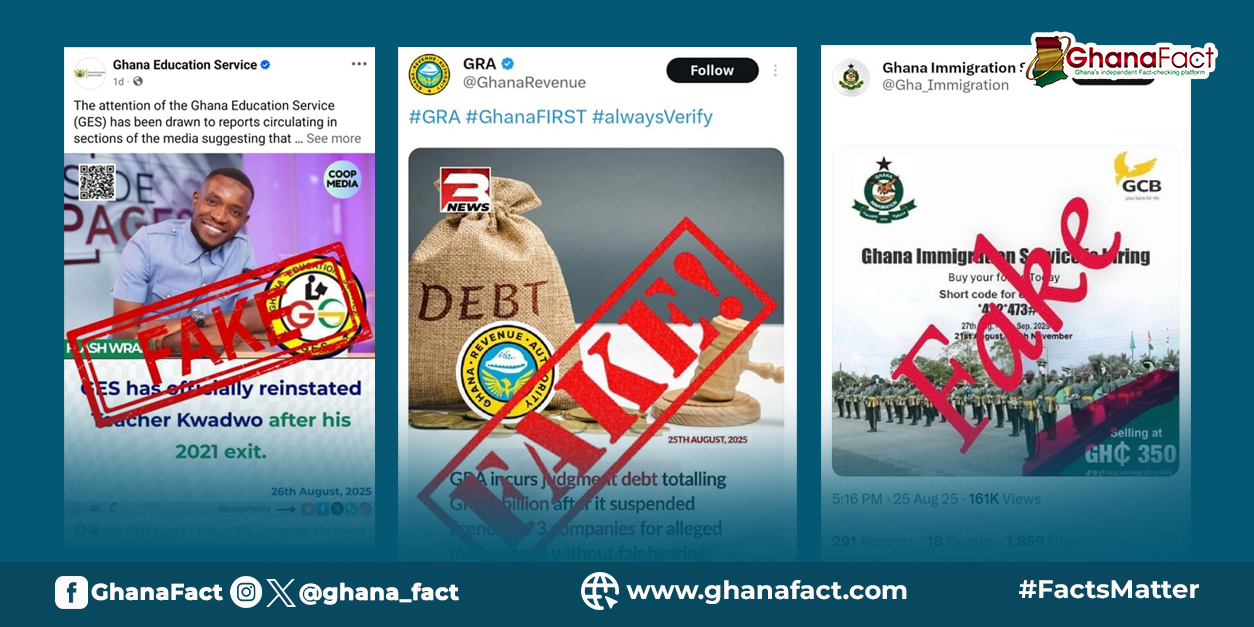
In the space of a week, a number of state entities have issued public disclaimers regarding social media posts, peddling one false narrative or another about the operations of these respective institutions.
A disclaimed viral post about the reinstatement of a popular teacher, a dismissed quote card shared by a prominent news organisation, and two fraud alerts from a university and the immigration service.
In this narrative report, we trace how some of these disclaimed reports found their way to social media and how the institutions reacted.
1 – Teacher Kwadwo reinstated
Conversations about the reinstatement of Michael Owusu Afriyie (alias Teacher Kwadwo) started on August 25, 2025, when a Facebook user made a post asking about his whereabouts.
The subsequent reaction 24 hours later of a Ghana Education Service (GES) official was highlighted by the poster as a possible confirmation of the reinstatement.
On August 26, 2025, an X account posted a “Breaking” story about the reinstatement of Teacher Kwadwo, who was dismissed in 2021.
RelatedNews




The full post, accompanied by an image of Owusu Afriyie, read: “BREAKING: GES reinstates Teacher Kwadwo.” The post had received significant reactions (196.1K Views, 99 comments, 689 reposts, 7.3K likes and 77 bookmarks).
On August 27, the GES posted a disclaimer with a FAKE inscription across a quote card that had been created from the alleged reinstatement.
“The attention of the Ghana Education Service (GES) has been drawn to reports circulating in sections of the media suggesting that Mr. Michael Owusu Afriyie, popularly known as Teacher Kwadwo, has been reinstated into the Service. The Ghana Education Service wishes to state that the report is false. Mr. Owusu Afriyie has not been reinstated,” the post said.
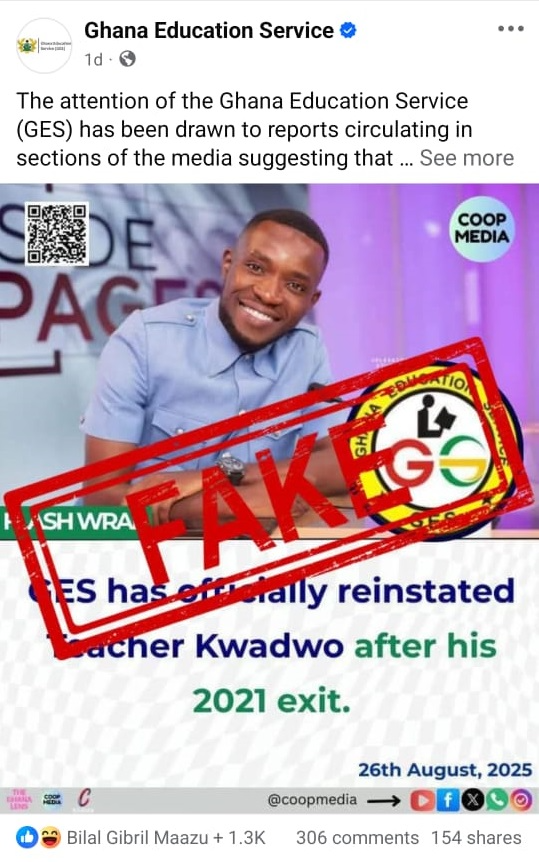
Our checks show that the media organisation whose flyer was used in the now-disclaimed flyer, COOP Media, has issued an apology for their misleading post.
2 – GRA disclaims the TV3 flyer
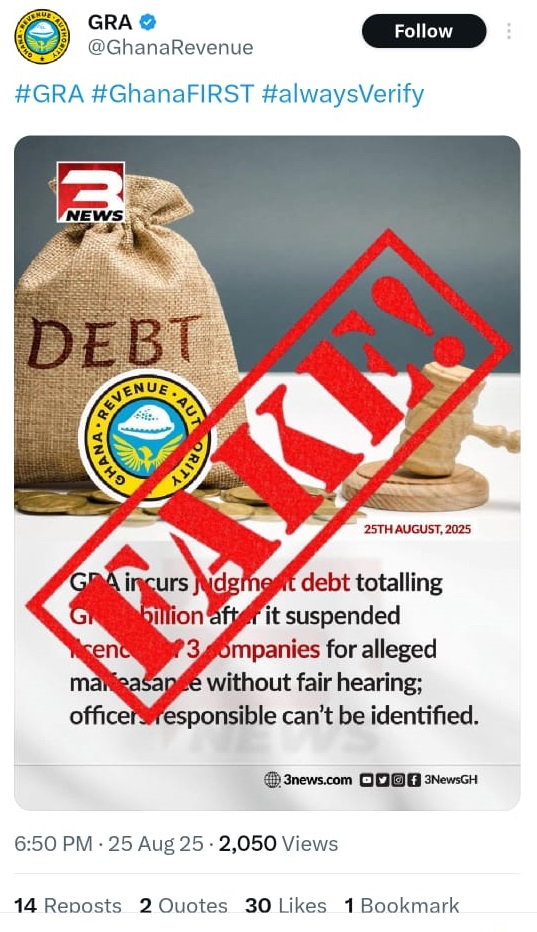
The Ghana Revenue Authority (GRA) disclaimed a TV3 flyer on August 25, 2025. The outfit claimed the GRA had been ordered to pay a judgment debt after suspending the licenses of three companies without a fair hearing.
GRA’s disclaimer was limited to a FAKE inscription across the TV3 flyer. The media house has not responded to the disclaimer, and its story linked to the flyer remains live.
3 – GIS disclaims fake recruitment
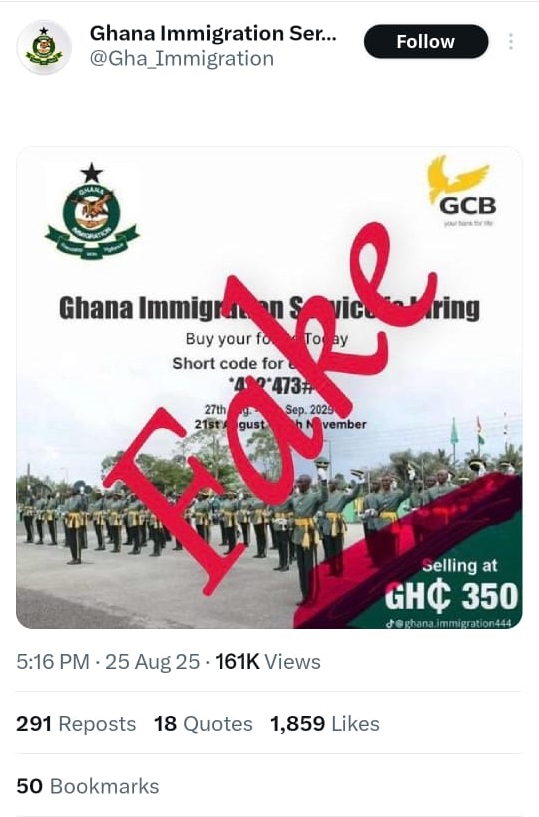
The Ghana Immigration Service (GIS) on August 25, 2025, reacted to a viral flyer that claimed the service was recruiting personnel. The supposed flyer, with a short code, stated that prospective applicants were required to pay 350 cedis for the application.
By way of a disclaimer, GIS posted a copy of the flyer with a FAKE inscription written across it.
On August 28, they posted a statement titled RECRUITMENT FRAUD ALERT, which cautioned the public against the recruitment advert on social media.
“Members of the public are therefore cautioned not to fall prey to this fraudulent and misleading advert,” the statement dated August 24 and signed by Assistant Commissioner M. Amoako-Atta read.
It is worth noting that the GIS has been targeted with such fake recruitment adverts in recent years. GhanaFact has worked on one such GIS recruitment scam, which was accompanied by a phishing link. Our WhatsApp chatbot has also received a number of such recruitment adverts.
4 – UG disclaims fraudulent WhatsApp group
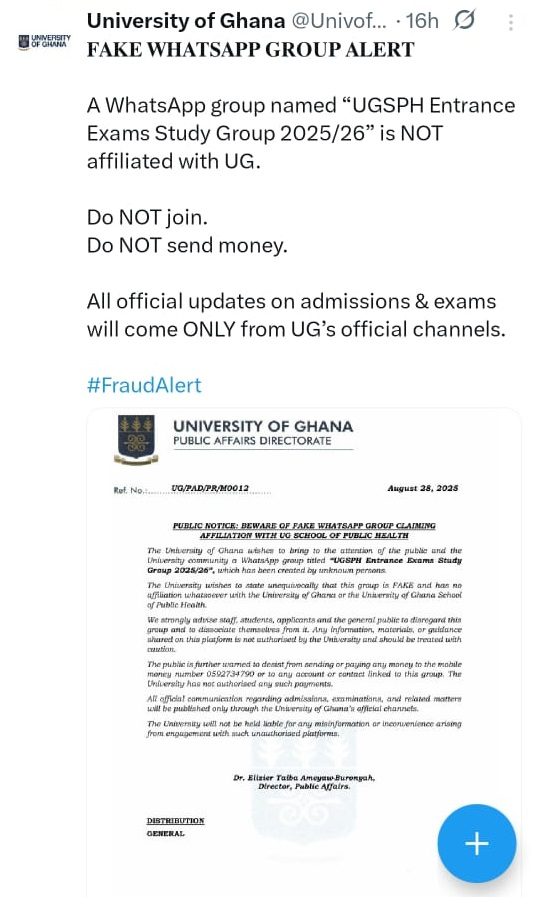
The University of Ghana, this week, in a fraud alert post, cautioned a section of its students against a fraudulent WhatsApp group.
The post on social media was captioned ‘𝐅𝐀𝐊𝐄 𝐖𝐇𝐀𝐓𝐒𝐀𝐏𝐏 𝐆𝐑𝐎𝐔𝐏 𝐀𝐋𝐄𝐑𝐓.’
It asked UG School of Public Health students to desist from either joining or sending money to a WhatsApp group named “UGSPH Entrance Exams Study Group 2025/26” because it was NOT affiliated with UG.
“All official updates on admissions & exams will come ONLY from UG’s official channels,” the caption said. The post was accompanied by an official letter from the university giving further details about the fraud alert.
Conclusion
In the space of a week, four state institutions straddling the security sector to education, and revenue mobilisation have had reason to point out some information disorder linked to their operation.
It is worthy of note that in most instances, the disclaimers were posted directly on social media because the content being disclaimed had gone viral on one platform or across a number of platforms.