
Researched by Gifty Tracy Aminu
Parts of the Road Traffic Regulations, 2026 (L.I. 2519), specifically the ban on hawking and preaching in moving vehicles, have sparked conversations on social media platforms, including Facebook, X and TikTok.
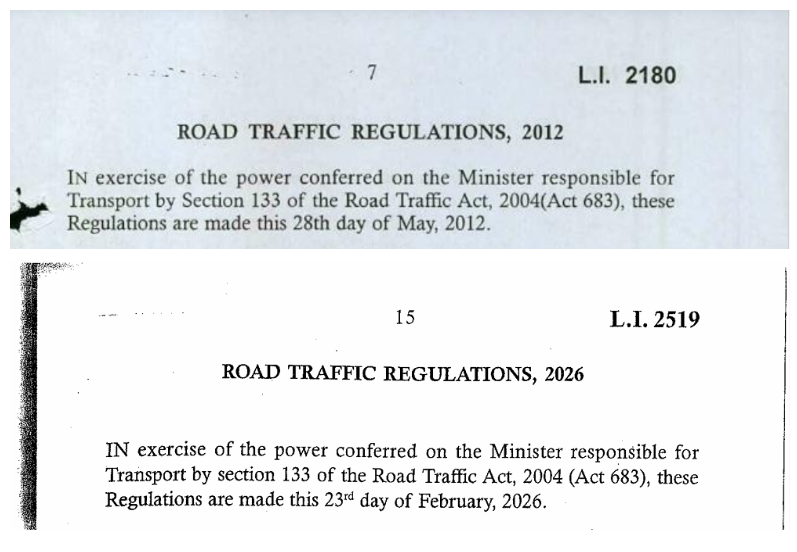
The latest regulation (L.I.2519), however, replaces the Road Traffic Regulations, 2012 (L.I. 2180). The current regulation became necessary after the passage of the Road Traffic (Amendment) Act, 2025 (Act 1153) and assent by the President on 24 December 2025. The current regulation, which governs the new law, was also approved by Parliament on 28 May 2026.
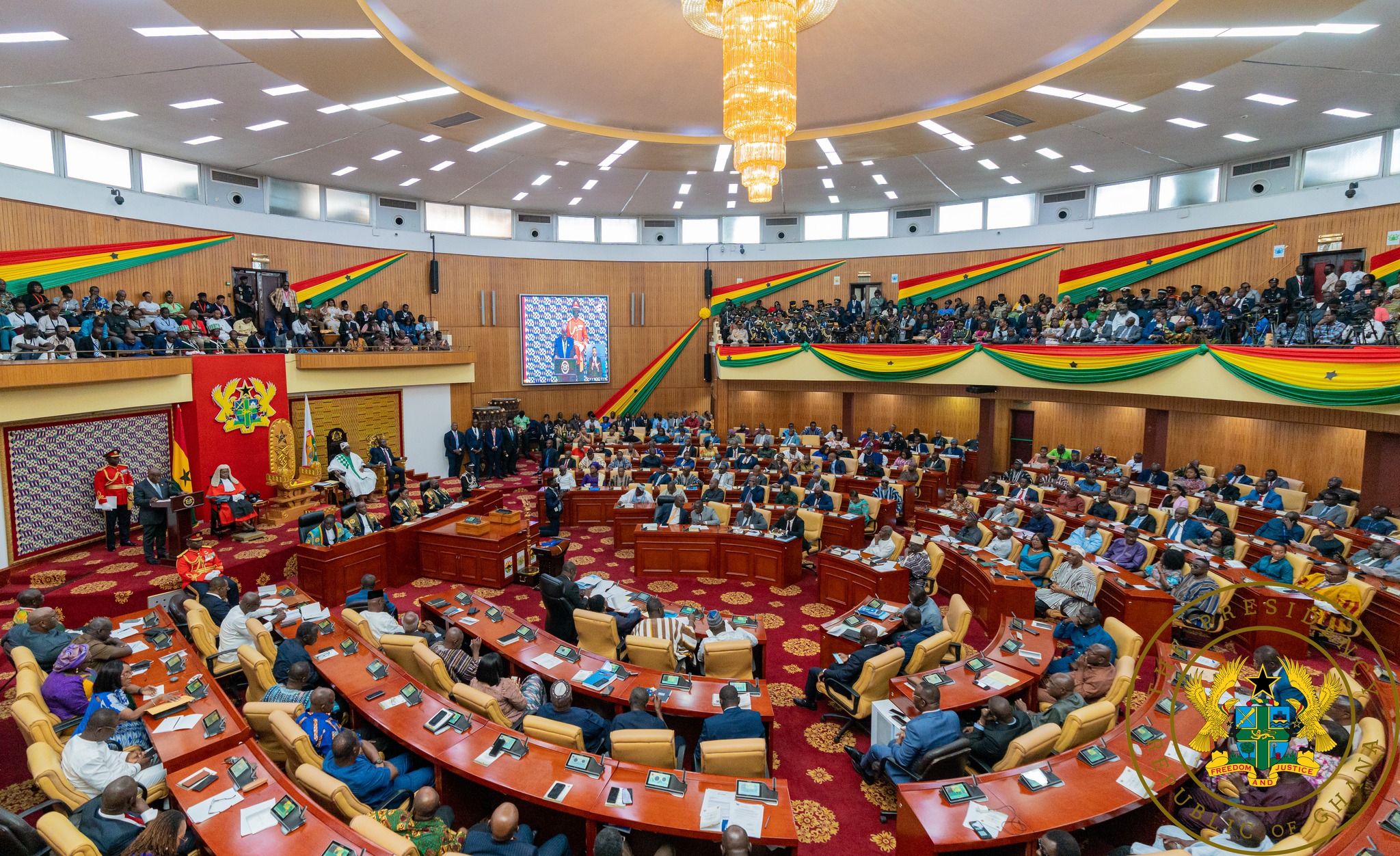
Portions of the Regulations, which set varying penalty regimes -from fines, terms of imprisonment, or both- have drawn reactions from a section of the public, especially the ban on preaching and hawking on moving vehicles.
Preacher, publisher and MP weigh in on preaching ban
In a video that was widely circulated on social media, the Senior Pastor of the Holy Hill Chapel Assemblies of God, Rev. Kwadwo Boateng Bempah, was heard saying, “Now they said we shouldn’t preach in the bus as if they bought the bus for somebody. When those little little things begin, they are trying to shut the mouth of the church. But others are screaming early morning at 4:30 a.m. on loudspeakers. You didn’t buy a bus for anybody; you say we shouldn’t preach in the bus.”
Member of Parliament for the Assin South Constituency, John Ntim Fordjour, in protest against the ban said in a post on X: “Mr President, please order them to abandon this bogus regulation which seeks to jail innocent Pastors and Evangelists – simply for preaching in buses. Now preaching JESUS in buses is described as NUISANCE? Or this is also part of the unpopular policies your Ministers are pushing without your approval? Who is really in charge in this govt?”
In the defence of the government, the Managing Editor of the Insight Newspaper, Kwesi Pratt Jnr. said: “Now, in Ghana and in the world, there isn’t just one religion. There are hundreds of religions. Even in Christianity, there are many, many different versions of Christianity and so on,” Pratt said while criticizing opponents of the regulation.
RelatedNews


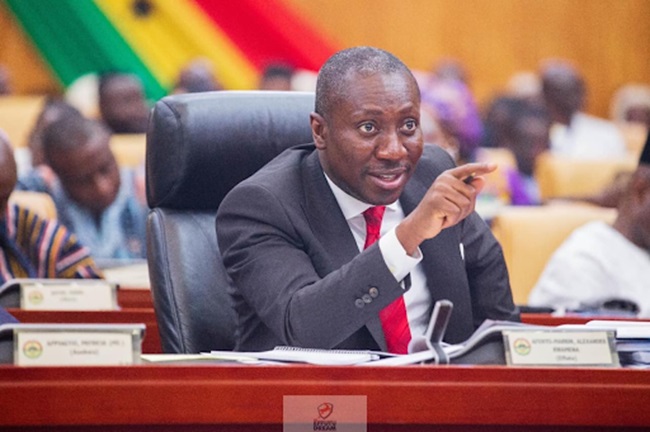
On October 9, 2026, days into the controversy which was widely discussed on traditional media and across social media platforms, reports on media platforms suggested the government had suspended the ban on hawking and preaching in moving vehicles. However, President Mahama clarified and said,
“Those preaching on the bus, we’ve asked them to stop,we didn’t say that. When the bus is at the station, you can climb and preach, but when the bus starts moving, no one should sell, and no one should preach. Because the driver’s attention will be moved to what you are saying. Apart from that, while you are standing and preaching, if the driver pulls the brake, you can get hurt. It is a law that has been there for a very long time,” he explained.
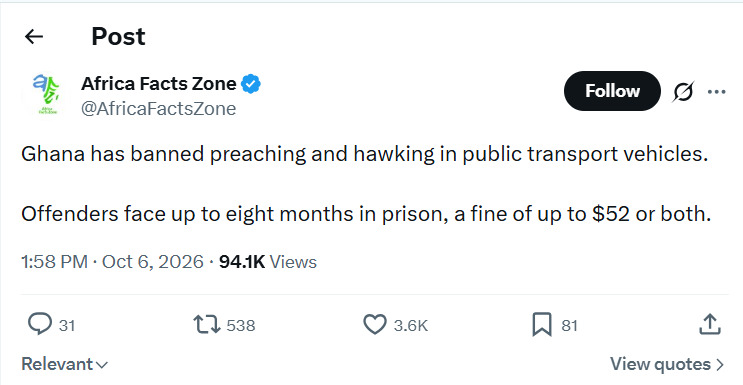
In the midst of the controversy, a post on X by Africa Facts Zone claimed that persons who engaged in hawking and preaching in public transport risked a $52 fine, an eight-month jail term, or both.
Ban on hawking and preaching – What the regulation says
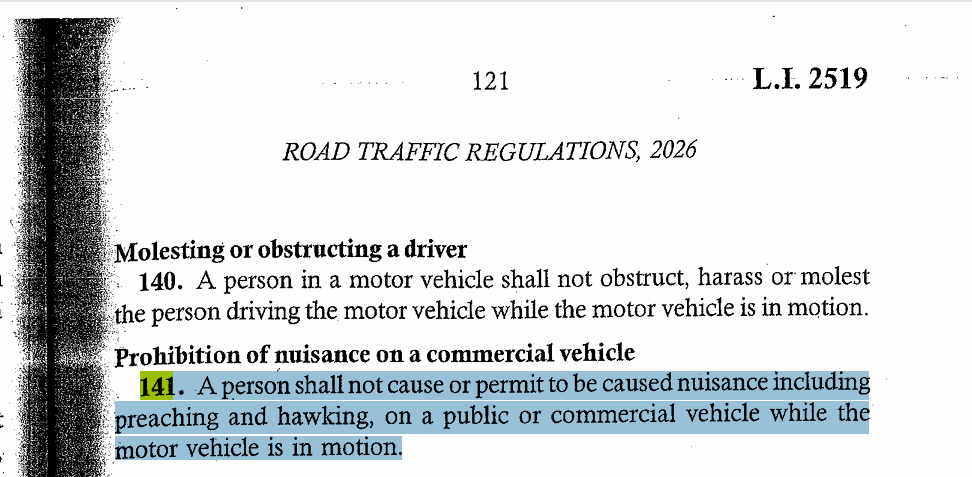
Regulation 141 titled: Prohibition of nuisance on a commercial vehicle, states, “A person shall not cause or permit to be caused nuisance, including preaching and hawking, on a public or commercial vehicle while the motor vehicle is in motion.”
The law makes provision for punishing offenders under regulation 243. This regulation caters for all other regulations that do not have a direct penalty associated with them.
Regulation 243 titled: General penalty states that:
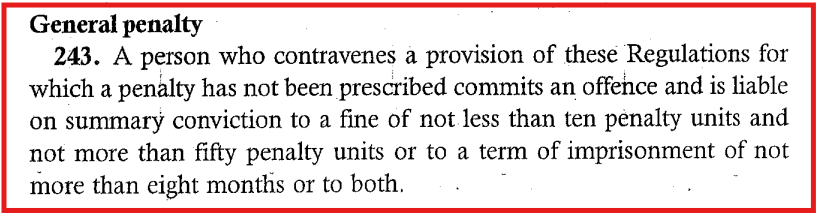
The statutory fine for a penalty unit is worth GH₵12.00. Therefore, multiplying the penalty unit by the fine, an offender would be paying between GH₵120.00 and GH₵600.00.
Using the maximum fine of GH₵600 and dividing it by the Bank of Ghana’s current dollar rate of 11.6692 gives $51.4173, which is close to the 52 dollars in the claim. Note that the amount may change depending on the dollar rate of the day. So, yes, you are likely paying between GH₵120.00 and GH₵600.00 or approximately 52 dollars, when found culpable.
Road Traffic Regulations, 2026 (L.I. 2519): Highlighting other popular parts
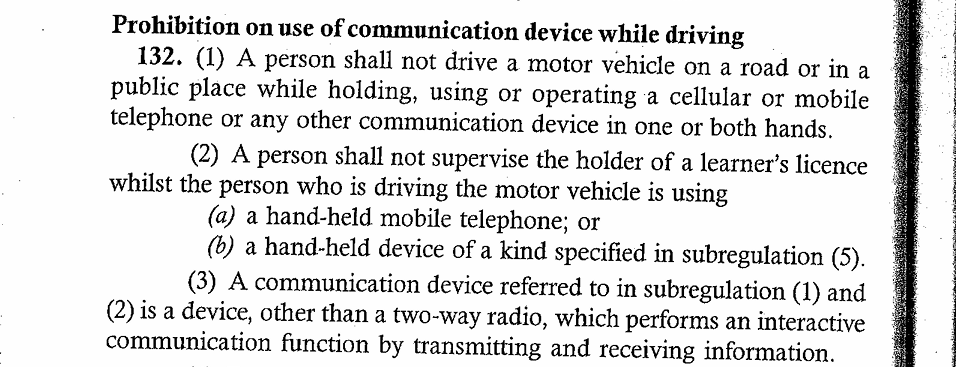
Regulation 132 prohibits using a communication device while driving. It states that “a person shall not drive a motor vehicle on a road or in a public place while holding, using, or operating a cellular or mobile telephone or any other communication device in one or both hands.”
However, the regulation makes an exclusion for the use of a radio gadget while explaining what communication device is prohibited: “A communication device referred to in subregulation (1) and (2) is a device, other than a two-way radio, which performs an interactive communication function by transmitting and receiving information.”
A person who contravenes any section of Regulation 132 faces the penalty of “summary conviction to a fine of not more than fifty penalty units or to a term of imprisonment of not more than three months or to both.”
Police Urge Public To Disregard False Flyer On Use Of AirPods And Earphones
On August 18, 2026, the Ghana Police Service debunked the claim that motorists are banned from using AirPods, earphones and other audio devices while driving in Ghana.
In the statement, the Police said;
- The Ghana Police Service would like to urge the public to disregard a flyer circulating on social media, purporting to be a public safety announcement from the Service, and claiming, among other things, that the use of AirPods, earphones, or other audio devices while riding or driving is prohibited under the law.
- The Service wishes to clarify that the flyer is not a communication of the Ghana Police Service. The Service has neither issued nor authorised the said publication; and our Cybercrime Unit is working on tracing those behind the false publication.
- The Service, however, wishes to remind motorists and other road users that any activity or device that distracts them or compromises their attention, hearing, control of the vehicle or awareness of surrounding traffic can pose a serious risk to road safety. Motorists and riders should therefore endeavour to avoid distractions and exercise maximum care while on the road. Read more
It is, therefore, against the law to discharge oil and other substances on the road under Regulation 136, with a penalty of a “summary conviction to a fine of not less than 25 and not more than 50 penalty units, a term of imprisonment of not more than three months or both.”
Also placing injurious substances on the road, such as a nail, a wire, a scrap of metal, a glass, crockery, a sharp stone or any other material that may be injurious to a person or an animal or that is likely to cause damage to the tyre or a wheel of a motor vehicle under Regulations 137
This is punishable by a summary conviction to a fine of not less than 25 and not more than 50 penalty units, a term of imprisonment of not more than three months, or both.
According to Regulation 138, “A person shall not deposit construction material or equipment on the road in a manner that is likely to impede traffic, cause danger, nuisance or injury to a person or damage to property,” and is liable to a “summary conviction to a fine of not less than 25 and not more than 50 penalty units, a term of imprisonment of not more than three months, or both.”
Under Regulation 139, “A person who drives a motor vehicle on a road shall not cause or permit a wheel or a part of the motor vehicle to drag or spin on the surface of a road, except in the case of an emergency or without lawful authority dig across or construct a hump on a portion of a road.”
Anyone who contravenes would face a “summary conviction to a fine of not less than 25 penalty units, a term of imprisonment of not more than thirty days, or both.”
“A person shall not sell, display, offer for sale or deliver pursuant to a sale, goods, on or alongside a road, on a pedestrian walkway, within thirty metres of a railway level crossing, under a road traffic sign denoting a blind corner or rise, on, within an intersection, or on or alongside a road including a toll booth and a plaza,” under Regulation 142 prohibits such trading activities.
It comes with a “summary conviction to a fine of not more than 50 penalty units, a term of imprisonment of not more than three months, or both.”
Under Regulation 144, “A person shall not drive a motor vehicle unless the motor vehicle is fitted with a seat belt, drive a motor vehicle on a road unless a seat belt is fitted to the space on the front seat occupied by the person driving, and for the passenger where there is a front seat which has seating accommodation for passengers, or use a motor vehicle on a road if the seat belt of that motor vehicle is being repaired or replaced.”
Also, A person who drives a motor vehicle shall ensure that the seat belt fitted to the motor vehicle is in good working condition and meets the standards determined by the Licensing Authority, and is removed only for repair and replacement, and a seat belt or a child restraining device fitted in the motor vehicle meets the standards developed in accordance with the Act; and bears a certification or mark of approval of the manufacturer.
However, the Licensing Authority may exempt a person from the provisions of this regulation on medical grounds and under conditions that the Licensing Authority may determine.
Flouting this leads to a summary conviction to a fine of not less than 10 and not more than 50, a term of imprisonment of not more than eight months or both.
Regulation 145 provides guidelines for the fitting of seatbelts, which states that “A person who owns a motor vehicle shall provide a seatbelt for each seating position in the motor vehicle. Where seating accommodation is provided for more than two persons abreast, by means of a continuous seat commonly known as a bench seat, or by separate seats, the seatbelts for the person other than the person seated next to the body of the car may consist only of the lap strap.”
Its penalty is a summary conviction to a fine of not more than 50 penalty units, a term of imprisonment of not more than three months, or both.
Regulation 211, which guides general speed limits, states “ Except as otherwise indicated by the Road Authority, a person driving a motor vehicle shall not exceed a maximum permissible speed limit of 30 kilometres per hour on a road, within a school, a playground or a health facility, a church, a mosque, a market or a shopping centre or a procession or where human activity is predominant.
Meanwhile, it is 50 kilometres per hour on a road or a section of a road situated within an urban or a built-up area and 90 kilometres per hour on a road or section of a road, other than a motorway, situated outside an urban or a built-up area; or 100 kilometres per hour on a motorway.
With obedience to stop light, stop sign and yield right-of-way sign under Regulation 222 (7, 8 & 9) “A person who drives a motor vehicle or rides a motorcycle or bicycle or operates a non-motorised vehicle shall not jump the red light at a signalised intersection.”
“For purposes of subregulation (7), a person who drives a motor vehicle, rides a motorcycle or a bicycle, or operates a non-motorised vehicle jumps the red light at a signalised intersection if a tyre of the motor vehicle, motorcycle, bicycle or non-motorised vehicle crosses the stop line at the intersection when the signal lights have turned red,” the law further explained.
Whoever contravenes is liable to a summary conviction to a fine of not less than 10 and not more than 30 penalty units, a term of imprisonment of not more than thirty days or both.
Conclusion
The Road Traffic Regulation implementation is set to begin in November 2026 to ensure the safety of all road users. From speed limits to the use of helmets and seat belts, to traders on the roads, and preachers on buses, among others, these efforts aim to make roads safe and reduce the rate of accidents that claim thousands of lives annually.