

Introduction
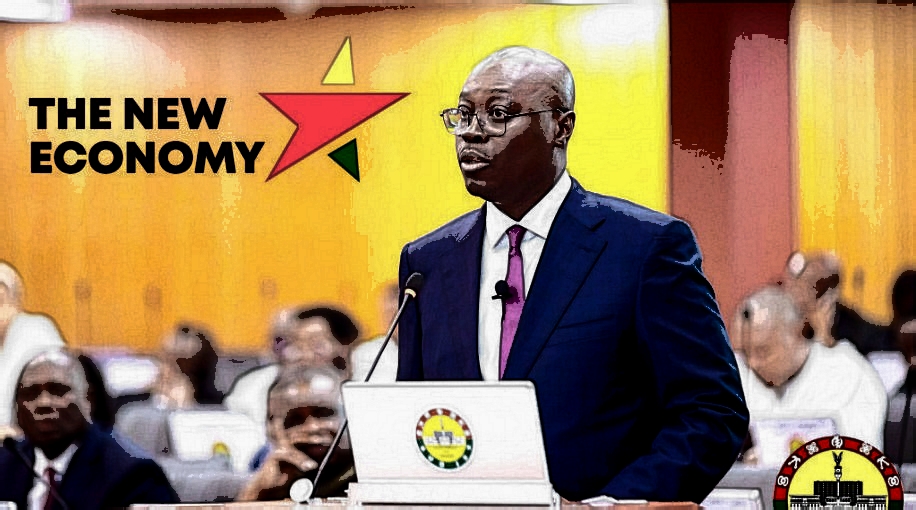
‘The New Economy’ is perhaps the most popular term in public discussions before, during and after the reading of the 2027 Budget Statement and Economic Policy of the government on November 12, 2026.
The term was first mentioned in May 2026 by the Finance Minister, Dr Cassiel Ato Forson, during a brief to Parliament on the ministry’s engagement with the International Monetary Fund (IMF).
“President Mahama’s administration has designed a new economic programme, The New Economy, to be unveiled in the 2027 Budget. The New Economy will move Ghana from stabilization to transformation, with a clear focus on sustainable jobs, higher productivity, greater resilience, and broad-based prosperity,” he said at the time:
During the 2026 mid-year fiscal policy review in June, he dedicated a paragraph to ‘The New Economy’ stating: “Through the New Economy agenda that we will unveil, we will build an economy that does not merely withstand shocks but creates jobs, generates wealth and grows on the strength of what Ghana produces.”
The New Economy – Minister lays out the $10 billion 4-year plan
During his presentation of the 2027 Budget Statement, Minister Ato Forson dedicated considerable time to the New Economy.
“The New Economy is the Government of Ghana’s four-year programme, beginning in 2027, to confront these weaknesses and transform the structure of our economy. We will expand production, process more of our resources at home and turn our nation’s wealth into decent jobs, higher incomes for lasting prosperity,” he stated.
RelatedNews

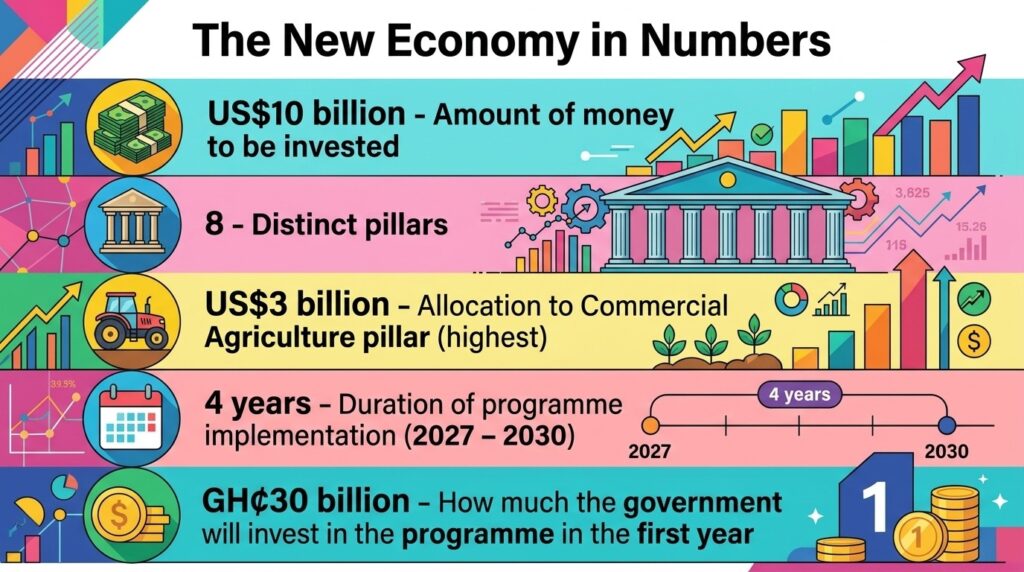
On the cost of the programme, he said: “… over a four-year period, from 2027 to 2030, Government will spend US$10 billion to create a modern Ghanaian economy for jobs and prosperity.”
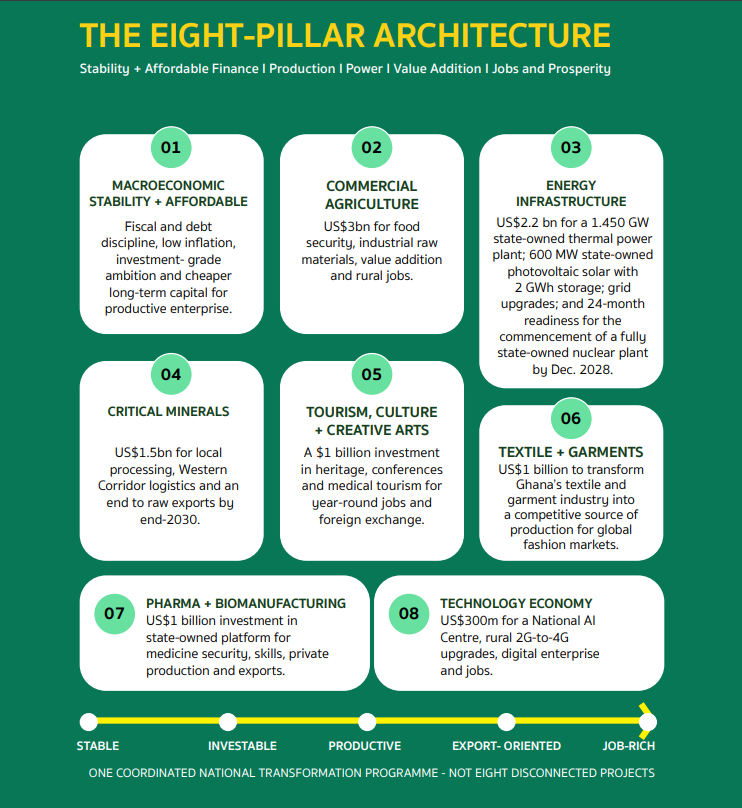
| Pillar | Funds Allocated | Summary |
| Microeconomic Stability and Affordable Finance | Affordable finance must reach farmers, manufacturers and exporters; | |
| Commercial Agriculture | US$3billion | Agriculture must supply food and industrial raw materials; |
| Energy infrastructure | US$2.2billion | Reliable energy must support a 24-hour economy; |
| Critical Minerals and Value Addition | US$1.5billion | Minerals and cocoa must gain value in Ghana before export; |
| Tourism, culture and creative Arts | US$1billion | Tourism, culture and creative arts must turn our rich heritage and creativity into thriving businesses, jobs and foreign exchange; |
| Textile and Garments | US$1billion | Textiles and garments must expand local manufacturing, create jobs and connect Ghanaian skills and enterprise to global fashion markets; |
| Pharmaceuticals and biomanufacturing | US$1 billion | Pharmaceuticals and biomanufacturing must produce more medicines and vaccines in Ghana, strengthen health security and supply markets across Africa; and |
| Technology Economy | US$300 million | Technology must widen our sources of jobs and foreign exchange. Rural connectivity must allow talent in every region to participate in the New Economy. |
Source of Funding – The twin fiscal measures
According to the Minister, the government will spend US$10 billion between 2027 and 2030 to bring the new economy to life using two fiscal measures.
- First, we will reduce Ghana’s primary surplus target by 1 percentage point of GDP over the period, creating room for investment in productive infrastructure, industries and jobs.
- Second, tax reforms already approved by Parliament and compliance measures are expected to generate 0.5 per cent of GDP.
He added that in 2027, the government will invest 1.5 per cent of GDP, equivalent to GH¢30 billion, in the New Economy. The investment will finance the foundations for economic transformation needed to expand businesses, increase exports and create jobs for the Ghanaian people. The minister said the government aims to create a conducive and stable financial environment for farmers and factories to access affordable financing.
The minister also outlined the government’s economic targets for 2027 and 2030.
| By 2027, the government aims to: | By 2030, the targets are to: |
| Maintain a positive primary balance of at least 0.5% of GDP; Keep public debt at 45% of GDP; Sustain single-digit inflation Strengthen external buffers. | Achieve GDP growth of about 8% Reduce unemployment below 8% Establish a credible path towards an investment-grade sovereign credit rating. |
The government intends to publish an annual Investment Grade Readiness Report on reserves, debt affordability, monetary credibility, financial sector strength, institutional quality and economic diversification to encourage businesses. The Minister said lower interest rates will help businesses to afford financing for their businesses.