

The use of Artificial Intelligence, AI-generated content, continues to feature prominently in political conversations on social media in Ghana with users increasingly creating images, videos and other forms of content around topical political discourse.
During the recent public exchanges between Minority Leader, Alexander Afenyo-Markin and GoldBod Chief Executive Officer (CEO), Sammy Gyamfi, over the reported losses under the Domestic Gold Purchase Programme (DGPP), GhanaFact observed a systematic usage of AI-generated content to comment on the controversy.
Timeline of events
The controversy centered on a US$1.7 billion loss (approximately GH¢22 billion), associated with the 2025 Domestic Gold Purchase Programme (DGPP). The figure was reported by the International Monetary Fund (IMF) in its August 2026 report on the programme.
Addressing the press on August 18, 2026, Afenyo-Markin focused on the reported GH¢22 billion (US$1.7 billion) loss under the DGPP, and attributed the loss largely to GoldBod.
“Our central bank is technically bankrupt, therefore, and the single biggest driver of that collapse in the 2025 was gold operations, Goldbod, Goldboard’s own domain, 22 billion Cedis; that’s equivalent to 1.7 billion US dollars in one year alone. Therefore, ladies and gentlemen, let’s call it what it is. These losses are not bad luck.” ( watch from 1 min:46 secs).
On August 19, 2026, Sammy Gyamfi responded during the Government Accountability Series, rejecting the claim that Gold Board itself incurred the US$1.7 billion loss.
RelatedNews


“First, ladies and gentlemen, Afenyo-Markin and his followers alleged on several occasions, on the floor of parliament and in the media, that the Goldbod made losses in its gold operations in the year 2025. This claim is a barefaced lie which has been debunked time without number by the Goldbod…”
On the same day, Afenyo-Markin issued a statement responding to Sammy Gyamfi. “First, the loss is admitted. The Chief Executive Officer does not dispute the IMF’s finding that there is a loss of US$1.7 billion (22 billion Ghana cedis) under the Domestic Gold Purchase Programme in 2025. He disputes only who should be blamed. This is public money, whichever State balance sheet it sits on,” the statement partly said.
On August 24, 2026, the dispute escalated further, with the Office of the Special Prosecutor’s (OSP) announcement that it would assess extortion allegations the GoldBod CEO made publicly against Afenyo-Markin. At the same time, the Minority Leader opened legal action against Gyamfi for the extortion claims.
Amid the back and forth about whether the loss was on the GoldBod or the central bank, on September 4, 2026, the Institute of Economic Affairs (IEA) at a press conference in Accra clarified whose books the said loss sat on, stating that the “US$ 1.7 bn DGPP loss sits on BoG books, not GoldBod.”

The AI contents
Social media has increasingly become the main field where topical discussions either are platformed or discussions around them are had. The US$1.7 billion loss was not an exception.
Across social media platforms like; X, Facebook, TikTok and Instagram, different forms of content – AI-generated images, digitally altered and generated content, depicting the two politicians in fictional situations, as well as humorous and satirical representations of the controversy, were widely circulated.
Some of the content clearly shows political satire and humour, while other posts use those visuals alongside captions that promote particular interpretations of the controversy.
Afenyo with the ‘devil’
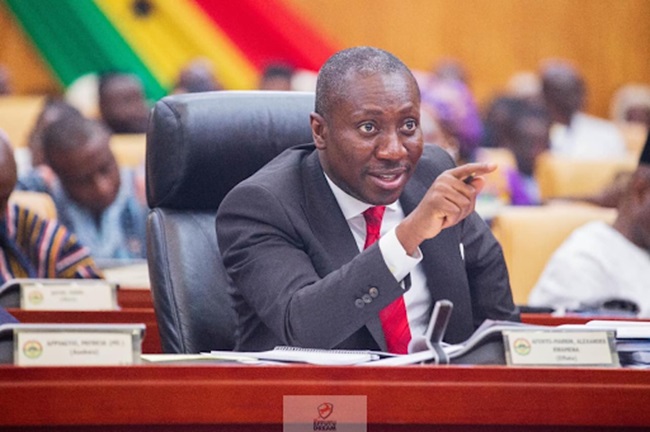
On August 24, 2026, an X user shared a manipulated image showing Minority Leader Afenyo-Markin speaking in Parliament, with a viral TikTok character portrayed as the devil leaning towards him and whispering into his ear.
The post was captioned in Twi, “Bonsam ka nsɛm gu n’asowa mu,” which translates to “The devil whispers into his ear.” The post had attracted 67,000 views, 586 likes, 69 reposts and 56 comments at the time of this report.
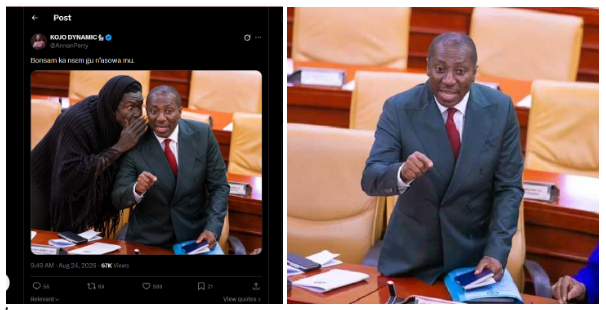
GhanaFact traced the image to an original photograph showing Afenyo-Markin standing alone and speaking in Parliament. A comparison of the two images shows that the original photograph was digitally altered to add the figure portrayed as the devil beside him.
“$1.7 billion GoldBod loss” shirts
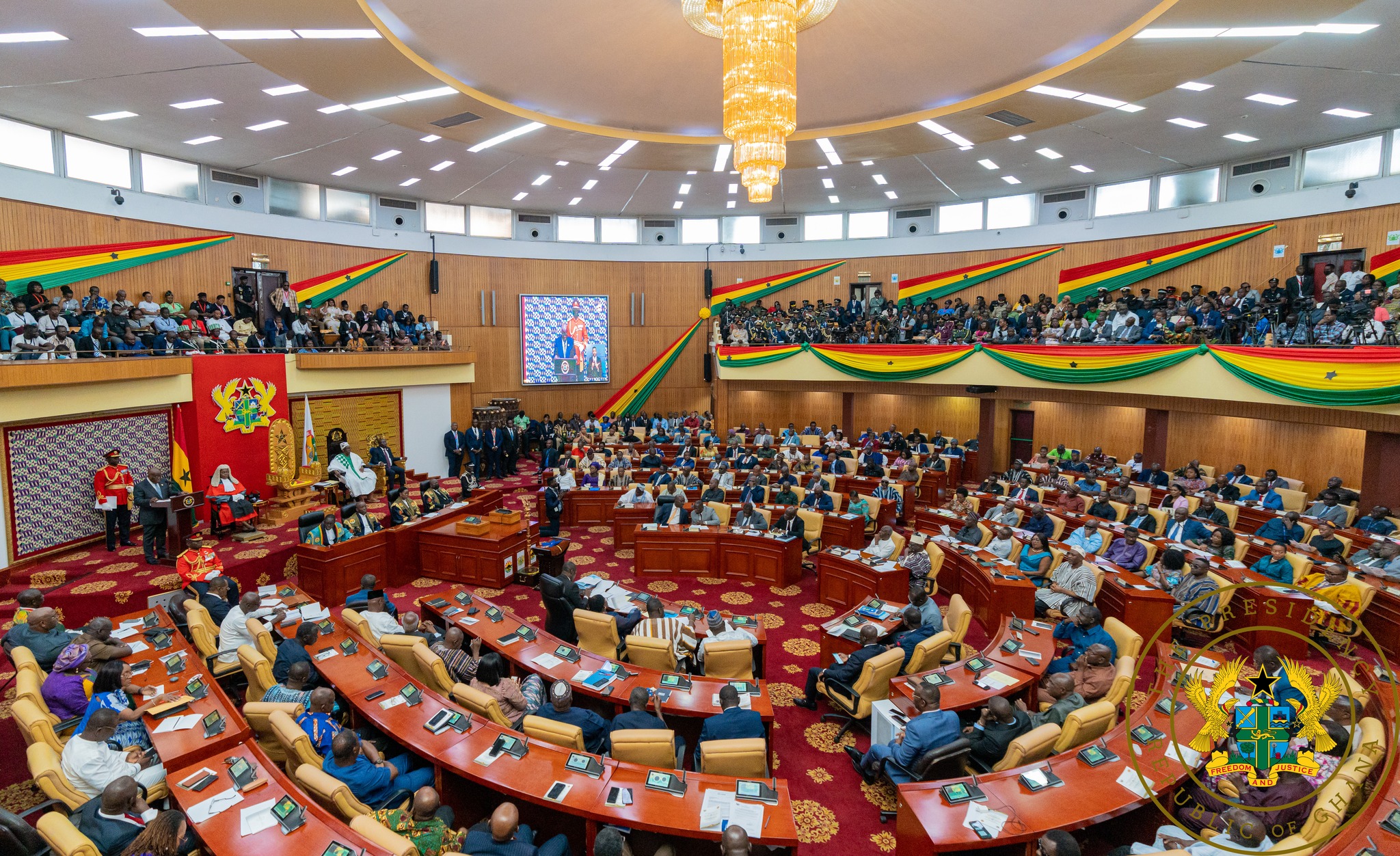
Another image on Facebook shows Minority MPs seated in Parliament, all wearing green T-shirts with the inscription $1.7 BILLION GOLDBOD LOSS while their leader addressed the house with a projected speech bubble that said, “Na GH¢22 billion no wo hen?”
The post was captioned, “Leader make wild on Sammy Ataa Ayi Gyamfi.” As of the time the report is written, the post had attracted 1.8K reactions, 337 comments and 77 shares.
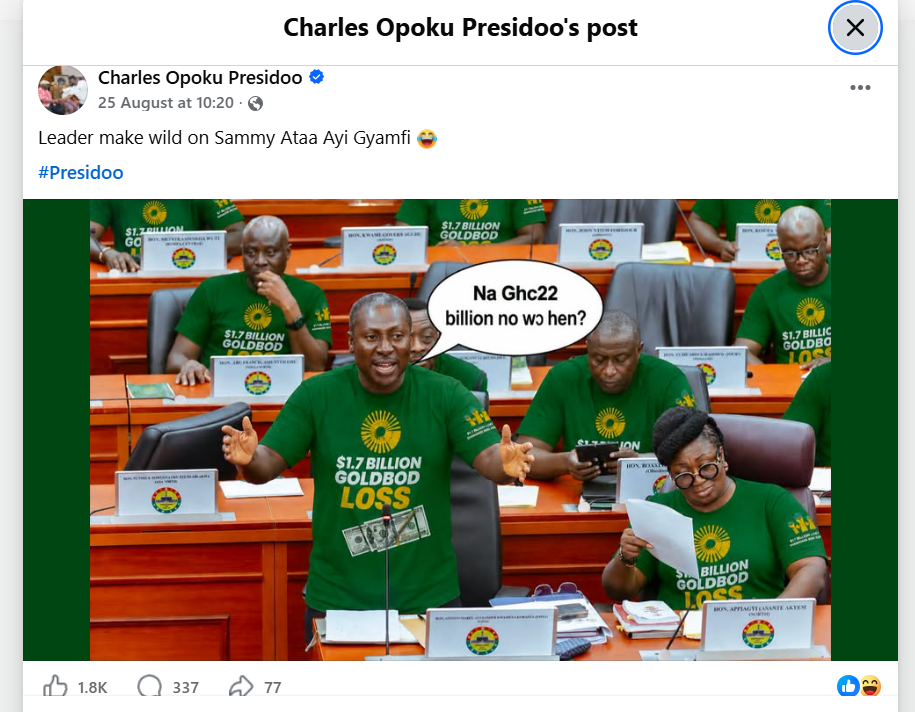
GhanaFact found that the parliamentary setting and the people depicted in the image are real. However, the green T-shirts and the “$1.7 BILLION GOLDBOD LOSS” inscriptions appear to have been digitally altered of the original image, along with the speech bubble.
The alteration transforms an authentic parliamentary photograph into a satirical representation of the ongoing controversy over the US$1.7 billion loss.
Sammy Gyamfi chases Afenyo-Markin
Another manipulated graphic depicts Sammy Gyamfi and Afenyo-Markin in a courtroom-themed setting.
The graphic with the headline “SAMMY GYAMFI ‘CHASES’ AFENYO-MARKIN FOR DEFAMATION SUIT” shows the GoldBod CEO pursuing the Minority Leader who is holding what appears to be a legal document labelled “Defamation Lawsuit.”
The image also shows a judge’s gavel and scales of justice, reinforcing the legal theme.
The graphic was circulated after media reports suggested that despite having been sued for defamation over his extortion allegations against Afenyo-Marking, Sammy Gyamfi had instructed his lawyers to demand the suit from the court registry because he had not been served.

‘The Effutu Jesus Christ’
On Facebook, a user shared an AI image showing Afenyo Markin surrounded by several men portrayed as his followers.
The image, designed like a movie poster, had the title: ‘The Effutu Jesus Christ,’ and the tagline “The Teacher The Healer The Messiah.”
The post was captioned “Jesus Christ’s sacrifice and redemption. And Jesus Christ was attacked but kept quiet. Meanwhile, he was not accused of Extortion.” The post was labelled as ‘Titles are generated by AI from Meta.’
It was circulated after Afenyo-Markin’s appearance on Joy News where when pushed about the extortion allegations said like Jesus, he was not going to respond to the accusations to the extent that they were not true.

Afenyo and the ‘Wakyi gu hɔ’ trend
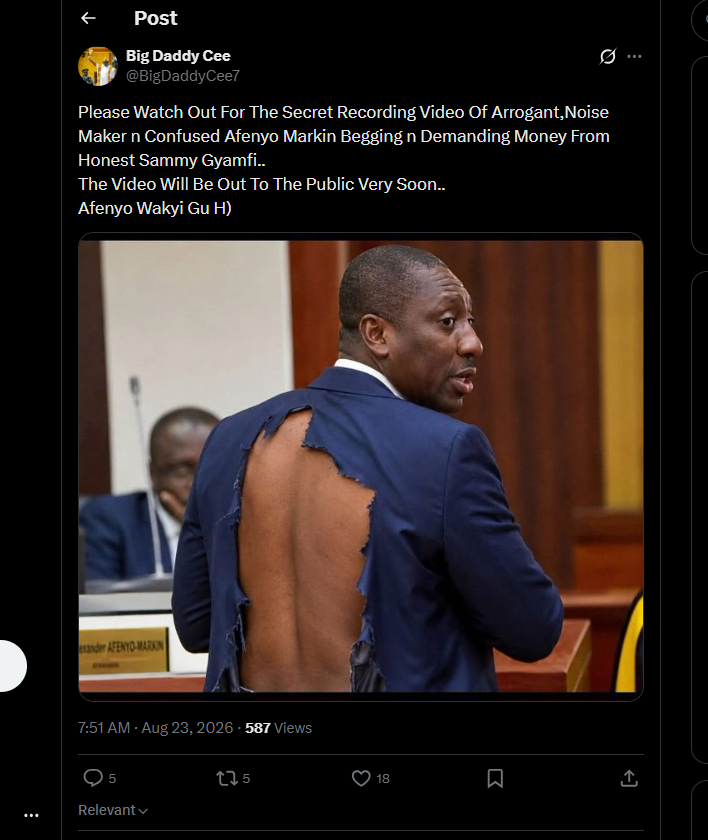
Similarly, an X user shared an image showing Afenyo-Markin standing in Parliament, with the back of his suit torn and exposing his back. The image depicts the popular ‘wakyi gu hɔ’ trend, a phrase used to suggest that an individual is ignorant of something or exposed.
The post was captioned: “Please Watch Out For The Secret Recording Video Of Arrogant, Noise Maker n Confused Afenyo Markin Begging n Demanding Money From Honest Sammy Gyamfi… The Video Will Be Out To The Public Very Soon.. Afenyo Wakyi Gu H)”
A generated song joins the conversation
Beyond the use of digitally altered images, the controversy also took on a musical tone. A TikTok video features a song created around the question, “Where Is The $1.7 Billion,” with the performer shown singing along to the track.
The video uses the reported US$1.7 billion figure as its central theme, turning the financial controversy into a musical and satirical piece for social media. Its circulation demonstrates how AI and other digital content-creation tools are increasingly being used not only to create visual representations of political figures, but also to produce entertainment-oriented content around ongoing political debates.
Several other examples of AI-generated or digitally manipulated content were also identified here, here, here.
These examples demonstrate how AI-generated content is being incorporated into the political conversation surrounding the Afenyo-Markin vs. Sammy Gyamfi exchange. Rather than simply sharing photographs or videos from actual events, social media users are creating fictional scenes that place the politicians in exaggerated or humorous situations.
In some cases, the image itself carries the message, such as the portrayal of Afenyo-Markin with a figure depicted as the devil. In others, the altered visual is accompanied by captions making specific claims or suggestions about the ongoing controversy.