

Misleading or false information on social media targeting public institutions is increasingly becoming a common tactic used by mis/disinformation agents. In August 2025, the Ghana Education Service (GES) had reason to dismiss multiple posts related to announcements regarding the Free Senior High School (Free SHS) programme.
GhanaFact observed, over the course of the month, that the GES embossed fake inscriptions on at least three flyers circulated by social media users and in one case a media house.
In this narrative report, GhanaFact analyzes the issues surrounding these disclaimers and the importance of a proactive approach to tackling false information for a critical state institution as the GES.
Disclaimer on release of 2025 BECE results and placements
On August 13, 2025, the GES issued a disclaimer to a purported statement about the release of the 2025 Basic Education Certificate Examination (BECE) results. This fake statement mimicked an official press release of the GES, making it likely for people to believe its authenticity.
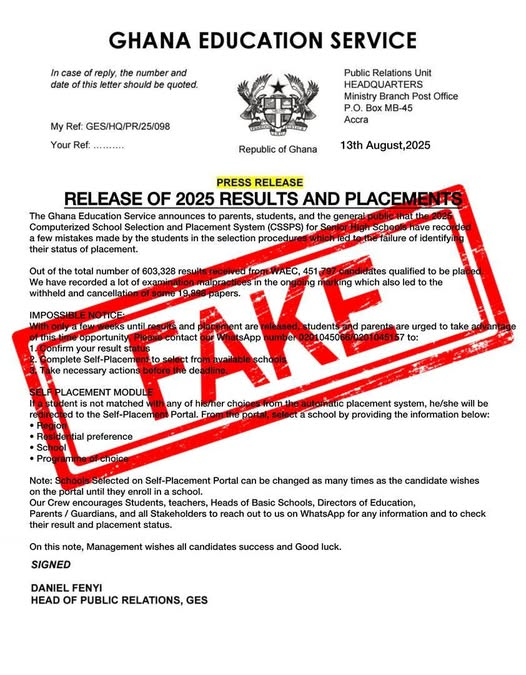
The content of the fake press release sought to create an impression that there had been mistakes with the SHS selection process for BECE candidates, and had urged parents and guardians to remedy this situation by contacting a designated number on WhatsApp.
At the time the release was issued, however, the West African Examination Council (WAEC), had not yet released BECE results. But more importantly, since the introduction of the Computerised School Selection and Placement System (CSSPS) in 2005, the placement of students in SHSs is no longer a manual process as the fake press release sought to suggest using the WhatsApp contact number.
RelatedNews




GhanaFact additionally observed that despite the GES’s disclaimer on August 13, social media users continued to share the false statement (here, here, and here).
Claims that GES has scrapped the double-track system
On August 23, 2025, a purported GES letter announcing reopening dates for Senior High Schools was interpreted to mean that authorities had reversed the double-track system to a single track under the Free SHS policy.
Accra-based GHOne TV posted a viral flyer with text that read: “GES reverses 2025/2026 academic calendar to single track,” the flyer has since been deleted and the station has apologised for same.
GhanaFact observed again that even though the media outlet had apologised for the “misinformation,” some social media users (here, here, and here) had already shared the flyer, reinforcing the narratives as true.
The posts had generated conversations on social media, with at least one post on X garnering 4,105 views, 19 reposts, and 67 likes.
On August 24, 2025, the same day some of these posts were shared, the GES issued a disclaimer slapping a fake inscription across the GHOne flyer on a post on Facebook.

“In the spirit of transparent and honest communication, the Ghana Education Service (GES) wishes to clarify that the 2025/2026 academic calendar has 𝗻𝗼𝘁 𝗳𝘂𝗹𝗹𝘆 𝗿𝗲𝘃𝗲𝗿𝘁𝗲𝗱 𝘁𝗼 𝘁𝗵𝗲 𝘀𝗶𝗻𝗴𝗹𝗲-𝘁𝗿𝗮𝗰𝗸 𝘀𝘆𝘀𝘁𝗲𝗺, as reported in some sections of the media.
“The academic calendar, released last week, makes clear provision for both 𝘀𝗶𝗻𝗴𝗹𝗲-𝘁𝗿𝗮𝗰𝗸 and 𝗱𝗼𝘂𝗯𝗹𝗲-𝘁𝗿𝗮𝗰𝗸 schools,” GES said in a post on Facebook.
BECE cut-off points for school placements
On August 28, 2025, posts on social media (here and here) suggested that the GES had fixed cut-off points under the Computerised School Selection Placement process for candidates who wrote the Basic Education Certificate Examination (BECE).
Based on the posts, it meant that BECE candidates with specific results would get into their first, second, or third choice schools.
This information, however, was false, causing the GES to issue another disclaimer on August 29, 2025.
“It is important to emphasise that the notion of fixed cut-off points is misleading and has no basis in the placement process. Anyone relying on such so-called cut-off benchmarks has been misinformed.
“GES therefore urges parents, guardians, and students to 𝗱𝗶𝘀𝗿𝗲𝗴𝗮𝗿𝗱 𝘀𝘂𝗰𝗵 𝗽𝘂𝗯𝗹𝗶𝗰𝗮𝘁𝗶𝗼𝗻𝘀, as they are a mischievous attempt by unscrupulous persons to mislead the public,” GES said in a Facebook post.

Conclusion
In the space of a month, a critical state institution like the Ghana Education Service was forced to respond to misinformation about announcements purported to have come from the institution.
While this may appear to be a proactive approach against misinformation, it resonates with calls by the Director of Africa Education Watch, Kofi Asare, in July that the Ministry of Education (parent body for GES) should have a more responsive disinformation unit.
“I think that because we have a lot of politically sensitive policies in this country, it will be important for the Ministry of Education to have a disinformation unit to immediately respond to some of these things,” Asare told GhanaFact in an interview over a False narrative that was being circulated about the cancellation of the Free SHS policy.