

Claim: There wasn’t a quorum when anti-LGBTQ Bill was passed
Source: President John Dramani Mahama, Oliver Barker-Vormawor
Verdict: False
Researched by Alfa Shaban
On May 29, 2026, Parliament passed the Human Sexual Rights and Family Values Bill, popularly referred to as the anti-LGBTQ Bill; marking the second time the Bill had been passed after the initial passage in 2023.
A legal challenge to the constitutionality of the first passage stalled its transmission to the president. The Supreme Court subsequently dismissed two legal challenges against the initial passage paving the way for a reconsideration of the Bill and present passage.
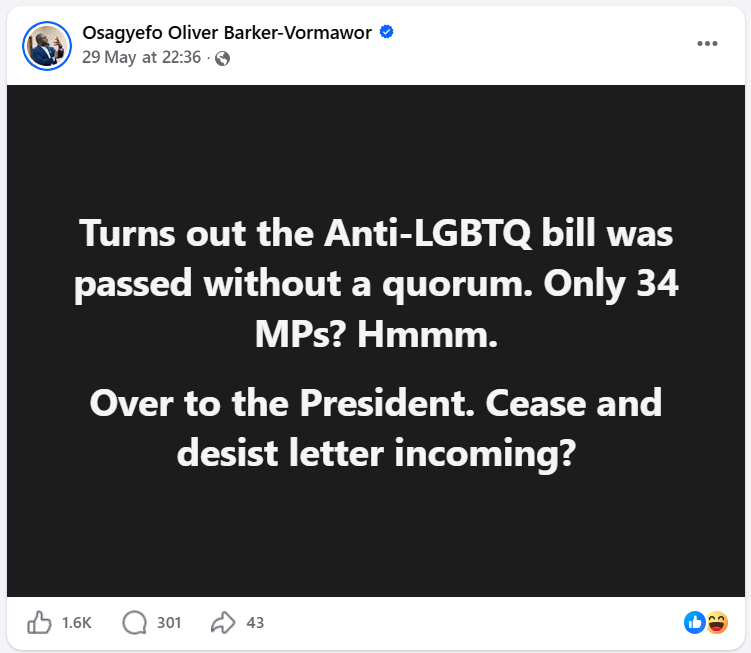
Following the passage, a key reaction that followed was that the passage was without a quorum because of the number of MPs present when the Bill was passed. Lawyer and activist, Oliver Barker-Vormawor in a May 29 social media post said: “Turns out the Anti-LGBTQ bill was passed without a quorum. Only 34 MPs? Hmmm. Over to the President. Cease and desist letter incoming?”
RelatedNews
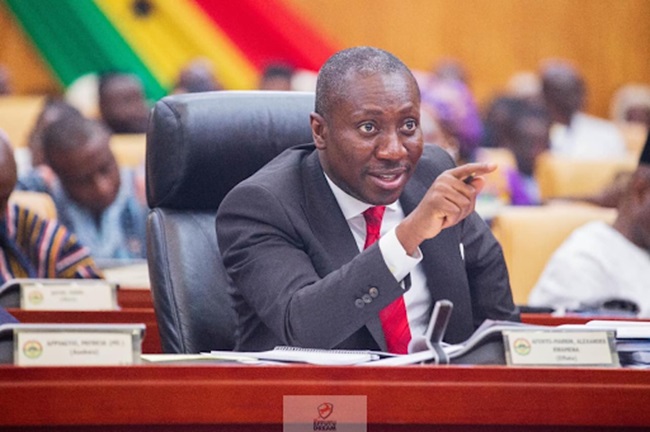


Days later, President John Dramani Mahama speaking at a Chatham House event on June 1 alluded to a similar sentiment around the quorum issue.
“It has been a bill that has probably evoked the most interest in Ghana, it shows how important issues of family values are. Parliament has been considering it and it was supposed to have been passed last week.
“There have been a few issues raised, one; that there wasn’t a quorum when it was passed and two there were some procedural lapses in terms of its passage,” the president stressed.
This report will analyze the issue of quorum and fact-check whether or not the House was properly constituted at the time of the passage of the Bill.
Fact-check
Quorum refers to the minimum number of members required to be present for an organization (in this case Parliament) to conduct business.
The subject of quorum is captured in Article 102 of the Constitution and in Order 48 of Parliament’s Standing Orders. The two clauses on quorum in the Standing Orders states: “(1) The presence of at least one-third of all Members of Parliament besides the person presiding shall be necessary to constitute quorum of the house.
“(2) If at any time of sitting, a Member takes notice or objection that there are present in the House, besides the person presiding, less than one-third of the number of all Members of Parliament, and after an interval of 10 minutes a quorum is not present, the person presiding shall adjourn the House without Question put until the next sitting day.”
A quorum is constituted at the beginning of a sitting and presumed to be subsistent throughout a particular day’s proceedings until the issue is raised at any point of proceedings, for example when the House is set to take a vote.
Dr. Rashid Draman of the Africa Center for Parliamentary Affairs (ACEPA) also weighed in on the matter in an interview with FactSpace West Africa. He said: “These people are dancing around the issue because of how sensitive it (the anti-LGBTQ Bill) is.
“Many Bills have been passed around the same circumstances in the past, unless a court decides to stretch the quorum issue and call for visuals or footage during the vote, the first record of the House even a court will rely on is the Votes and Proceedings which will show that Parliament had quorum at the time the Bill was passed,” he stressed.
In an interview on Channel One TV, MP for Akwatia, Bernard Bediako said: “Quorum is always presumed, it is when you raise it, this is trite and he knows that what we do if you believe there are issues of quorum is to raise it.
“If you don’t raise it, it is presumed to be regular. You were in the House and my respected Minority Leader was in the House and nobody raised it. In fact, Rev Ntim-Fordjour was there, nobody raised it, so we presumed.”
His position was, however, sternly contested by colleague MP for Manhyia South, Nana Agyei Baffour Awuah, who insisted that they was no provision in the Constitution or Standing Orders of Parliament that said explicitly or otherwise that quorum can be presumed at any point.
Dr. Draman, however, holds a different position on the particular point. “The presumption of quorum is just a practice that has become part of the House because legally, what can be used to determine quorum is the Votes and Proceedings.
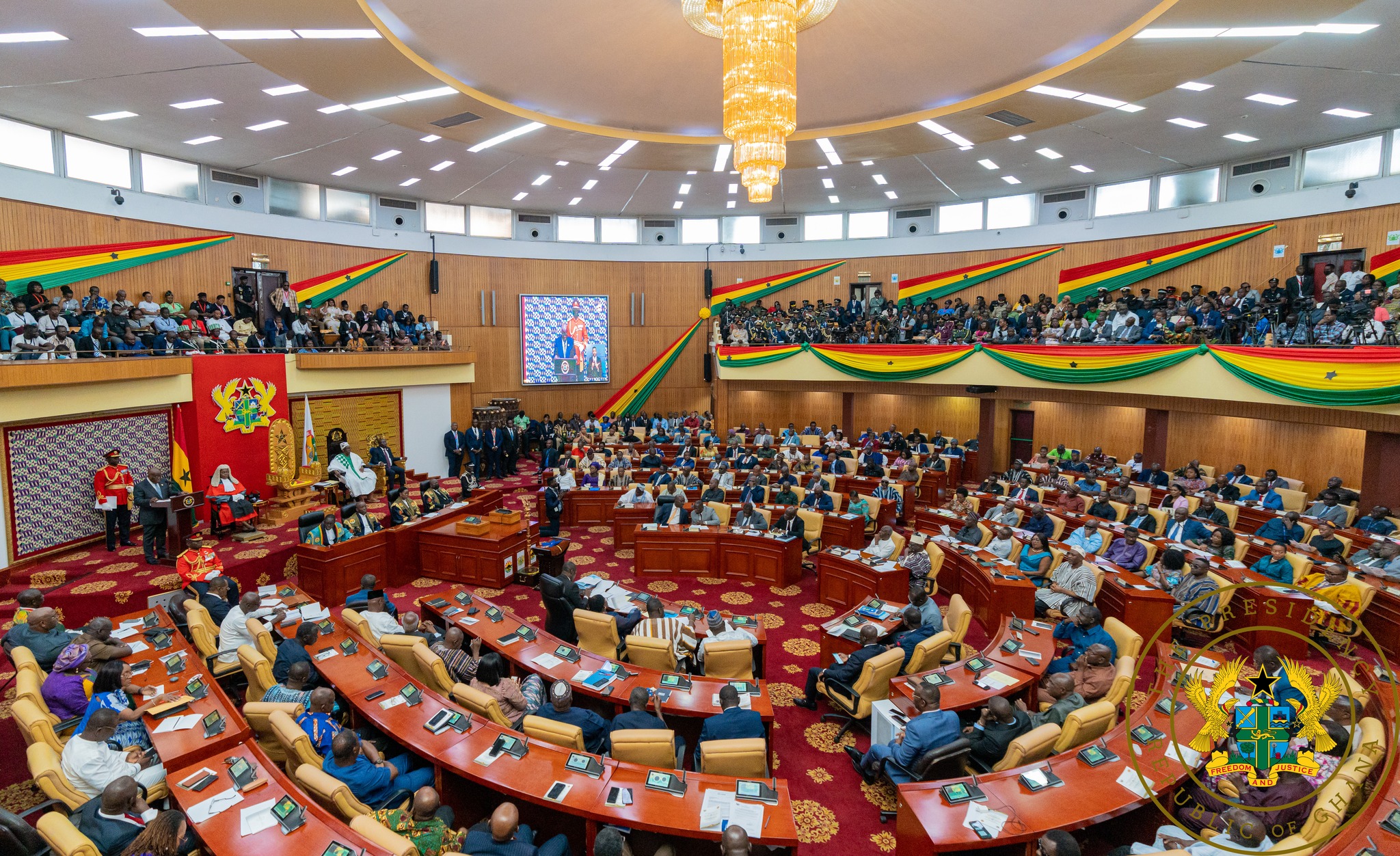
According to the Votes and Proceedings of May 29, 2026 when the Bill was passed, the House had a quorum at the time proceedings started because 193 MPs were present, 15 were absent with permission whereas 68 others were absent without permission.
On June 3, 2026, Speaker Alban Bagbin, delivered a communication to the House on the passage of the Bill, appealing that the House reconsiders the passage and allows the Bill to be reintroduced to the House for a consensus passage given the accusation by the Minority that Parliament passed a watered down version of the Bill.
“I respectfully appeal to Honourable members to reflect carefully of all the issues raised and to consider in the larger national interest, the bipartisan character of the Bill, the unity of the House and the nation and the need to maintain the highest standards of procedural integrity, to revisit its decision on the third reading of the Bill to permit a reconsideration of the final text of the Bill and any amendments thereto,” Speaker Bagbin said.
Nowhere in his communication did the Speaker allude to a quorum challenge in the passage of the Bill, all other procedural issues he raised were not in any way connected to the quorum at the time of passage.
On whether Parliament should amend its rules to make quorum during decision taking more specific, the ACEPA boss said: “There appears to be a gap in the Standing Orders that might need to be dealt with to explicitly state that key votes should be based on MPs present and voting and not those who came in and signed and left for one reason or the other.”
Verdict:
From the publicly available record of proceedings, it is not the case that Parliament passed the anti-LGBTQ Bill without a quorum. We therefore rated the claim as False.