
Researched by Gifty Tracy Aminu
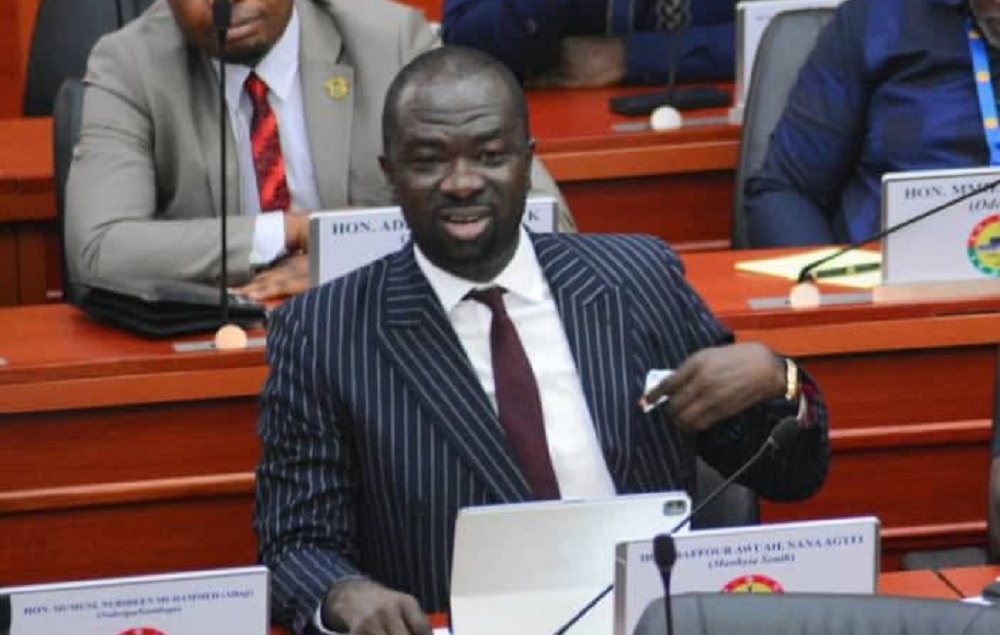
An attempt by the Economic and Organised Crime Office (EOCO) to arrest the Member of Parliament (MP) for Manhyia South, Nana Agyei Baffour Awuah, at the premises of an Accra High Court on September 23, 2023, sparked a conversation about Articles 117 and 118 of the 1992 Constitution.
The conversations rebirthed a long-held perception that security agencies cannot legally arrest or invite a lawmaker for questioning without seeking permission from the Speaker, due to immunities enshrined in especially Article 117 of the 1992 Constitution.
The immunity accorded to MPs continues to be highlighted in the media and on social media, especially whenever there is an arrest or attempted arrest of an MP for one reason or the other.
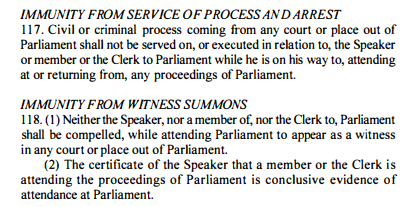
In this article, we asked questions relative to the suitability and applicability of the constitutional immunity in the immediate case of the Manhyia South MP but also of other instances where MPs have faced arrest or have been arrested.
Legal perspective – GhanaFact speaks with a lawyer
A private legal practitioner and a Partner at Benchmark Lawyers, Prince Ganaku, shared some perspectives with us.
1. Is the legal process of inviting an MP for questioning or arresting an MP clear enough?
Ans: The constitutional text is clearer than the practice that has grown up around it. Article 117 provides that civil or criminal process from any court or place outside Parliament “shall not be served on, or executed in relation to” the Speaker, an MP or the Clerk” while he is on his way to, attending at or returning from any proceedings of Parliament”.
RelatedNews
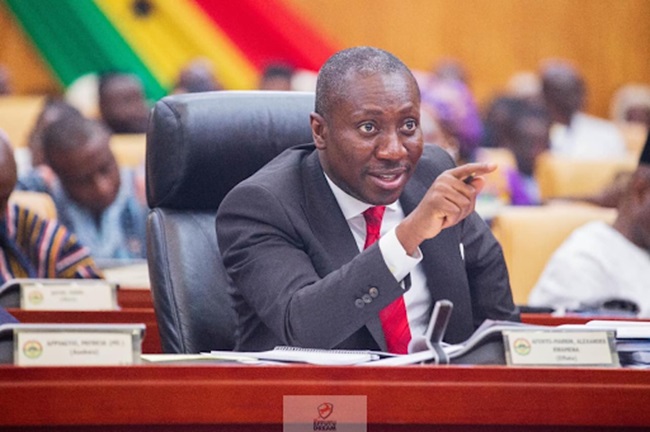



Article 118 (1) adds that none of them can be compelled, while attending Parliament, to appear as a witness in any court or place outside Parliament. The protection is therefore limited in time and place. It safeguards the parliamentary function, not the MP as a person. It does not shield an MP from investigation. Nor does it say that the Speaker’s permission must be obtained before the criminal law can act.
The uncertainty comes from practice. Under Speaker Professor Aaron Mike Oquaye, an arrangement developed in which, while Parliament is in session, agencies have in practice routed their requests through the Speaker, who then arranges for them to engage the MP. The convention continued under Speaker Alban Bagbin.
2. What happens to Article 117 when Parliament is in recess? Must agencies still write to the Speaker and the Clerk?
Ans: Article 117 depends on there being “proceedings of Parliament” for the MP to be going to, attending or returning from. During recess there is ordinarily no plenary business, so the protection generally does not apply.
The exception is an MP who is travelling to, attending or returning from a committee sitting or other parliamentary business held during recess. In that case, the protection applies for that period. Whether such business existed can be verified. A Speaker’s certificate of attendance is conclusive evidence under Article 118(2).
3. What are the processes involved in serving sitting MPs with court papers?
The practice of going through the Speaker has been tied to Parliament being in session. Nothing in the Constitution requires agencies to write to the Speaker or the Clerk during recess. The Chief Justice’s November 2024 circular expressly allows court processes to be served directly on MPs during recess. Agencies may still choose to notify Parliament out of courtesy.
Parliament speaks on arrest of Manhyia South MP
On September 23, 2026, an EOCO officer’s attempt to arrest the Manhyia South MP, Nana Adjei Baffour Awuah, led to a violent confrontation between the two and other bystanders after the MP demanded an identification card from the officer and opted to attend an EOCO invitation in his own vehicle. He subsequently drove to Parliament and EOCO issued a statement about the altercation.
However, on October 1, 2026, the MP reported to EOCO and was subsequently placed under arrest before he was arraigned before the High Court on October 3 for a bail application. His arrest according to EOCO was premised on a September 30 warrant from the High Court.
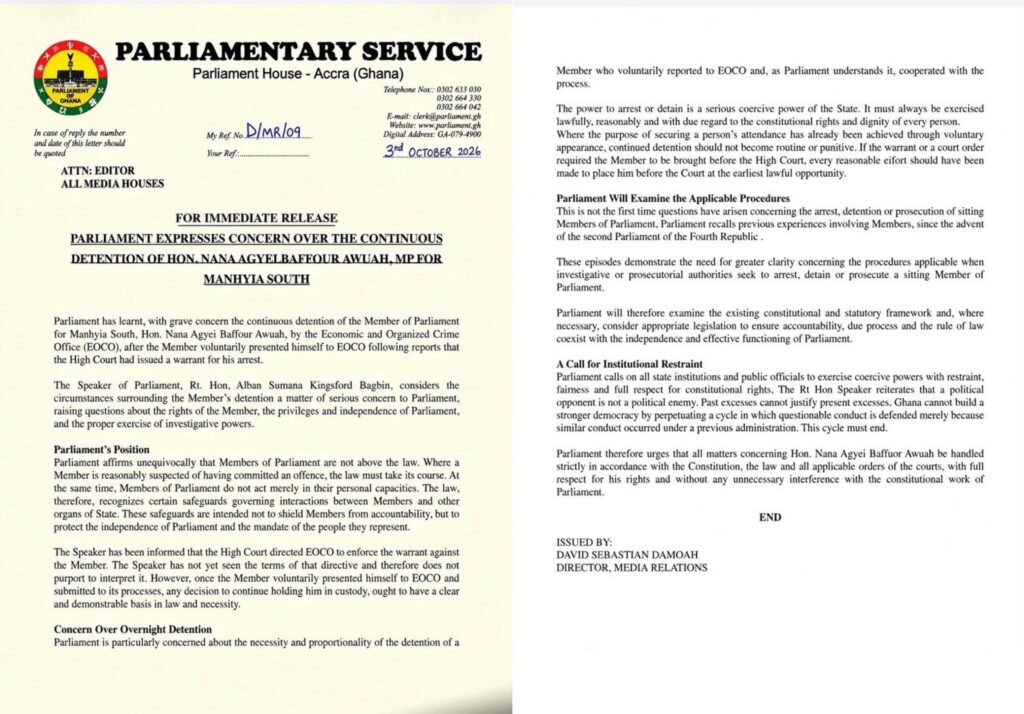
A statement dated October 3 from the Parliament of Ghana said, “The Speaker of Parliament, Rt. Hon. Alban Sumana Kingsford Bagbin, considers the circumstances surrounding the Member’s detention a matter of serious concern to Parliament, raising questions about the rights of the Member, the privileges and independence of Parliament, and the proper exercise of investigative powers.
“Parliament affirms unequivocally that Members of Parliament are not above the law. Where a Member is reasonably suspected of having committed an offence, the law must take its course. At the same time, Members of Parliament do not act merely in their personal capacities. The law, therefore, recognizes certain safeguards governing interactions between Members and other organs of State.
“These safeguards are intended not to shield Members from accountability, but to protect the independence of Parliament and the mandate of the people they represent,” the statement added.
The Majority Chief Whip, Rockson-Nelson Dafeamekpor, reacted to the attempted arrest via an X post in which he cited Article 117 as having the procedure on how legal processes shall be served on the Speaker, MPs and the Clerk to Parliament.
“This Constitutional protection applies strictly while the individual is on his/her way to, attending at, or returning from official parliamentary proceedings. However, this provision has been effectively interpretively enlarged to imply that, any arrest of any alleged erring MP or Clerk, etc must first and foremost be channeled through the Speaker of Parliament of Ghana.
“So far, this is the procedure in force in respect of an arrest of MPs in all cases. It is therefore absolutely unacceptable for EOCO to seek to arrest a sitting Member of Parliament, especially within the precincts of Court, without applying the procedure in force regarding his Article 117 rights,” he added.
History of arrest of MPs
Over the years, a number of lawmakers have been arrested on different issues. Those in this category include:
- Former MP for Abuakwa South, Samuel Atta Akyea,
- Former MP for Akuapim South, Osei Bonsu Amoah
- Current MP for Madina Francis-Xavier Sosu and
- MP for Manhyia South, Baffour Awuah.
On July 11, 2011, the then MP for Abuakwa South, Samuel Atta Akyea, was arrested at the premises of the High Court by the Ghana Police Service over his alleged role in the embezzlement of US$60,000 earmarked by J. Adom Company Limited for the purchase of a building situated in the Airport Residential Area in Accra.
Samuel Atta Akyea, however, denied the allegation.
On February 21, 2012, news reports indicated that Osei Bonsu Amoah, MP for Aburi-Nsawam, now Akwapim South, was arrested in connection with Alfred Agbesi Woyome’s GH₵51 million judgment debt. Police reportedly picked up the MP at his residence.
The MP for Madina, Francis Xavier-Sosu, evaded arrest on two separate occasions in 2021. On October 25, 2021, he led constituents in Madina to protest poor road conditions, leading to roadblocks and obstructing traffic. The Police’s first attempt at arrest was at the demonstration ground, which failed. The second attempt was at the church for the same offences, but he evaded arrest.
On November 3, 2022, the MP was arrested for another traffic offence. The lawmaker was arrested after he was caught by the police driving in the middle of the road.
‘MPs are not immune from the law’ – Speaker Bagbin
During the First Sitting of the 2nd Meeting of the 2nd Session of the 9th Parliament on May 21, 2026, the Speaker, Alban Bagbin, indicated that the privilege and immunity for parliamentarians do not supersede the laws of the country.
“No privilege or immunity supersedes the law. For purposes of emphasis, MPs are not immune from the law. Apart from this, after we are elected, we are all made to swear oaths to commit ourselves to the law, to the trust and the interest of Ghana and Ghanaians above our personal or partisan interest.”

He also emphasised that the security agencies do not need his permission before inviting or arresting an MP. “I end by drawing the attention of the public, particularly the security agents, that the Speaker is only informed of incidents involving Members of Parliament as to whether they have gone wrong on the side of the law or not.
“It is not for the security agents to seek my permission before arrest. It is not. It is for them to inform me and include the circumstances or the allegations that have created the suspicion, and I go through the law and then apply the law as to whether the person is in a privileged situation or is immune from what is taking place.
“I am saying this because there’s some perception that they need permission of the Speaker before a member can be apprehended or even invited to respond to inquiries. That is not the state of the law.”
Conclusion
It is clear that Article 117 of the Constitution does not protect a Member of Parliament, the Clerk or Speaker from answering questions or being arrested by law enforcement officers. The underlining principle is to inform the Speaker with the necessary details of the invitation.