


Historically, cocoa has been one of Ghana’s most valued cash crops, generating export revenue, supporting rural livelihoods and contributing significantly to the country’s economy while financing development in areas such as education, health and infrastructure.
Through cocoa, Ghana has also built a strong reputation on the international market, particularly for the quality of its beans. As of 2022, the cocoa sector contributes more than 30 per cent of Ghana’s overall foreign earnings.
The country has historically ranked among the world’s leading cocoa producers and exporters and is currently the second-largest producer after Côte d’Ivoire. Together, the two West African countries account for about 60 per cent of global cocoa production, giving them considerable influence over the international cocoa economy.
At a June 2026 high-level summit, the two countries identified major challenges confronting the sector. Part of the communique signed by Presidents of both countries said: “the sector remains exposed to major challenges such as price volatility, illegal gold mining, adverse effects of climate change, the rise in the use of cocoa substitutes and equivalents, and the increasing demands of international sustainability regulations.
A sector under growing pressure
Despite its immense contribution to the Ghanaian economy, the cocoa sector faces challenges including ageing farms, disease, climate, high production costs and smuggling.
Illegal small-scale mining, known as galamsey, has become another major threat, particularly in cocoa-producing regions, where miners take over and degrade farmland and pollute or divert water sources.
RelatedNews



Stakeholders within the cocoa sector have described galamsey as a serious threat, warning that farmers who surrender their farms to miners for short-term payments can lose a long-term source of income. COCOBOD has also linked illegal mining to the destruction of productive cocoa farms in areas such as Wassa Akropong and Akwatia.
In a JoyNews broadcast with some cocoa farmers in the Amansie West District, they described the financial pressure and long-term consequences of releasing their farms to illegal miners. One farmer said, “Many farmers sell their lands because of quick money, forgetting that cocoa land is a natural resource that generates income not just for today but for future generations as well.”
Another farmer said the money offered by illegal miners is often difficult to resist, noting that “Most farmers have never seen the kind of money the galamseyers offer them. This makes it very difficult to convince them otherwise, and many eventually give in and release their lands.”
The District Agricultural Officer for Amansie West told JoyNews that illegal mining is causing severe land degradation and deforestation in the area. She said, “Almost all the trees have been uprooted by the excavators and stuff. They’ve left some potholes. They don’t cover the land, and that will gradually affect us in the near future.”
The threat is also reflected in Ghana’s production outlook. In July 2026, COCOBOD projected that cocoa production could fall by at least 16 per cent in the 2026/27 season, citing several factors including weather, disease and the impact of illegal mining, particularly in the Western and Western North regions.
The 2026 Ghana Cocoa Board Bill – A legal response to the threat
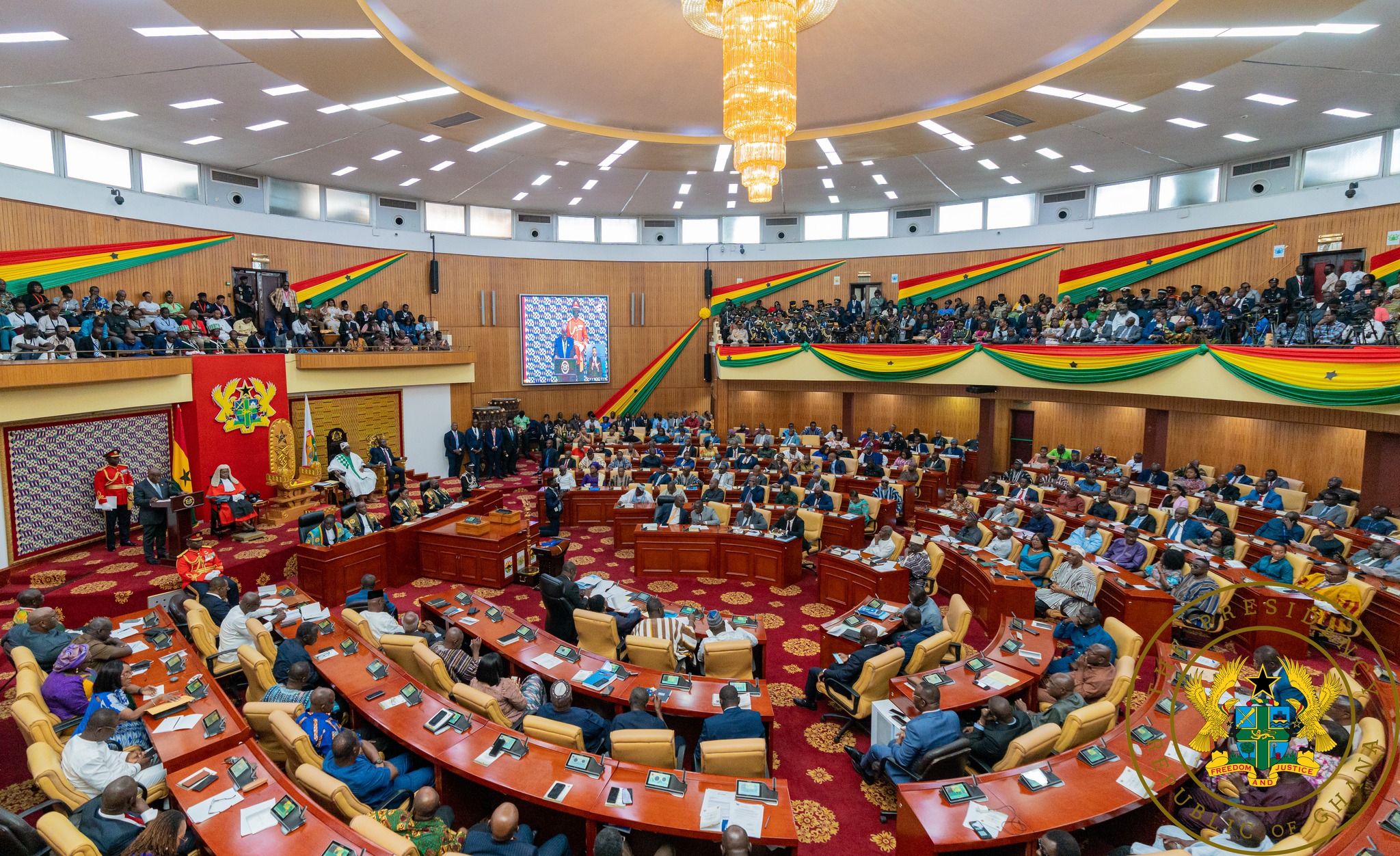
It is against this background that Parliament passed the Ghana Cocoa Board Bill, 2026, on July 30, 2026, and was subsequently signed into law by President John Dramani Mahama on August 26, 2026, as part of 10 Bills he assented to.
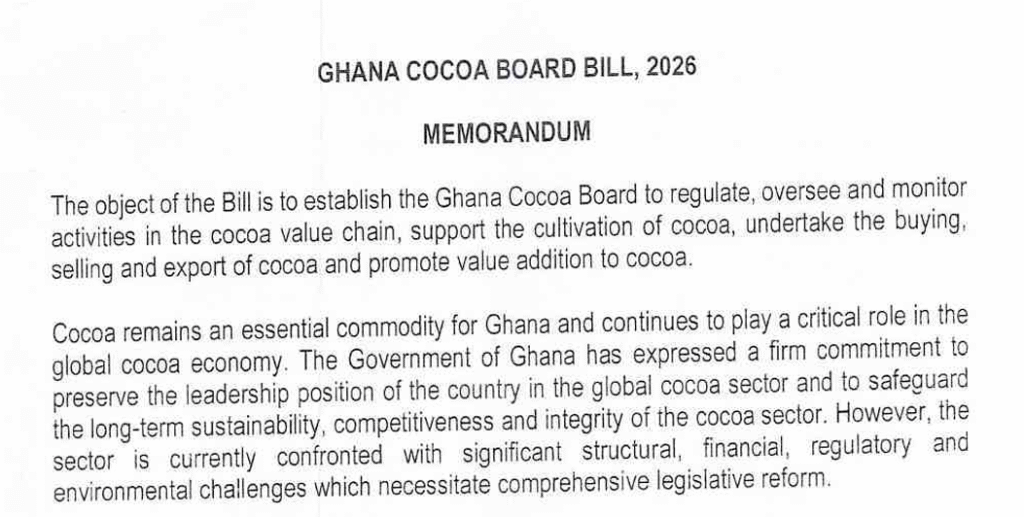
The law introduces a new legal framework for the regulation and development of Ghana’s cocoa sector, with provisions to strengthen the sector, support farmers, promote local processing and protect cocoa farms from activities that threaten their long-term productivity.
The Act also incorporates the government’s commitment to process at least 50 per cent of cocoa beans locally, ensure farmers receive 70 per cent of the world market price, and the designation of cocoa farms as protected areas.

Cocoa farms become “protected farms”
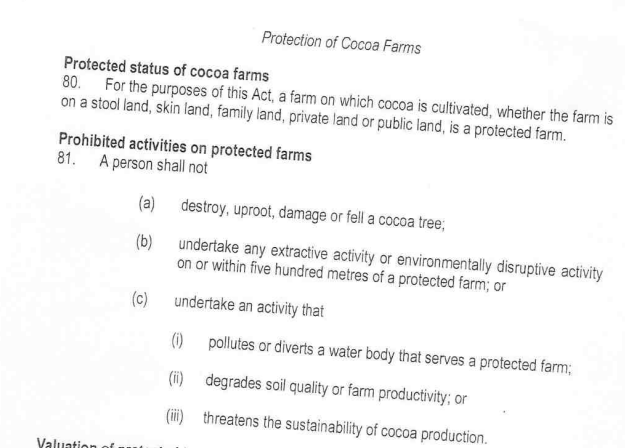
Clause 80 of the law gives cocoa farms a special legal status.
It states: “For the purposes of this Act, a farm on which cocoa is cultivated, whether the farm is on a stool land, skin land, family land, private land or public land, is a protected farm.” This provision is important because the protection does not depend on who owns the land.
No matter the ownership of a farm, once cocoa is cultivated there at the time of coming into force of the law, the farm is classified as a protected farm under the legislation.
The provision does not mean that ownership of the land automatically transfers to the government. Rather, it creates a legal protection around the cocoa farm and places restrictions on activities that could destroy the trees, damage the land or threaten the sustainability of cocoa production. COCOBOD has also clarified that the protected status is not the same as government ownership.
This distinction matters because the legislation is attempting to address one of the ways galamsey operators gain access to cocoa-growing areas: the conversion or destruction of productive cocoa land for mining and other activities.
What activities are prohibited?
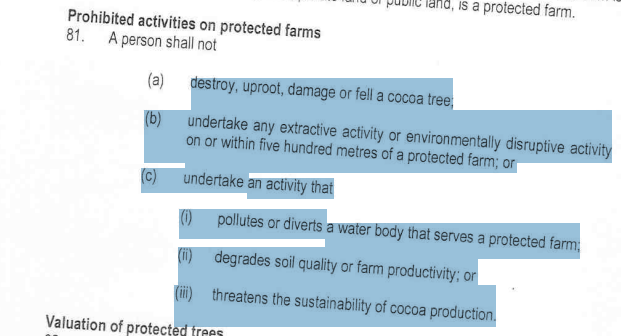
Clause 81 sets out the activities that cannot be undertaken on or around a protected cocoa farm.
It provides that a person shall not:
(a) destroy, uproot, damage or fell a cocoa tree;
(b) undertake any extractive activity or environmentally disruptive activity on or within five hundred metres of a protected farm; or
(c) undertake an activity that (i) pollutes or diverts a water body that serves a protected farm; (ii) degrades soil quality or farm productivity; or (iii) threatens the sustainability of cocoa production.
The significance of this clause goes beyond illegal mining itself.
Under the provision, extractive or environmentally disruptive activities within 500 metres of a protected cocoa farm are restricted. This creates a buffer around cocoa farms and is particularly relevant to mining because mining is an extractive activity.
The provision also recognises that the threat to a cocoa farm may come from outside the farm itself. An activity does not necessarily have to destroy a cocoa tree to put the farm at risk. If it pollutes or diverts a water body serving the farm, damages the soil, reduces productivity or threatens the sustainability of cocoa production, it can fall within the prohibited conduct.
This is particularly significant in the fight against galamsey because the environmental damage associated with illegal mining can extend beyond the exact location where excavation takes place.
Mining near cocoa farms faces an additional restriction
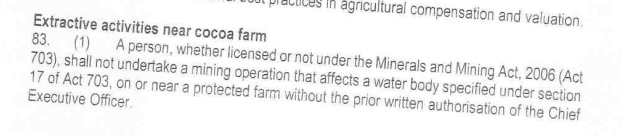
The Bill goes further in Clause 83 by dealing specifically with mining operations that affect water bodies close to protected cocoa farms.
Clause 83(1) states: “A person, whether licensed or not under the Minerals and Mining Act, 2006 (Act 703), shall not undertake a mining operation that affects a water body specified under section 17 of Act 703, on or near a protected farm without the prior written authorisation of the Chief Executive Officer.”
The wording is significant because it covers both licensed and unlicensed persons.
In other words, having a mining licence under the Minerals and Mining Act does not, by itself, remove the additional restriction created by this provision where the mining operation affects a specified water body on or near a protected cocoa farm.
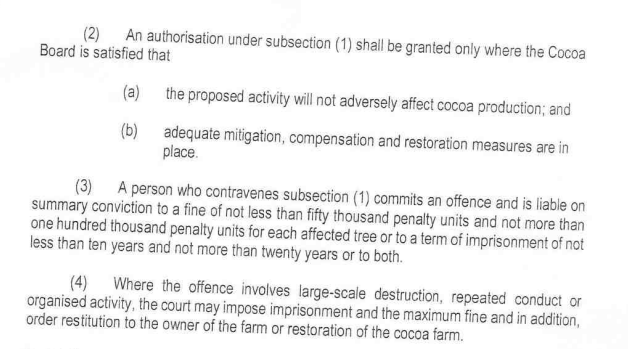
The provision therefore creates an additional layer of protection for cocoa farms and the water sources that support them.
Conclusion
With President John Dramani Mahama’s assent on August 26, 2026, the Ghana Cocoa Board Bill, 2026 is now law, giving the cocoa sector a stronger legal framework to protect farms from galamsey and other activities that threaten their productivity.
From designating all cocoa farms as protected areas to restricting extractive activities within 500 metres, and safeguarding water bodies serving farms as well as imposing severe penalties for violations, the Act provides stronger protection for Ghana’s cocoa-growing areas. However, its success will depend on effective enforcement, farmer education and sustained support to make cocoa farming a viable long-term livelihood.