

Claim: According to Ghana Chamber of Mines about 80% of small-scale miners engage in illegal mining activities
Source: John Darko (MP for Suame Constituency)
Verdict: False
Researched by Charlotte Gbonsu
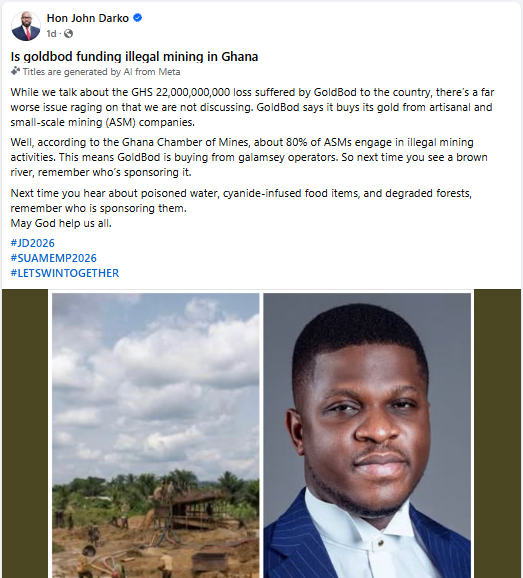
The Member of Parliament for Suame in the Ashanti Region, John Darko, on August 24, 2026, made a Facebook post claiming that according to the Ghana Chamber of Mines “about 80% of Artisanal and Small-Scale Miners (ASM) engage in illegal mining activities.”
He made the post amidst the controversies around a reported 1.7 billion dollar loss attributed to the Ghana Gold Board’s (GoldBod) which has been proven to be false.
The Facebook post received significant attention, garnering over 415 likes, 251 comments, and 75 shares. Ghana Fact noted that on X the same post had received some engagements with 271 likes, 165 comments, 63 reposts, and 13 bookmarks.
RelatedNews


This fact-check will verify the MP’s claim that the Chamber of Mines has reported that about 80% of ASMs engage in illegal mining activities (galamsey).
Fact-check
GhanaFact reached out to the Ghana Chamber of Mines by email inquiring if the data the MP cited in his post indeed came from the Chamber.
In their email response to GhanaFact, the Chamber of Mines denied making such a statement. ‘“No. This statement did not originate from the Ghana Chamber of Mines.’’
The Chamber also added that they do not collect data on small-scale mining and that such data is only sourced from the GoldBod.
We contacted MP John Darko via his Facebook and X accounts with our findings around his claim. We however did not receive a response.
Small-scale mining in Ghana
Artisanal and Small-Scale Mining (ASM) is a low-tech-labour intensive method of extracting minerals, often carried out by individuals, local groups or small enterprises. According to GoldBod, as of 2025, the ASM sector accounted for an estimated 39% of national gold output, compared to 28% in 2023.
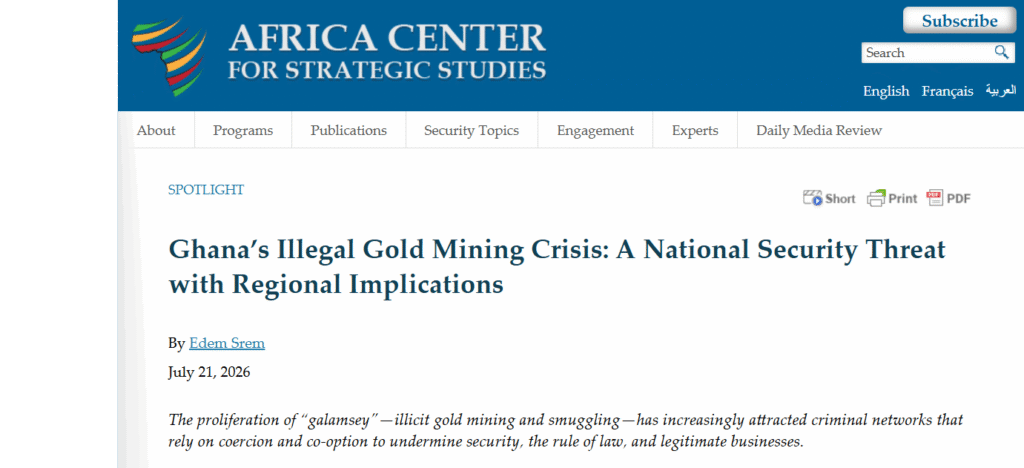
The Africa Center for Strategic Studies (ACSS) in a July 2026 publication titled: ‘Ghana’s Illegal Gold Mining Crisis: A National Security Threat with Regional Implications,’ noted that the ASM industry generates roughly $11billion in foreign exchange, compared to $9 billion for large scale miners.
While ASM provides livelihoods for many communities, it is often informal and may lack legal recognition, environmental safeguards, health and safety standards, and economic security. If left unregulated, these operations can lead to environmental pollution, public health concerns and human right violations.
The ACSS report, however, adds that about 70% to 80% of artisanal and small-scale miners operate without a licence citing an October 2024 Reuters publication.
The other report that spoke to the ASM licensing regime was published in 2020 by the NDPC and Copenhagen Consensus, which report was also citing two 2016 research works.
“… despite a clearly laid out formalization process in Ghana’s Mineral and Mining Act (Act 703), bureaucratic bottlenecks and prohibitive licensing costs compel a significant number of miners (between 70 and 80 percent) to operate illegally (Crawford and Botchwey, 2016; McQuilken and Hilson, 2016).
Verdict:
Therefore, the claim by the NPP MP that the Ghana Chamber of Mines has said “80% of Artisanal and Small-Scale Miners(ASM) engage in illegal mining activities” is rated false!