
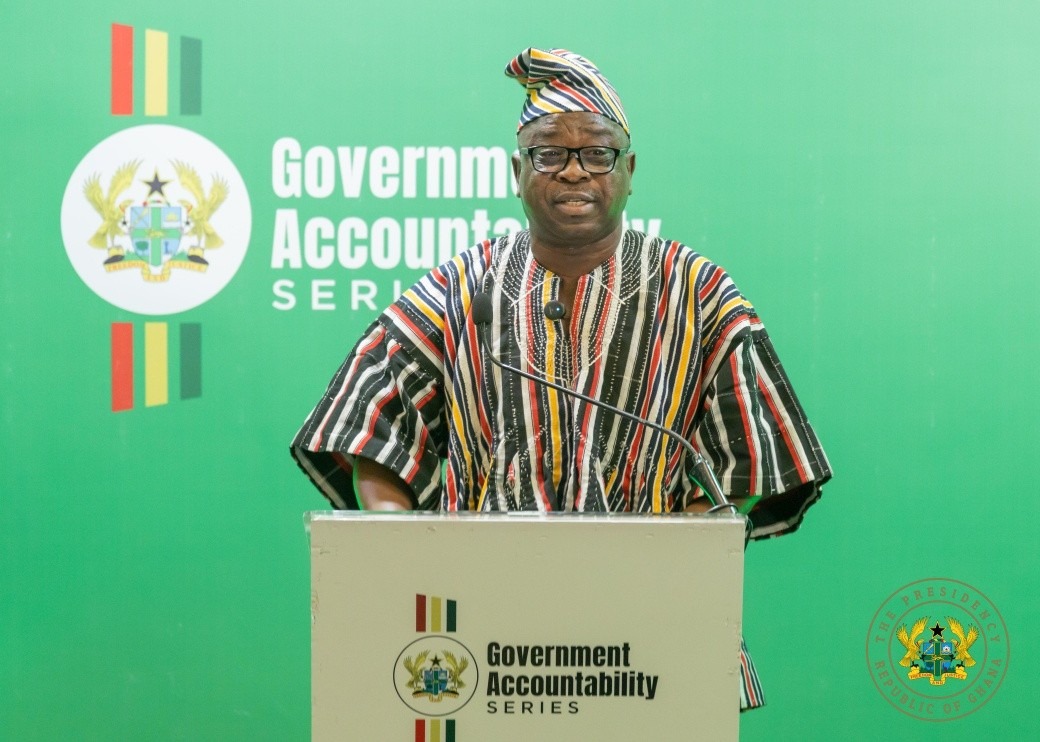
The Minister of State in Charge of Climate Change and Sustainability, Seidu Issifu, has outlined government efforts to strengthen climate coordination, attract climate finance, and position Ghana as a key player in global climate discussions.
Speaking during the Government Accountability Series on May 6, 2026, the minister described climate change as not only an environmental issue, but also a multi-pronged national development challenge.
“Climate change is no longer an environmental issue. It is a national development challenge that directly affects Ghana’s economy, infrastructure, water security, food systems, and energy transition,” he stated.
According to him, his ministry was established under the Office of the President to provide high-level coordination for Ghana’s climate agenda, mobilise international partnerships, and attract climate finance to support resilience and sustainable growth.
The minister noted that one of the major challenges inherited by the office was fragmentation in climate governance, where climate-related initiatives were often implemented in silos with limited cross-sector coordination.
“Upon assuming office, it was apparent that Ghana’s climate governance architecture, despite being supported by key institutions and policy, was constrained by fragmentation, insufficient cross-sector coordination, and limited access to large-scale climate finance.
RelatedNews


Climate-related initiatives were frequently delivered in silos, and opportunities to align national priorities with international finance mechanisms and investment platforms were not fully realized.”
To address this, he noted that the government has begun establishing climate and sustainability units across agencies and sectors of the economy to improve coordination and align national climate priorities.
He revealed that, “the office convened the inaugural inter-ministerial and agency technical working group meeting, bringing together ministries, agencies, financial institutions, the private sector, civil society organizations, and development partners.”
Mr. Issifu also highlighted Ghana’s growing engagement with international climate platforms and development partners, including collaborations with the United Nations Development Programme (UNDP), United Nations Industrial Development Organization (UNIDO), and several diplomatic missions in Ghana, while actively participating in major global climate discussions to strengthen the country’s visibility and attract investment opportunities.
The Minister further highlighted the establishment of the Climate Change and Sustainability Hub, which serves as a central centre of excellence for climate research, policy coordination, capacity building, and the monitoring of climate initiatives across the country.
“The climate change and sustainability hub is an initiative of my office. The very reason why we came out with this initiative is to give some coordinated approach to climate action. We came up with this initiative to ensure that we have a central point where climate action revolves….
“To a large extent, you’ll find out that most of these initiatives and projects are multi-sectoral. So we’re saying that if we’re able to establish this hub, a center of excellence for climate action. We have the research unit there. We have the capacity building unit there. We have the climate think tank. They will mobilize and monitor, influence and assist in building capacity across the length and breadth of our economy. This was the vision or this is the vision.”
He added that the government is currently collaborating with international partners to secure funding for the initiative and expand climate and sustainability units across districts to promote a bottom-up approach to climate action.
According to the minister, the broader goal is to build a more coordinated, resilient, and investment-driven climate governance system that not only addresses environmental challenges, but also supports Ghana’s long-term economic transformation and sustainable development ambitions.
Written by Nusrat Essah