Monday, April 27, 2026
Ghana Fact
  • Who We Are
    • About Us
    • How we work
    • Submit a claim to check
    • Partners
    • Our Team
    • Funding
    • Principles
    • Corrections
    • Privacy Policy
    • Press Releases
  • Contact
  • Home
    • Latest
    • Trending
  • Governance
  • DisinfoLab
    • Narrative Reports
    • Scams & Spam
  • Politics
    • Election 2020
    • Election 2024
  • Economy
  • Health
    • COVID-19
  • Environment
  • AI & Deepfakes
No Result
View All Result
Ghana Fact
  • Home
    • Latest
    • Trending
  • Governance
  • DisinfoLab
    • Narrative Reports
    • Scams & Spam
  • Politics
    • Election 2020
    • Election 2024
  • Economy
  • Health
    • COVID-19
  • Environment
  • AI & Deepfakes
No Result
View All Result
Ghana Fact
No Result
View All Result
Home General News

EU-Ghana Security and Defence Partnership: The FIMI and cybersecurity components  

In this analysis report, we delve into the digital threat components of the recently signed security and defence pact signed by the European Union and Ghana. We zoom in on the FIMI and cybersecurity angles of the agreement as key elements of non-traditional security areas. 

Nusrat EssahRahman ShabanbyNusrat EssahandRahman Shaban
April 2, 2026
in General News
Reading Time: 5 mins read
A A
EU-Ghana Security and Defence Partnership: The FIMI and cybersecurity components  
Share on FacebookShare on TwitterShare on ThreadsWhatsApp

Contemporary security and defence pacts have usually incorporated measures to combat digital threats in the wake of the increased weaponisation of online platforms and digital spaces by bad actors.

Security is no longer limited to traditional defence-related issues, but increasingly encompasses non-traditional security areas, including foreign information manipulation and interference (FIMI) or hybrid threats, amplified by emerging disruptive technologies.

While the government forms policy and legislative measures through inter-agency efforts to regulate digital spaces, collaboration with other external actors in an increasingly interconnected world is another key aspect in the fight against digital threats.

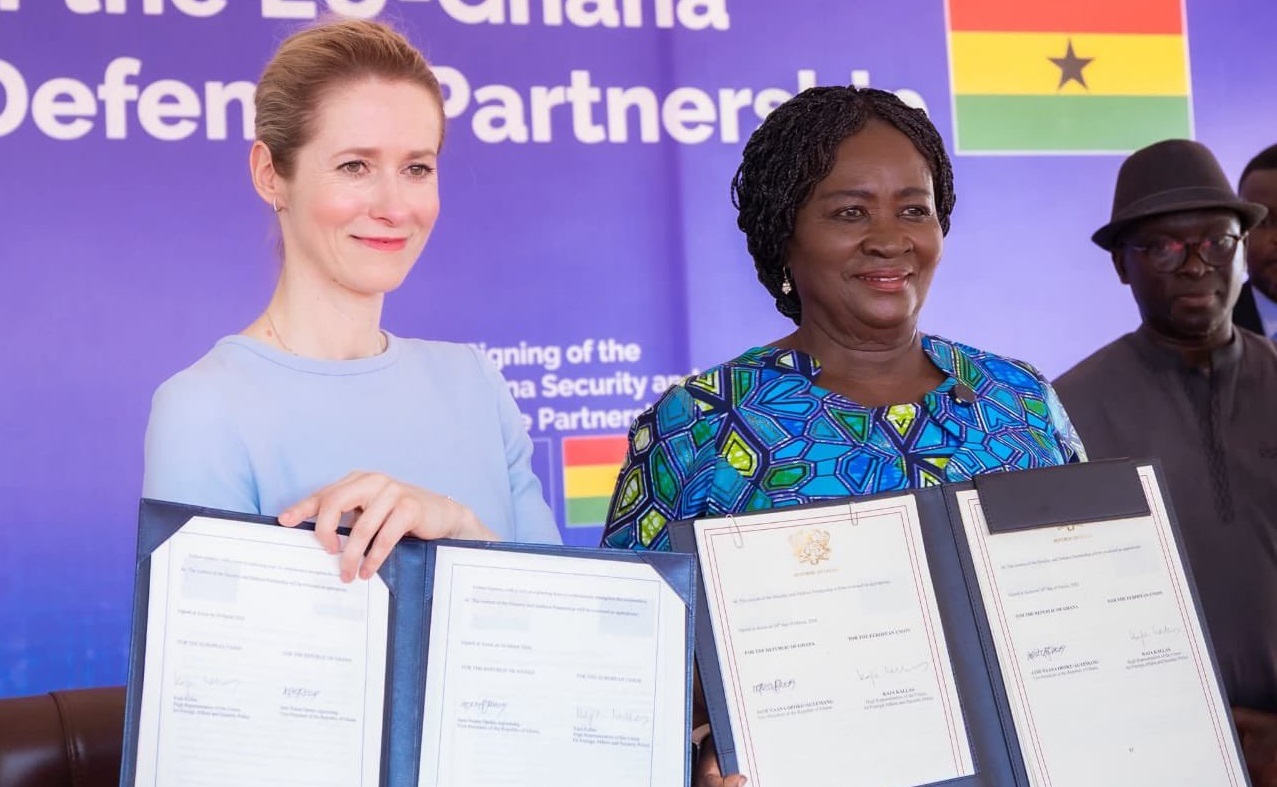
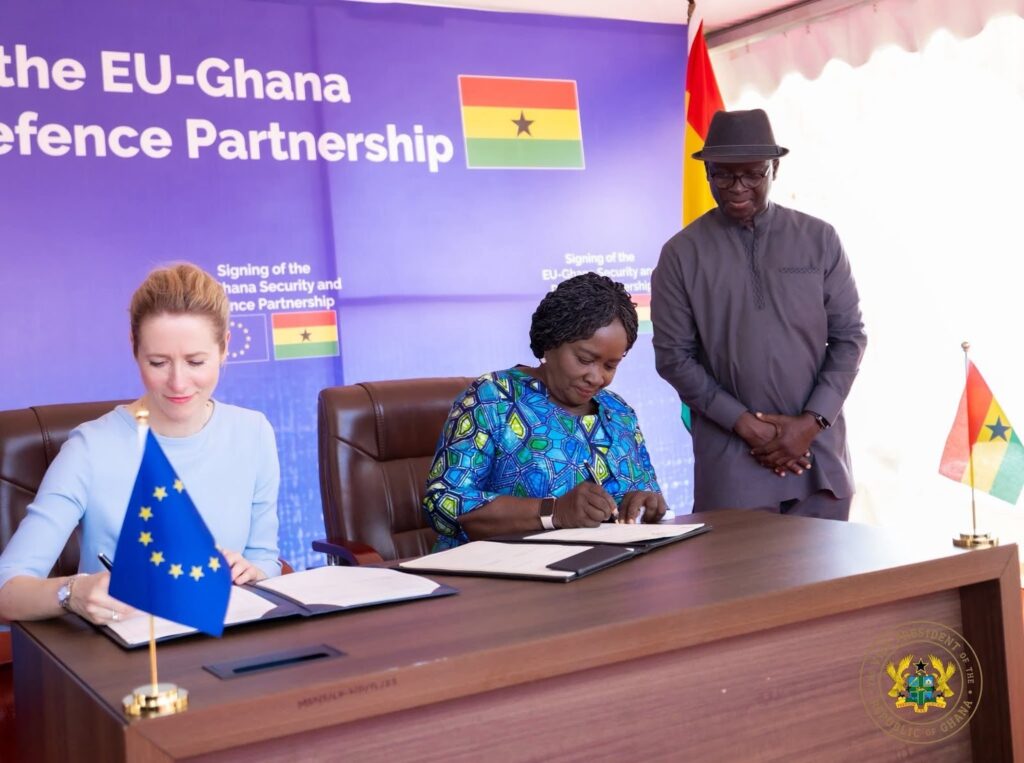
On March 24, 2026, the European Union (EU) and Ghana signed a Security and Defence Partnership in Accra aimed at strengthening cooperation on peace, security, and defence matters (Read the full pact here).

The agreement is particularly significant as Ghana becomes the first African country to sign a Security and Defence Partnership with the European Union (EU), positioning the country as a key partner in the EU’s expanding security cooperation with non-EU states.

The agreement was signed by the EU High Representative for Foreign Affairs and Security Policy, Kaja Kallas and Ghana’s Vice President, Professor Naana Jane Opoku-Agyemang.

RelatedNews
How Ghana, Nigeria, others navigated fuel pricing strait amid Middle East war

How Ghana, Nigeria, others navigated fuel pricing strait amid Middle East war

False! NPP MP wrongly claims NDC chairman Asiedu Nketiah is on 9th Parliamentary Service Board 

FACT-CHECK: Asiedu Nketiah’s claim that 500,000 people applied to join the Police Service is False

Ivory Coast now paying lower cocoa producer price compared to Ghana

Ivory Coast now paying lower cocoa producer price compared to Ghana

FACT-CHECK: Do Ghana’s West African neighbours have lower monetary policy rates?

FACT-CHECK: Do Ghana’s West African neighbours have lower monetary policy rates?

According to VP Opoku-Agyemang, the partnership as signed: “demonstrates the strengthening collaboration between Ghana and the European Union in tackling evolving security challenges especially in our subregion and across the Sahel.”

According to security analyst Richard Kumadoe, “nations all over the world sign various security and defense contracts with others, whether at a regional level or at a global level. What is important is that in the days of disinformation and misinformation, which has the tendency of degenerating into chaos and leading into instability, it is important that politicians or government officials will communicate the terms and the details of the agreement publicly so that the nation will carry it along.”
EU-Ghana Security and Defence Partnership: The FIMI and cybersecurity components  

The partnership expands cooperation beyond traditional defence-related issues to include Foreign Information Manipulation and Interference (FIMI) and Cybersecurity threats, which are the dual focus of this piece. 

These areas have become increasingly important as misinformation, disinformation, and cyber threats play a growing role in shaping public opinion and national security.

Foreign Information Manipulation and Interference (FIMI)

The European External Action Service (EEAS) defines FIMI as: “the intentional and coordinated activities carried out by state or state-linked actors, aimed at manipulating the information environment in a deceptive, misleading, or coercive manner with the objective of undermining public trust, weakening democratic processes, and advancing geopolitical goals.”

The partnership identifies growing interference by both domestic and foreign actors in the information space as a critical threat to stability, social cohesion, and democracy in both Europe and Africa. 

To address this, the EU and Ghana plan to strengthen multi-stakeholder cooperation to monitor, respond to and counter information manipulation threats while respecting fundamental freedoms.

Both parties also intend to exchange assessments on information space threats.

This approach recognises that countering information manipulation cannot rely solely on government action. Instead, it requires coordinated efforts with other stakeholders, including civil society and the independent media.

For Ghana, this element of the partnership is particularly relevant as the country continues to deal with misinformation and coordinated online narratives.

@factspacewa

Ghana recently signed a Security and Defence Partnership with the European Union. In this video we present some facts about the Foreign Information Manipulation and Interference (FIMI) and cybersecurity threats components of the partnership. #Throwback #viraltiktok #ghanatiktok #viralvideochallenge #viral?videotiktok😇😇 #trendy #viralvideo #goviral #viralchallenge #trendingvideo #FALSE

♬ original sound – FactspaceWA – FactspaceWA

Cybersecurity

The partnership also places significant emphasis on strengthening cybersecurity cooperation between both parties. The pact highlights plans to deepen exchanges on the cyber threat landscape, policy frameworks, and opportunities for cyber capacity building.

By focusing on cyber capacity building and technical assistance, the partnership may improve Ghana’s ability to detect, respond to, and recover from cyber incidents.

As Ghana’s digital ecosystem expands, through online public services, national identification systems, and digital financial systems, the risks associated with cyberattacks and digital vulnerabilities continue to grow. Strengthening cybersecurity capabilities could therefore be essential for safeguarding critical systems and maintaining public trust in digital governance. 

On the possible risks that such a partnership could present, Kumadoe said: “The major risks is national outlook, identity and sovereignty. We mustn’t compromise on these three, whether we are signing the agreement with the Americans or with the European Union, and whether we are signing some of these security and defense agreements with the global South, the three priority areas must be kept.

“If you look at the defense agreements that we have signed with all other countries over the years, it should be a basis for us to be able to boost on the new ones we are signing that what didn’t work in the past, we need to find out why it didn’t work and where the loopholes are so that we could be up from there,” he added.

Conclusion 

The 2026 report of the World Economic Forum’s Global Risks Report noted that Adverse Outcomes of Artificial Intelligence Technologies was the second biggest risk that Ghana faced, only behind the lack of economic opportunity or employment.

As Ghana wades between legislation and enforcement of existing digital ecosystem laws, there is no doubt that the need to monitor FIMI, cyber threats and other hybrid threats is important at the national, regional and international levels.

Researched by Nusrat Essah and Alfa Shaban

Tags: European UnioncybersecurityEUFIMIGhanasecurity
ShareTweetShareSend

Related Posts

Controversy around Google’s AI tools for local languages initiative: Here’s all you need to know

Controversy around Google’s AI tools for local languages initiative: Here’s all you need to know

CAF sanctions Senegal and Morocco over 2025 AFCON final chaos: Here are the full facts

CAF sanctions Senegal and Morocco over 2025 AFCON final chaos: Here are the full facts

Marburg outbreak in Ethiopia: MoH, GHS activate public health emergency response structures

Marburg outbreak in Ethiopia: MoH, GHS activate public health emergency response structures

2025 Paris Peace Forum: Ablakwa calls for global action against health misinformation

2025 Paris Peace Forum: Ablakwa calls for global action against health misinformation

‘We must work to win the global war against mis, disinformation’ – President Mahama at 2025 Paris Peace Forum

‘We must work to win the global war against mis, disinformation’ – President Mahama at 2025 Paris Peace Forum

2025 UNESCO MIL Week celebration: GhanaFact engages 2 schools on online safety

2025 UNESCO MIL Week celebration: GhanaFact engages 2 schools on online safety

Load More

Most Recent

Xenophobic violence in South Africa: Two 2025 ‘hospital eviction’ videos being recirculated in Ghana

Xenophobic violence in South Africa: Two 2025 ‘hospital eviction’ videos being recirculated in Ghana

FACT-CHECK: President Mahama’s claim that NCDs account for 42% of all deaths in Ghana is partly true

FACT-CHECK: President Mahama’s claim that NCDs account for 42% of all deaths in Ghana is partly true

Explainer: All you need to know about the Free Primary Healthcare Programme

Explainer: All you need to know about the Free Primary Healthcare Programme

Misleading! Video claiming to be Special Prosecutor’s response to recent High Court order is from 2023

Misleading! Video claiming to be Special Prosecutor’s response to recent High Court order is from 2023

Load More

Most Popular

South Korea and Japan are not offering $75000 for Black Men to impregnate their women

South Korea and Japan are not offering $75000 for Black Men to impregnate their women

FACT-CHECK: Has Niger adopted Hausa as a new official language?

FACT-CHECK: Has Niger adopted Hausa as a new official language?

FALSE: Bank of Ghana has not issued 500 cedi notes

FALSE: Bank of Ghana has not issued 500 cedi notes

Fact-Checking COCOBOD CEO’s claims on 2016, 2024 equity and debt he inherited 

Fact-Checking COCOBOD CEO’s claims on 2016, 2024 equity and debt he inherited 

Load More
Ghana Facts - factscheck

GhanaFact is a project by FactSpace West Africa aimed at curbing the spread of disinformation on traditional and social media.

Follow Us

Browse Articles

  • AI & Deepfakes
  • DisinfoLab
    • Narrative Reports
    • Scams & Spam
  • Economy
  • Election 2020
  • Election 2024
  • Environment
  • General News
  • Governance
  • Health
    • COVID-19
  • Other Checks
  • Politics
  • Press Releases
  • Promise Meter

Contact

Address: P. O. Box AB 521, Abeka-Lapaz, Accra

WhatsApp: +233 244 49 9971

Email: info@ghanafact.com

Memberships

Memberships
  • Submit a claim to verify
  • Contact
  • Corrections
  • Team
  • About
  • Funding
  • How we work
  • Partners
  • Principles
  • Sitemap
  • Privacy Policy

© 2025 Ghana Fact - All rights reserved - Web development by EnspireFX Websites.

No Result
View All Result
  • Home
    • Latest
    • Trending
  • Governance
  • DisinfoLab
    • Narrative Reports
    • Scams & Spam
  • Politics
    • Election 2020
    • Election 2024
  • Economy
  • Health
    • COVID-19
  • Environment
  • AI & Deepfakes

© 2025 Ghana Fact - All rights reserved - Web development by EnspireFX Websites.