
The economy is at every point in time a major topic of political discussion in Ghana, whether the indices being discussed are sourced internally or externally.
In the case of external verdicts on the economy, two major metrics often generate significant mainstream and social media conversations – these are performance of the local currency (the Ghana cedi) and economic performance by global credit ratings agencies (Standard and Poor, Fitch and Moody’s).
In the past few months, the performance of the cedi has dominated news headlines after one global business news outlet rated the currency as the best performing and then the worst performing currency in a space of four months.
Bloomberg, in a report dated September 3, 2025, ranked Ghana’s cedi as the world’s worst-performing currency in the third quarter of the year, a few months after rating it the best-performing currency.
Over the past years, the Ghana cedi has experienced sharp swings in value, alternating between periods of appreciation and depreciation, and Bloomberg has consistently tracked and ranked the performance of the cedi against major trading currencies such as the United States dollar.
The outlet has at different times, described the Ghanaian cedi as the world’s best-performing currency, while at other times, it is described as the worst, depending on the purchasing power of the Ghanaian currency.
RelatedNews




Bloomberg is a global leader in business and financial information, delivering trusted data, news, and insights that bring transparency and efficiency, and fairness to markets. Their activities and reports are often cited by governments, business institutions and the media.
Here’s how Bloomberg has ranked the cedi’s performance since 2019
On February 27, 2019, Bloomberg ranked the cedi as the worst-performing currency against the dollar among 140 currencies with an 8.2% decline early in the year.
A year later, on February 3, 2020, Bloomberg described the cedi as the best-performing currency, appreciating by 3.4% against the dollar under the headline: ‘Ghana’s Cedi is the Year’s Biggest Winner Against the U.S. Dollar’.
In November 2021, Ghana’s cedi found itself among the currencies with the ‘worst spot returns’, ranking 14th out of 20 African currencies tracked, with a 4.98% depreciation.
By August 2022, the cedi had moved down to the bottom again and was recorded as the world’s worst-performing currency with a depreciation of 5.2%, the worst among the countries tracked.
However, later in the year, in December 2022, after being tracked among 150 currencies, the cedi emerged as the best-performing currency, with 10% gains.
In May 2023, optimism around Ghana’s IMF bailout program lifted the cedi to the top of Bloomberg’s charts as the world’s fourth-best-performing currency, with 5.3% gains. But this rise was short-lived.
By November 11, 2024, Bloomberg reported that the cedi had lost 27% of its value against the dollar, ranking it as the fifth-worst-performing currency in the world.
The cycle repeated in 2025, during which the cedi was ranked twice, as the best-performing currency and the worst. On May 7th, 2025, Bloomberg rated the Ghana cedi as the best-performing currency in the second quarter, due to its 16% appreciation against the dollar.
Later, on September 3, 2025, the cedi was once again ranked as the world’s worst-performing currency, after a 13% loss erased much of its earlier gains.
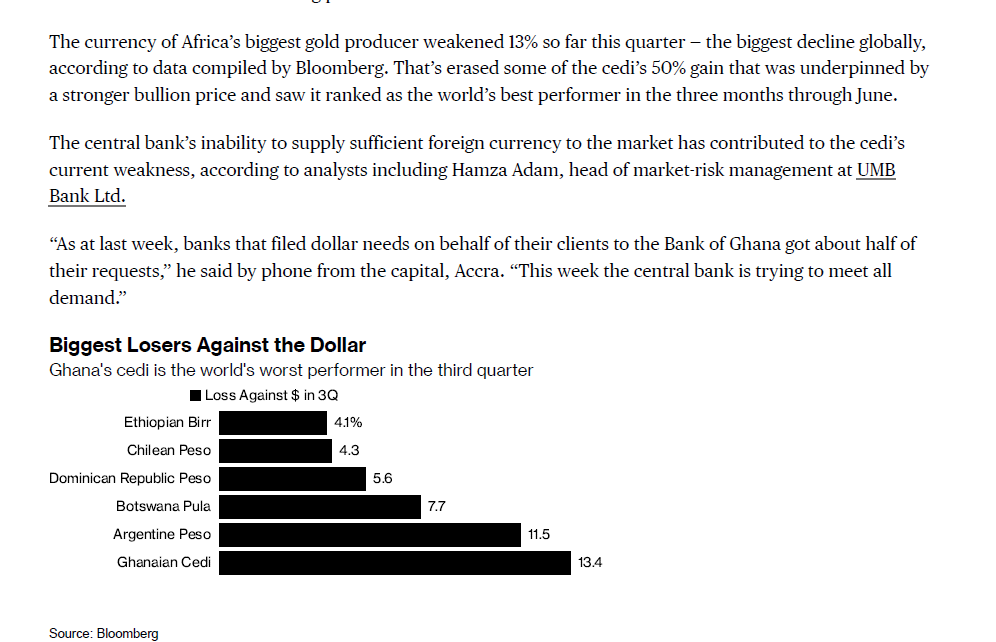
Breakdown of the cedi’s performance against the dollar:
| Year | Performance against the dollar | Rank |
| Feb. 2019 | 8.2% depreciation | Worst |
| Feb. 2020 | 3.4% appreciation | Best |
| Nov. 2021 | 4.98% depreciation | 14th among currencies with ‘worst spot returns’ |
| Aug. 2022 Dec. 2022 | 5.2% depreciation 10% appreciation | Worst Best |
| May 2023 | 5.3% appreciation | Fourth-best |
| Nov. 2024 | 27% depreciation | Fifth-worst |
| May. 2025 Sept. 2025 | 16% appreciation 13% depreciation | Best Worst |
Bloomberg’s shifting rankings highlight the volatility of the cedi and the challenges of Ghana’s economy. Within just a few years, the cedi has swung from being hailed as the ‘world’s best’ to being the worst, which shows how the currency responds to external economic shocks and fiscal imbalances.
By Nusrat Essah