

President John Dramani Mahama, on February 18, 2025, publicly presented his completed asset declaration forms to the Auditor-General, Johnson Akuamoah Asiedu, at the Jubilee House.
The President stated the act was in accordance with Article 286 of the 1992 Constitution, and Public Office Holders (Declaration of Assets and Disqualification) Act, 1998, (Act 550) highlighting that declaring assets is an effective way of tackling corruption.
“I have taken these steps of presenting these forms publicly as a way of injecting some openness and transparency to the process of asset declaration. I have always maintained that while it is all well and good to punish corruption, a more effective way of addressing the canker is preventing it from occurring in the first place. I honestly believe that if properly curated and enforced, the assets declaration process can become a sustainable tool for tackling corruption.” (1 min:17 secs to 1 minute: 43 secs)
President Mahama also instructed his appointees to declare their assets by March 31, 2025, warning that failure to comply would result in severe sanctions, including removal from office.
“I have asked the Chief of Staff to send word to all appointees to ensure that they declare their assets by the end of the first quarter of this year, that is by 31st March, 2025. I wish to stress that any appointee failing to meet this deadline will face severe sanctions, not excluding removal from office,” he stated. (2 mins: 09 secs to 2 mins: 31 secs)
The President’s action generated considerable discussions on and offline about Ghana’s asset declaration laws and their importance in promoting transparency and accountability in governance.
RelatedNews




What is an Asset Declaration?
The Ghana Anti-Corruption Coalition (GACC) defines asset declaration as “an anti-corruption tool that seeks to take inventory of the assets and liabilities of public officeholders before they take office, periodically, and after they have left office.”
It further states that: “The objective is to deter such officials from using the power and privilege of their office to enrich themselves illicitly as they would have to explain the source(s) of wealth acquired in office.”
Which Law Governs Asset Declaration?
Asset declaration in Ghana is primarily governed by Article 286 of Chapter 24 of the 1992 Constitution, and the Public Office Holders (Declaration of Assets and Disqualification) Act, 1998, (Act 550).
This law was introduced to promote transparency in public service, hold public officials accountable for unexplained wealth and prevent corruption and illicit enrichment.
Key Provisions of Article 286 of the Constitution
According to Article 286 (1) of the 1992 Constitution;
- Public officeholders must declare their assets and liabilities before taking office, every four years, and at the end of their tenure. The declaration must be submitted to the Auditor-General.
- If an official acquires assets that cannot be justified through legitimate means (e.g., salary, gifts, loans, inheritance), it is deemed unconstitutional.
- Officials who fail to declare their assets or knowingly provide false information will face consequences as per Article 287, which indicates that allegations of non-compliance are reported to the Commissioner for Human Rights and Administrative Justice (CHRAJ) for investigation. In the case of the CHRAJ Commissioner, the matter is referred to the Chief Justice.
Who is Required to Declare Assets?
Under Article 286 (5), the following public officials are required to declare their assets:
- The President of the Republic
- The Vice-President of the Republic
- The Speaker, the Deputy Speaker and Members of Parliament
- Ministers and Deputy Ministers
- Chief Justice, Justice of the Superior Court of Judicature, Chairman of a Regional Tribunal, the Commissioner for Human Rights and Administrative Justice and his Deputies and all judicial officers
- Ambassador or High Commissioner
- Secretary to the Cabinet
- Head of Ministry or government department or equivalent office in the Civil Service
- Chairman, managing director, general manager and departmental head of a public corporation or
- Company in which the State has a controlling interest; and
- Such officers in the public service and any other public institution as Parliament may prescribe.
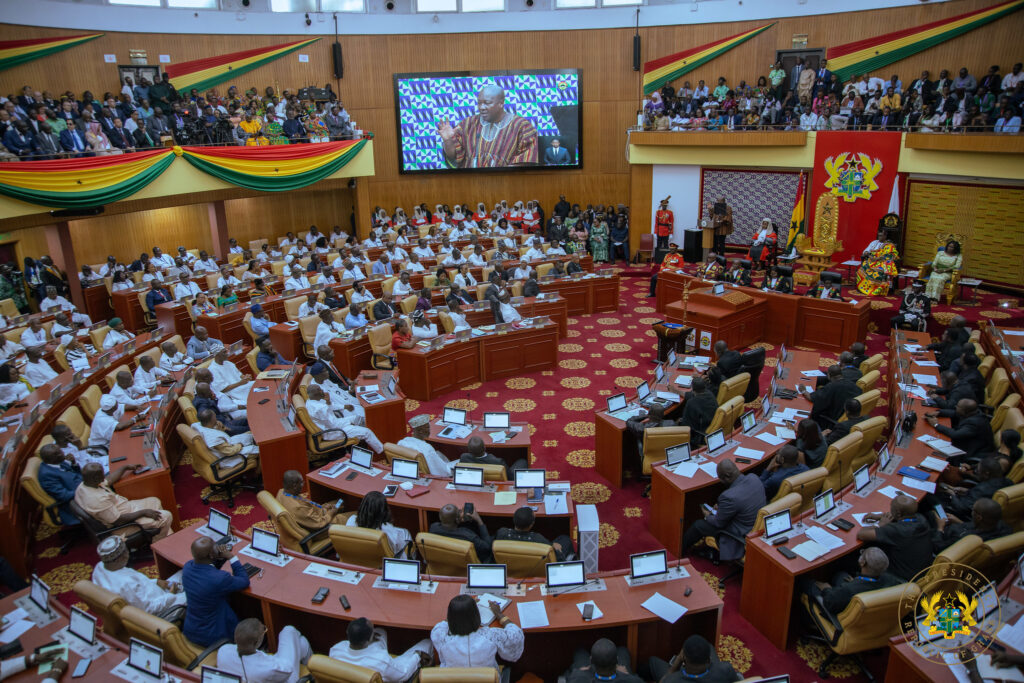
Public Reactions and Criticisms after Mahama’s declaration
The former Auditor-General, Daniel Yaw Domelevo in a discussion with Joy News commended President Mahama for declaring his assets but criticized the way it was done.
“I was not too happy seeing the envelope being given to the Auditor-General because that supports the perception that declarations are just sealed envelopes submitted without verification. Ideally, the form should have been reviewed to verify the signature and ensure proper completion,” he said.
He also questioned the March 31 deadline for appointees to submit their assets declaration, arguing that it contradicts the constitutional requirement for officials to declare their assets before assuming office.
Legal Practitioner, Martin Kpebu also raised concerns about the March 31 deadline, stating that it violates Article 286 (1) of the Constitution.
“The Constitution clearly states that asset declaration must be done before assuming office. The March 31 deadline is too long. Initially, I heard Mahama mention two weeks, which was already problematic. Now it has been extended further,” he said.
He reiterated that the six-month interval under Public Office Holders (Declaration of Assets and Disqualification) Act 550 is unconstitutional, citing Article 1 (2) of the Constitution, which states that any law inconsistent with the Constitution is void.
The National Democratic Congress (NDC) position on Asset Declaration
In their 2024 manifesto, the NDC promised to review and enforce the existing asset declaration system to enhance transparency and check corruption.
During the submission of his forms, President Mahama acknowledged concerns about the current system as stated in the manifesto, calling for reforms to strengthen Ghana’s asset declaration regime.
“I believe that we must move to a regime where the assets so declared can be published before and after public office so that the phenomenon of unexplained and overnight wealth, obviously earned through the proceeds of corruption, can be checked.”
The New Patriotic Party’s (NPP) position on Asset declaration
In their manifesto, the NPP proposed amending Article 286 and related laws to expand asset declaration to senior staff and heads of regulatory and public institutions not previously covered, and also, change the asset declaration from every four years to every two years.
“Expand Asset Declarations by public office holders to include, among others, senior staff and heads of regulatory and public institutions not previously covered, and – require asset declarations to be made, or updated, every two years, instead of every four years” the manifesto reads.
Asset Declaration Under the Previous Government
Under the Nana Addo Dankwa Akufo-Addo administration (2017 – 2025), compliance with Ghana’s asset declaration laws was inconsistent, despite Akufo-Addo himself declaring his assets on multiple occasions.
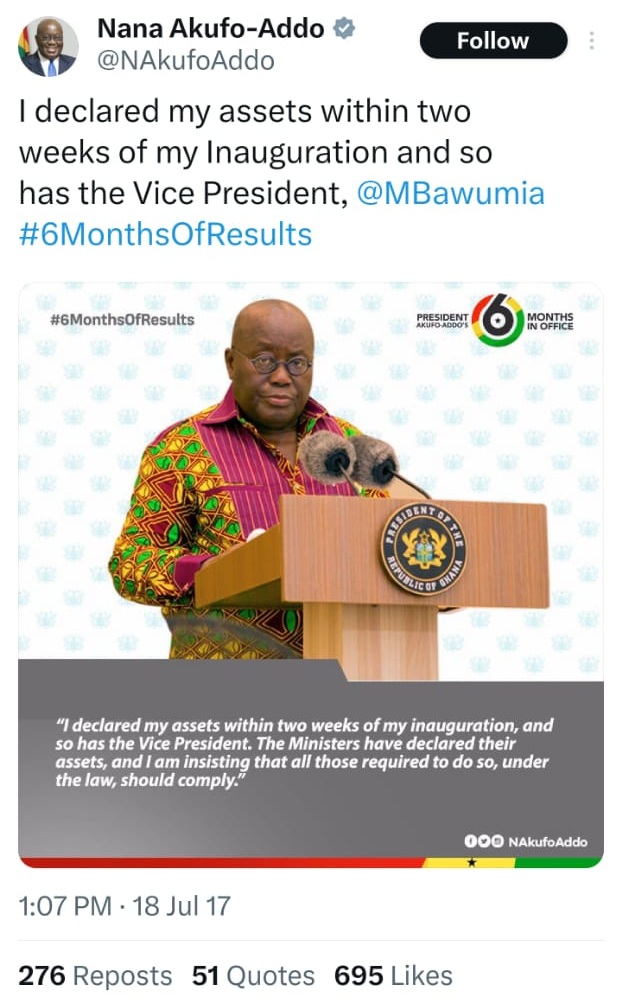
The Fourth Estate’s investigative report revealed that 27 ministers and deputy ministers failed to declare their assets throughout Akufo-Addo’s first and second term, raising concerns about transparency and accountability within his government.
The lack of compliance sparked criticism from anti-corruption advocates, who called for stricter enforcement and penalties. Critics also pointed to flaws in the assets declaration laws, particularly the lack of verification mechanisms and weak punitive measures.
Conclusion
While President Mahama’s decision to publicly announce his asset declaration has been largely welcomed, concerns about delayed deadlines, lack of immediate verification, and inconsistencies in existing laws highlight the need for urgent reforms.
The debate over Act 550 contradicting the Constitution further underscores the necessity for clarity in the legal framework.
As both NDC and NPP propose reforms, this moment presents an opportunity for Ghana to strengthen its asset declaration regime, ensuring greater transparency, accountability, and a stronger fight against corruption in public office.
By Nusrat Essah