

There is always excitement and anticipation when the Finance Minister presents the national budget to Parliament, because for many Ghanaians; it is the best avenue to find out the government’s spending plan for the coming year.
How much funding will be allocated for new roads? What will happen with education and healthcare? Will taxes increase or decrease? Which sectors will receive more attention? These are among the questions that occupy the minds of many Ghanaians. From television and radio discussions to conversations on social media, the budget becomes a major national conversation.
But beyond the announcements, the billions of cedis quoted and the promises made, have you ever stopped to ask what these figures actually mean for you and your community? More importantly, how can you tell whether the money announced in Parliament eventually reaches your district and is used for the purposes for which it was allocated?
It is easy to follow the national budget when it is being presented. The challenge is following through on disbursement after the presentation, particularly how money moves from one government institution to another before reaching the communities where its impact is expected.

The road you use every day, the public school in your neighbourhood, the market where you shop, the nearest health centre or the streetlights along your route home are some of the everyday things that public spending is expected to support. Yet, many people pay little attention to the budgets and financial records of the institutions responsible for development, especially at the local level.
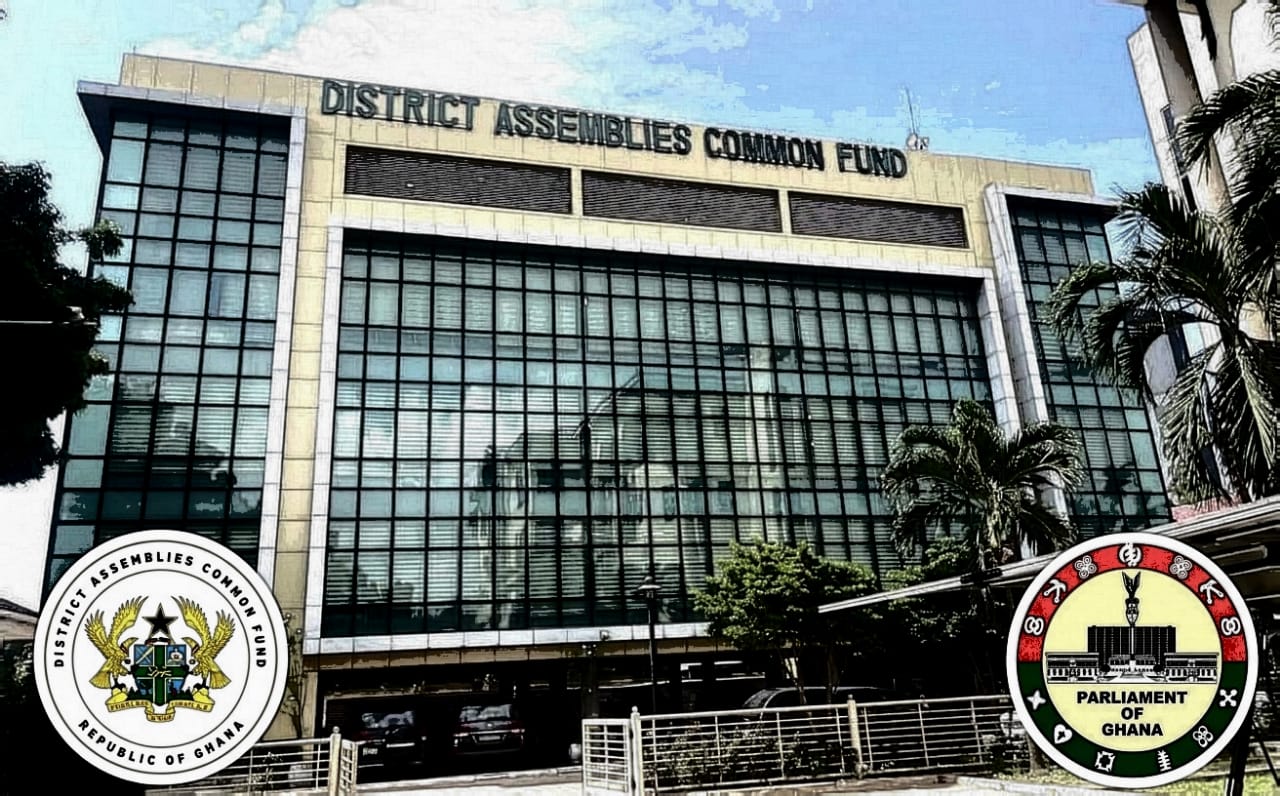
One institution you should pay particular attention to is the Metropolitan, Municipal and District Assembly (MMDA). This is because the assembly plays a central role in planning and coordinating development within your locality. It is also one of the institutions through which important public resources, including the District Assemblies Common Fund (DACF), are channelled towards local development.
RelatedNews




Understanding how these funds are allocated, disbursed, received and spent gives you the opportunity to move beyond government announcements and find out what is actually happening in your district.
Why should you pay attention to your District Assembly?
Think about the community where you live. Perhaps the road to your house is full of potholes, and it needs improvement. The nearest public school may need additional classrooms or furniture, the local market may lack adequate facilities, or your neighbourhood may require better drainage and street lighting. These are not simply local concerns. They are development issues that require planning, resources and accountability.
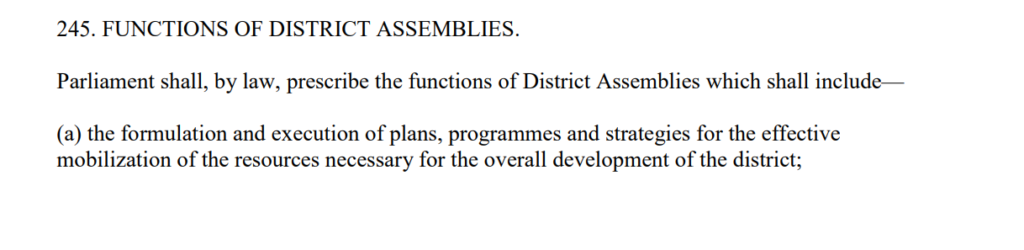
Assemblies are essentially local government structures responsible for planning and coordinating development within their respective jurisdictions (MMDAs). Article 245 of the 1992 Constitution provides for the functions of District Assemblies, including formulating and executing development plans and programmes for their districts.
This makes your assembly one of the most important public institutions to pay attention to when discussing development in your community.
You can begin by finding out what your assembly plans to do in your area, how much it has budgeted for those activities and where the money is expected to come from. You can also examine whether the projects outlined in its plans are being implemented.
The challenge is that many people know very little about their assembly’s budget, the amount of money it receives, the projects it intends to undertake or how it accounts for the resources entrusted to it. Understanding these processes is the first step towards demanding accountability.
What does the Constitution say about the District Assemblies Common Fund (DACF)?
The DACF is not simply a government initiative or a discretionary financial arrangement. It is a constitutional provision.
Article 252 of the 1992 Constitution establishes the District Assemblies Common Fund and requires Parliament to make annual provision for the allocation of not less than five per cent of Ghana’s total revenue to the District Assemblies for development.
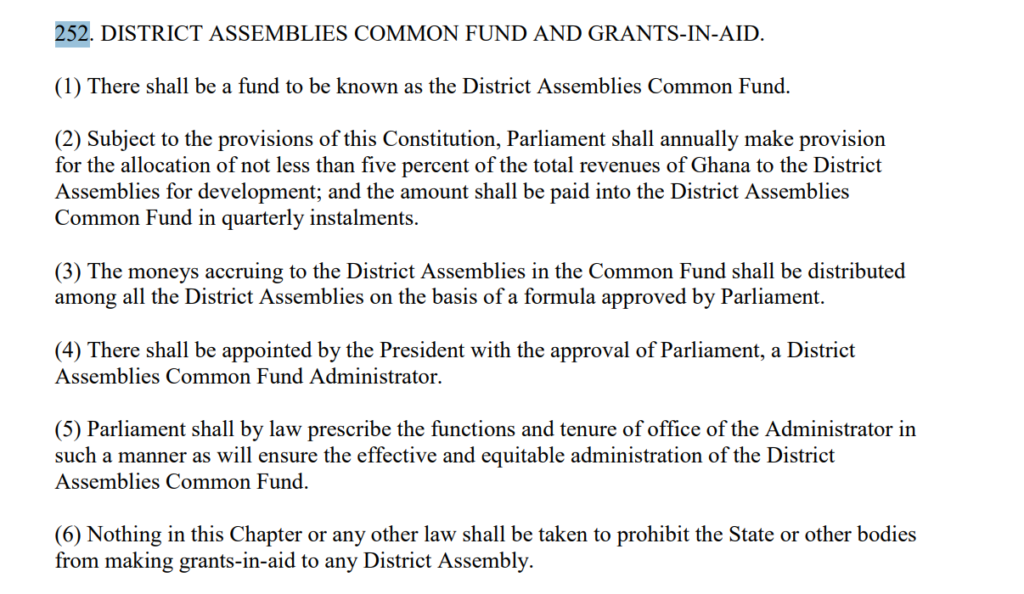
The Constitution further provides that the money must be paid into the fund in quarterly installments and distributed among all District Assemblies based on a formula approved by Parliament.
In simple terms, the Constitution guarantees a portion of national revenue for development at the district level. The intention is to ensure that assemblies have resources to address development needs within their jurisdictions.
Note that the five per cent provision is a constitutional minimum, not a guarantee that every assembly receives an equal amount. The distribution is determined by a formula approved by Parliament.
How does the money get from Parliament to your assembly?
To follow the money effectively, you must first understand the process through which it moves from the national budget to the District Assemblies. It begins with the national budget.
Under Article 179 of the 1992 Constitution, the President must cause estimates of the government’s revenue and expenditure for the following financial year to be prepared and laid before Parliament at least one month before the end of the current financial year.
This is the constitutional basis for the annual budget process. The Ministry of Finance coordinates the preparation of the budget, which outlines the government’s revenue expectations and expenditure priorities, including provisions for statutory funds such as the DACF.
After the budget is presented, Parliament considers and approves the relevant budgetary and appropriation provisions. The next stage is the approval of the DACF allocation formula.
The DACF Administrator prepares a formula explaining how the available funds should be distributed among the assemblies. The formula is submitted to Parliament for consideration and approval.
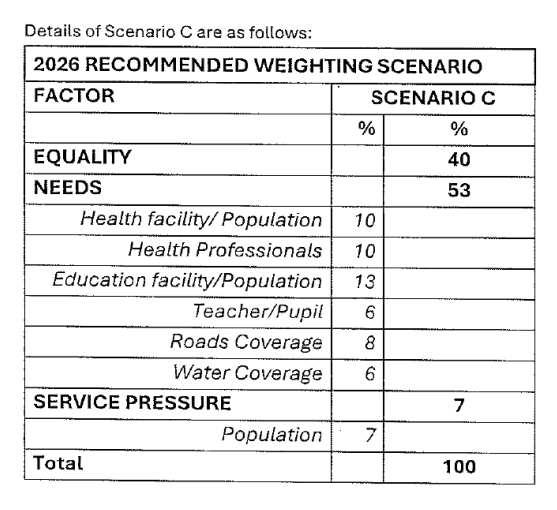
The formula uses indicators such as population, education, health facilities, water coverage and road infrastructure to determine how resources should be shared. The aim is to consider differences in development needs and the availability of facilities across districts.
For example, the 2026 DACF formula, approved by Parliament on 17 March 2026, provided for approximately GH¢8.77 billion to be distributed among Ghana’s 261 Metropolitan, Municipal and District Assemblies. Then comes the release of funds.
Following the relevant approvals, the Ministry of Finance releases money to the DACF for distribution. The DACF Administrator then oversees the distribution to the assemblies in accordance with the parliamentary-approved formula and applicable guidelines.
Once the funds are transferred to an assembly, they can be applied to approved development activities, subject to the relevant financial management and spending requirements.
However, there is an important distinction you must understand. The amount approved in the national budget is not necessarily the amount already released, and the amount released to the DACF is not automatically the amount received by your particular assembly.
For this reason, following the money requires you to examine the budget allocation, actual releases, receipts by the assembly and subsequent expenditure separately.
How can you follow the money in your district?
You do not have to be an economist, accountant or journalist to follow government allocations. Many of the documents required to understand how public funds are allocated and spent are publicly available.
The important thing is knowing where to look, what information to search for and how to use the available channels to request information when it is not readily accessible.
Let us use the Ga North Municipal Assembly as an example.
1. Start with the national budget and the DACF allocation formula
- Your first step should be to establish how much money the government planned to allocate to the DACF and how Parliament approved its distribution.
- Look out for the national budget statement, the relevant Appropriation Act and the DACF allocation formula approved by Parliament.
- The allocation formula is particularly important because it provides information on how the fund is distributed among the various assemblies.
- If you live in Ga North, for example, you should be interested in finding out how much was allocated to the Ga North Municipal Assembly for the financial year under review.
- Do not stop at the overall national allocation. Look for the specific amount assigned to your assembly.
- You can obtain information about the fund through the official District Assemblies Common Fund website and the Parliament of Ghana website.
2. Visit your assembly’s website and look for its Composite Budget
Once you establish the amount allocated to your district, the next step is to find out what your assembly intends to do with its resources. This is where the Composite Budget becomes important.
A Composite Budget provides information about the assembly’s revenue and expenditure estimates, development priorities, programmes and planned projects.
For Ga North, you can visit the official Ga North Municipal Assembly website and navigate to its Document Centre. This resource lists important documents, including the 2025-2028 Composite Budget and the 2026-2029 Composite Budget.
According to Ezra Abban, Programmes Lead associated with the Africa Center for Governance Studies (ACGS) and ACEP: “The composite budget is the assembly’s annual budget they prepare. But the annual plan reflects the projects and interventions the assembly intend to execute and it forms part of the medium term development plan”
When reviewing these documents, pay attention to the sections on the DACF, revenue projections, expenditure estimates, development programmes and proposed projects.
Look for projects that are expected to benefit your community. These could include road improvements, education infrastructure, market facilities, drainage works, sanitation projects and other infrastructure. Take note of the project’s description, estimated cost, location and proposed implementation period. These details will become useful when you begin monitoring specific projects.
3. Check the Annual Action Plan
The Composite Budget tells you about your assembly’s financial and development plans, but the Annual Action Plan helps you identify the activities and projects it intends to implement within a particular year. It is therefore another important document to examine.
For instance, the Ga North Municipal Assembly has published its 2026 Annual Action Plan on its website. If you live in Ofankor, Pokuase, Amasaman or another community within Ga North, you can examine the plan to identify projects expected to be undertaken in your area.
Do not just look at the project names. Pay attention to the proposed location, timelines, implementing department and expected outputs. This gives you something concrete to monitor.
If the assembly indicates that a particular road is scheduled for improvement, for example, you can follow up to establish whether the project commenced, whether it was completed within the proposed period and whether the work delivered corresponds with the original plan.
4. Find out how much money your assembly actually received
This is one of the most important parts of following the money. An assembly may have a budget showing that a certain amount is expected from the DACF. However, that does not automatically mean the full amount has been transferred to its accounts.
You should therefore seek information on the actual amount received during the year.
For Ga North, you can approach the Assembly’s Finance Department or Information Officer and request the DACF release and receipt records for the relevant financial year.
Specifically, you should seek information on:
- The total DACF allocation approved for the Assembly.
- The amount released by the Ministry of Finance.
- The amount actually received by the assembly.
- The dates the funds were received.
- Any outstanding amounts yet to be transferred.
It is important to distinguish between the amount released to the DACF and the amount subsequently transferred to a particular assembly.
These records help you establish whether your assembly received the resources it was expected to receive and whether there were delays or shortfalls.
5. Examine the Assembly’s Annual Budget Performance Report
After finding out what your assembly planned to do and how much money it received, the next question is whether it implemented its plans. This is where the Annual Budget Performance Report becomes useful.
The report provides information on the assembly’s budget implementation, revenue performance, expenditure and progress towards its planned activities. For Ga North, the Document Centre lists its 2025 Annual Budget Performance Report.
Compare the information in this report with the original Composite Budget and Annual Action Plan. For instance, if the assembly planned to construct a classroom block using part of its DACF allocation, find out whether the project was implemented.
If it was not implemented, was it postponed? Was there a funding shortfall? Was the project removed from the implementation plan? These are legitimate questions you can ask.
6. Look at procurement records and visit the project site
Documents are important, but you should also pay attention to what is happening on the ground.
If your assembly’s budget and action plan indicate that a particular project has been awarded or is being implemented, you can visit the location to establish its status. Look out for information such as the contractor’s name, contract sum, commencement date, expected completion date and funding source.
Where available, procurement records can provide additional details about the tendering and contract award process. The Ghana Electronic Procurement System (GHANEPS) is another resource worth exploring for relevant public procurement information.
However, do not assume that every project in your district is financed through the DACF. Some may be funded through other government programmes, grants or development partners. Establish the funding source before attributing expenditure to the Common Fund.
The objective is to compare what the records say with what is happening in your community.
What if you cannot find the information online? You can request it. One reason you may not follow public expenditure is the assumption that obtaining government financial information requires special connections or access to public officials.
This should not be the case.
Ghana’s Right to Information Act, 2019 (Act 989), provides you with a legal avenue to access information held by public institutions.
Article 21(1)(f) of the 1992 Constitution also guarantees the right to information, subject to the qualifications and laws necessary to protect the public interest and the rights of others. Under the RTI Act, you can request information held by a public institution without necessarily providing a reason for the request. If you cannot find information about DACF allocations, releases, project expenditure or other relevant documents on your assembly’s website, you can formally request them.
How do you make an RTI request?
The process is relatively straightforward.
First, identify the public institution that holds the information. If you want information about the funds received and expenditure by Ga North, for example, your request should be directed to the Ga North Municipal Assembly. Address your application to the Information Officer.
Clearly describe the information you are requesting. Avoid making a general request such as “I want information about the DACF.” Instead, specify the financial year, the documents and the particular details you need.
For example, you may request:
- The approved DACF allocation for the assembly for 2025 or 2026.
- Copies of DACF release and receipt records for the relevant year.
- A breakdown of DACF expenditure by project.
- Details of projects financed through the DACF, including their locations, contract sums and implementation status.
- Copies of relevant procurement and contract award records.
- Financial statements and audit reports relating to the assembly’s expenditure.
Your application should include your name, an address through which the institution can communicate with you, identification and the preferred format in which you want the information.
You can request to inspect the records or receive electronic or hard copies. The Ministry of Finance also provides guidance on the RTI application process through its Right to Information page.
An RTI application may be made in writing. The Act also makes provision for assistance where you are unable to prepare the application because of illiteracy or a disability.
Under Section 23 of the RTI Act 989, an Information Officer is generally required to make a decision on an application within 14 days of receiving it. Where access is refused, the institution must communicate the reasons and the relevant legal provisions.
If you are dissatisfied with the decision, you can seek an internal review from the head of the institution within 30 days. You may subsequently apply to the Right to Information Commission for a review.
It is important to keep a copy of your application and retain any acknowledgement or correspondence you receive.
How do you know whether the money was properly accounted for?
Receiving the information is only part of the process. You must also learn how to interpret the documents and compare them with what is happening in your community.
Suppose the Ga North Municipal Assembly’s records indicate that a particular amount was received from the DACF for development projects.
You can investigate how much was spent, which projects received funding and whether the expenditure is supported by relevant records. This is where the assembly’s financial statements, expenditure returns, procurement records and audit reports become useful.
The Auditor-General is constitutionally mandated under Article 253 to audit the accounts of District Assemblies annually and submit audit reports to Parliament.
These reports can reveal issues identified during the audit of public accounts, including unsupported expenditure, procurement irregularities, outstanding payments and other financial management concerns.
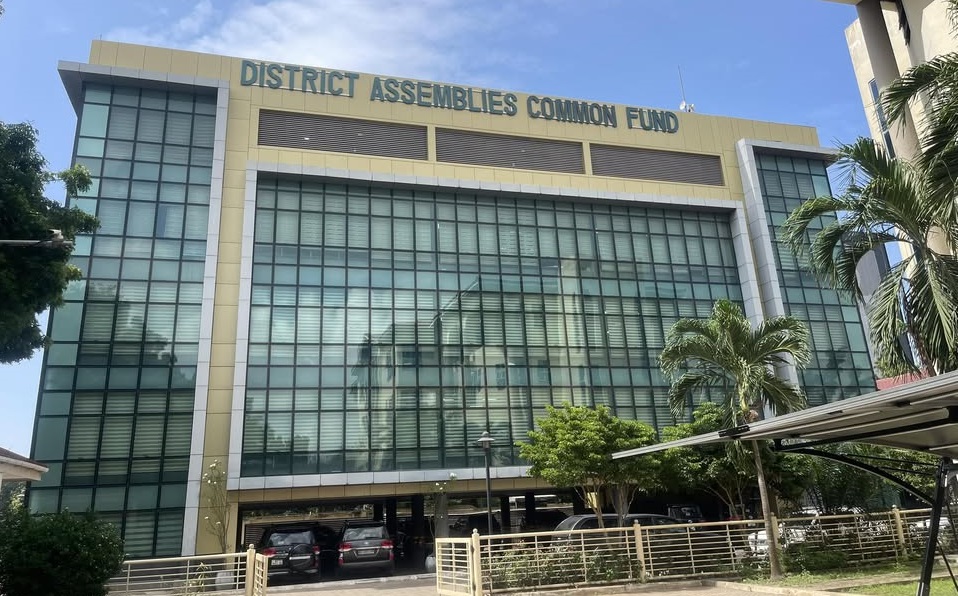
You can access relevant reports through the Ghana Audit Service and examine the findings relating to your assembly. If an audit report identifies an issue involving your assembly, pay attention to the recommendations and whether the institution has taken steps to address the findings.
It is important, however, not to treat every audit observation as proof of fraud or misappropriation. An audit finding must be understood in its proper context, and the institution concerned should have an opportunity to respond.
What questions should you be asking your assembly?
Following the money should not end with downloading documents. You should be willing to engage the institutions responsible for managing public resources.
Through community meetings, engagement with your Assembly Member, public hearings and formal information requests, you can seek answers to questions such as:
1. How much was allocated to my assembly from the DACF for the financial year?
2. How much of the allocation has actually been received?
3. Which projects were selected to benefit my community?
4. How much was budgeted and spent on each project?
5. Which contractors were awarded the projects, and what were the contract amounts?
6. What are the commencement and expected completion dates?
7. If a project has not been implemented, what explains the delay?
8. Are there outstanding audit findings relating to the use of the funds?
9. What steps has the assembly taken to address the findings?
These are legitimate questions you can ask as someone whose community is expected to benefit from public spending.
You can also attend public hearings organised by your assembly during the preparation of its development plans and budgets. These engagements provide an opportunity to understand the priorities being considered and make your own contributions.
You do not have to wait until a project is abandoned or a financial irregularity is reported before engaging your assembly.
Your district deserves your attention
The national budget will always attract attention because of the size of the figures and the policies announced. But the true impact of public spending is often felt much closer to home.
You experience it when children have access to better classrooms, when you can use improved roads, when traders have better market facilities, when communities have functional health facilities and when neighbourhoods benefit from adequate drainage and street lighting.
These developments do not happen simply because billions of cedis have been announced in Parliament. They require planning, funding, implementation and proper accountability. Your responsibility as a citizen should therefore go beyond listening to budget presentations. You can pay attention to what happens after the announcements.
Know your assembly. Read its budget. Examine its action plan. Find out how much money it receives. Monitor the projects in your community and ask questions when the information does not add up. You do not have to wait until an election year to demand answers about development in your community.
The national budget tells you what the government intends to do with public resources. Following the money to your district helps you establish what those intentions actually mean for your life and the development of your community.
After all, the money allocated to your district is not just another figure in a government document. It represents resources intended to support the development of the community you call home.
Written by Samuel Adjetey Adjei