

Artificial Intelligence or AI has become a topical issue in recent years, with different schools of thought either lamenting its dangers, applauding the ease it presents for everyday activities, or cautioning about the two-edged sword that it is.
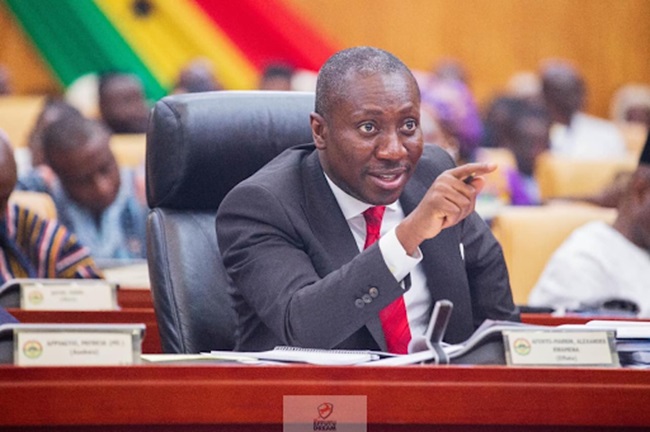
In recent months, AI has been positively projected in public by top Ghanaian public officials, including the President, the Chief Justice, and the Minister for Finance.
From building systems at the ports to empanelling Justices of the Supreme Court, and helping with Ghana’s tax administration systems, the admission to the potential of AI in the public space gives credence to the urgent need for an AI policy as soon as possible.
In this article, GhanaFact will explore the public pronouncements about Artificial Intelligence, Ghana’s journey towards a policy on AI, and some of the known pitfalls that AI presents, especially in the area of information disorder.
President hails AI system at Tema Port
President John Dramani Mahama, speaking at the official commissioning of the $1.5 billion Tema Port Expansion Project, said the state-of-the-art artificial intelligence (AI) system now running Tema Port was developed by students from the University of Ghana, Legon, following a challenge posed by Meridian Port Services (MPS) executive, Mohamed Samara.
President Mahama added that the locally developed AI algorithm enables faster and more predictable operations at the port.
RelatedNews




“The AI algorithm that this port uses was developed by young Ghanaians. Algorithms show it how to manage the containers and make everything predictable so that work goes on faster,” he stated.
“This port is not just about infrastructure; it is about people, innovation, and opportunity. Young Ghanaians are running the algorithm that makes this port efficient,” the President added.
Chief Justice on AI’s role in judicial administration
During his vetting as Chief Justice nominee before Parliament’s Appointment Committee, Justice Paul Baffoe-Bonnie was asked about how he would ensure equitable assigning of cases in the Supreme Court, given the caseload and number of Justices.
After speaking to the existing format of empanelling Justices based on their seniority (years served at the apex court), the Chief Justice hinted that AI could also be employed to play a role – “We should be able to consider AI to do that.”
“I am not very AI but I know that those who know about AI tell me that, if you are able to feed the computer or AI with information about judges, their philosophies and everything, the AI should be able to do the empaneling, based (I mean based upon) the I information that we have fed it with … I think it is done elsewhere, so we can try it,” he added.
AI captured in the 2026 budget
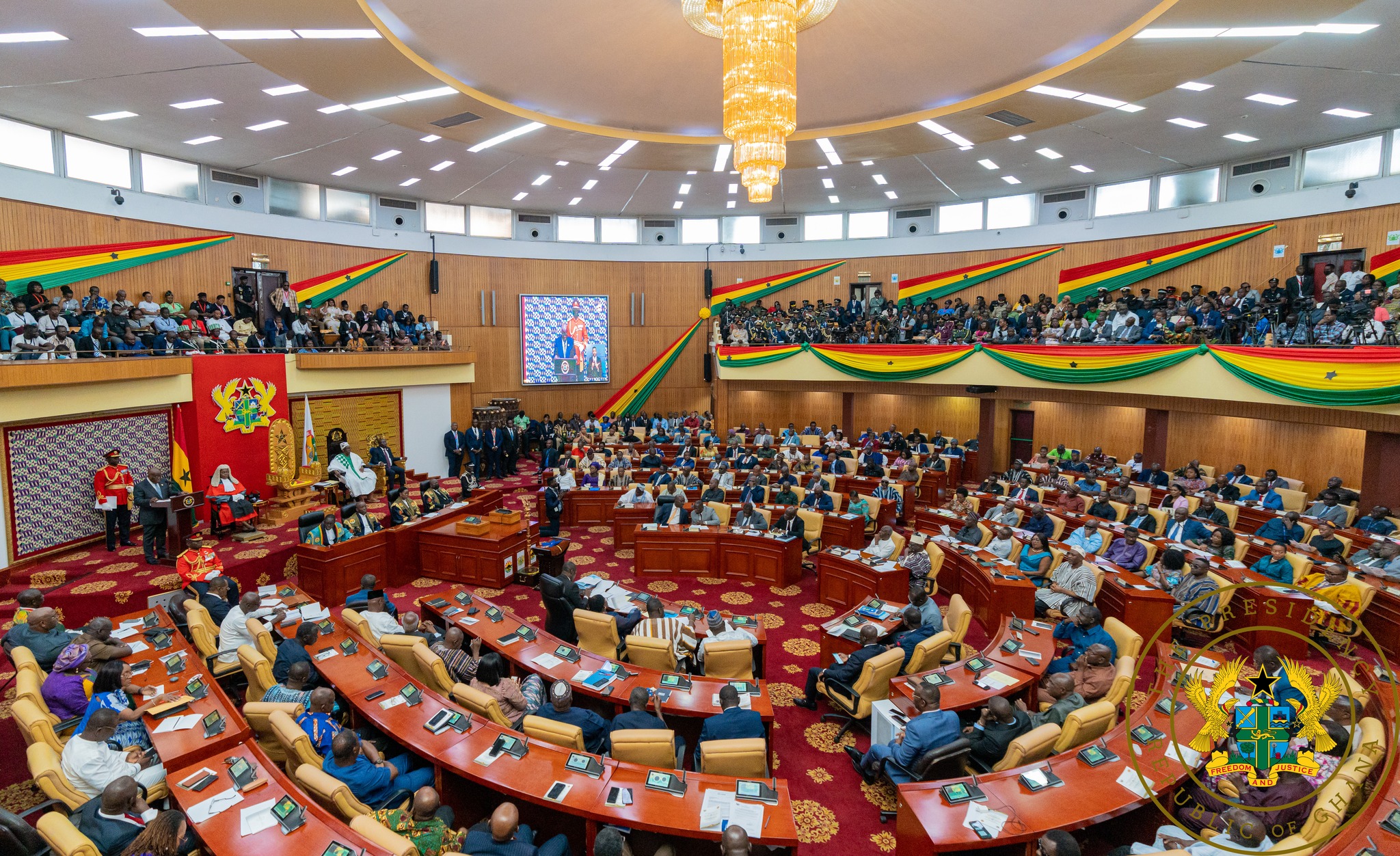
In the 2026 budget presented to Parliament on November 13, 2025, AI appeared on a range of issues. From being a theme for the 2025 Civil Service Week celebration, bilateral agreements on AI cooperation, and the incorporation of AI in school curriculum, as well as its role in the management of cross-border shipments.
The relevant portions as captured in the budget were as follows:
344. Mr Speaker, in accordance with Section 88 of the Civil Service Act, 1993 (PNDCL 327), the Office successfully organised the 2025 Civil Service Week and 2024 Awards Ceremony under the theme “Adapting to Automation, Artificial Intelligence, and E-Governance: The Civil Service in Contemporary Ghana.”
371. Further engagements with China yielded new agreements on Artificial Intelligence cooperation, Belt and Road Initiative projects, and a US$30 million grant for digital infrastructure.
552. In 2026, (the) Government will overhaul the basic school curriculum from kindergarten to primary six to equip learners with practical skills in moral integrity, electronics, robotics, coding, and artificial intelligence, preparing them for the modern economy.
694. The Ghana Statistical Service is also leading the preparation of the third National Strategy for the Development of Statistics, NSDS3, for 2026–2030. This is our blueprint for a modern, coordinated, and well-financed national statistical system that tracks our national priorities and the SDGs, among others. The strategy will scale the use of modern technology, including artificial intelligence, strengthen administrative data across MDAs, and deliver faster, cheaper, more granular statistics by region, district, gender, age, and disability.
825. To tackle this, (the) Government will deploy Artificial Intelligence (AI)-driven pre-arrival inspections for all cross-border shipments. This technology will detect under-valuation, flag high-risk goods, and strengthen Customs’ capacity to combat smuggling, improve safety, and protect national security.
Does Ghana have an AI policy yet?
Ghana does have an AI document known as the National AI Strategy of 2023. This strategy is anchored on eight broad pillars as contained in the visualisation below:

In May 2025, the Communications and Digital Innovations Minister, Sam Nartey George, launched the National AI Strategy Stakeholder Consultation Forum, whose focus was to help Ghana’s commitment to effective use of AI be harnessed and tracked.
“Artificial Intelligence is no longer a future concept. It is here, and it is already reshaping our world”, the Minister said.

What are some risks associated with AI
The National AI strategy document highlights some major risks associated with AI, stating thus: “the opportunities of AI are connected with substantial ethical and societal risks, including bias, discrimination and lack of transparency & explainability in algorithmic outcomes, widening inequality gaps, cybersecurity, privacy and safety concerns, and gaps in inclusion and data governance.”
- AI systems can widen already existing inequalities and exclusion, for example, gaps in digital inclusion in rural areas and other demographic groups.
- Data collection challenges – Model bias and algorithmic bias can occur in data and models from foreign contexts that do not fit Ghana’s context.
- Data privacy concerns and platform transparency – Personal data is vulnerable to violations of privacy or security during data collection, sharing, processing, and storage.
- Information disorder – AI-generated realistic text, audio, and video (‘deep fakes’) and personalised disinformation campaigns can manipulate, persuade, and deceive citizens.
- Employment dilemma – The AI economy can provide both job opportunities and losses across skill levels
The document stressed that “it is imperative for Ghana to ensure a responsible, inclusive and sustainable AI ecosystem. As much as AI wields positive transformative power, it has the potential to infringe on human rights and lead to biased decision-making and misuse of data.”
“To this end, data governance and policy are key to driving Ghana’s AI ecosystem while mitigating its many risks,” it stressed.
Researched by Alfa Shaban