
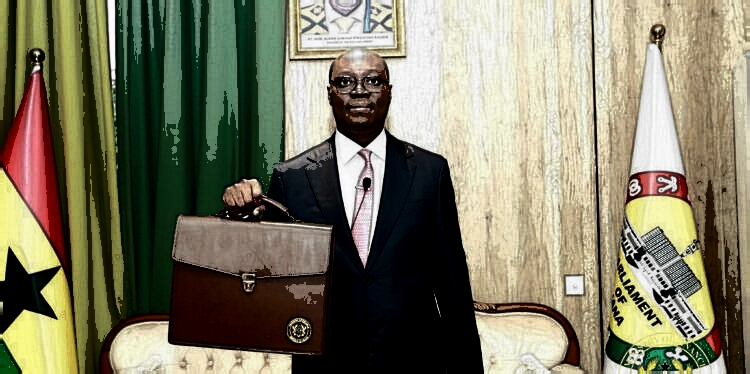

The Minister of Finance, Cassiel Ato Forson, today, November 12, 2026, is presenting the 2027 Budget Statement and Economic Policy of the John Dramani Mahama-led administration to Parliament.
The presentation is expected to outline the administration’s next line of action in terms of public spending for 2027 as he lays out what the much-touted New Economy of the government entails.
Earlier in July 2026, Ato Forson presented the mid-year budget review, highlighting, among other things, key economic indicators like inflation, gross international reserves and exchange rate performance for the first half of the 2026 fiscal year.
You can read our live fact-check of the mid-year budget review here.
This fact-check report seeks to verify claims from the minister’s presentation of the 2027 budget.
Claim 1:
By the end of 2022, inflation rose to 54.1%. Primary balance stood at a deficit of 4.3% of GDP. The Gross International Reserves had fallen to less than 3 weeks of import cover.
RelatedNews


Fact-Check
Data from GSS confirmed that: “Year-on-year inflation rate for December 2022 was 54.1%.” However, BoG’s Monetary Policy Committee report released in January 2023, stated: “At the end of December 2022, the stock of Gross International Reserves stood at US$6.2 billion (equivalent to 2.7 months of import cover).”
The claim on inflation is true, while that of the months of import cover is False.
Verdict: Therefore, the claim is a mixture.
Claim 2:
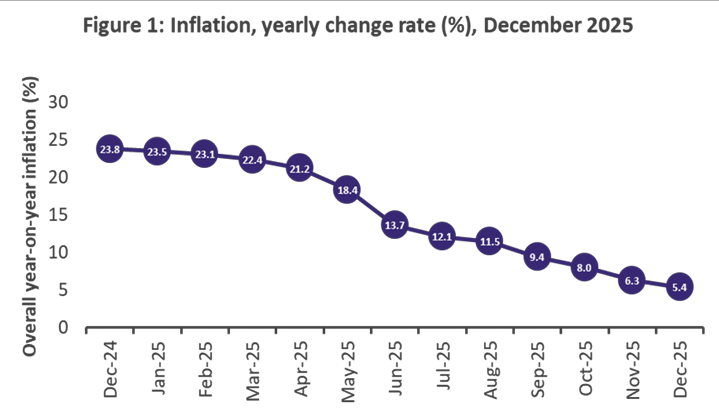
By end of 2025, inflation had fallen from 23.8% to 5.4%
Fact-check
According to data from GSS, the inflation rate at the end of December 2025 was 5.4% falling from 23.8% by end of December 2024.
Verdict: Therefore, the claim is True
Claim 3:
By the end of 2025, Public debt had fallen to 44.7% of GDP, and gross international reserves had risen to 5.7 months of import cover
Fact-check
According to the Annual Public Debt Report for the 2025 financial year published in March 2026, “The public debt-to-GDP ratio declined sharply to 44.7 percent at end-December 2025, from 61.6 percent in 2024.”
Also the BOG’s Monetary Policy Committee released in January 2026 states that, “Gross International Reserves increased to US$13.8 billion, equivalent to 5.7 months of import cover, at end-December 2025.”
Verdict:
Therefore, the claim is True.
Claim 4:
Agriculture accounts for about 20% of Ghana’s economy and accounts for almost 40% of employment and nearly 25% of export earnings.
Fact-check
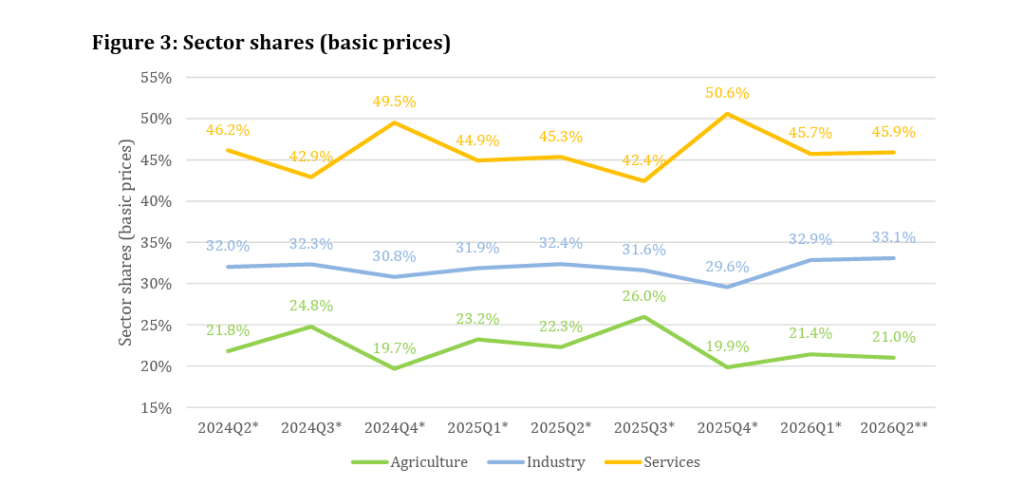
According to the Ghana Statistical Service (GSS) STATISTICAL NEWSLETTER: GROSS DOMESTIC PRODUCT SECOND QUARTER 2026 (April to June) published in September 2026, agriculture accounted for 21% of Real GDP.
“The Services sector continues to be the largest sector of the Ghanaian economy in Q2 2026 with a share of 45.9 percent of GDP at basic prices. The GDP shares of Industry and Agriculture were 33.1 percent and 21.0 percent, respectively,” the report read in part (page 4).
Verdict:
The claim that agriculture accounts for about 20% of Ghana’s economy is True.
The New Economy programme – Key components
“The New Economy is the Government of Ghana’s four-year programme to transform the structure of the Ghanaian economy,” Minister Ato Forson stated.
- It is the Government of Ghana’s four-year programme, beginning in 2027, to confront structural weaknesses and transform the structure of our economy.
- It will expand production, process more resources at home and turn our nation’s wealth into decent jobs, higher incomes and lasting prosperity.
- Over a four-year period, from 2027 to 2030, the Government will spend US$10 billion to create a modern Ghanaian economy for jobs and prosperity.
The Programme has eight connected pillars:
i. macroeconomic stability and affordable finance;
ii. commercial agriculture;
iii. energy infrastructure;
iv. critical minerals value addition;
v. tourism, culture and creative arts;
vi. textiles and garments;
vii. pharmaceuticals and biomanufacturing; and
viii. the technology economy.
Claim 5:
“By the end of 2022… the IMF debt sustainability analysis put our debt at over 100 percent of GDP.”
Fact-check
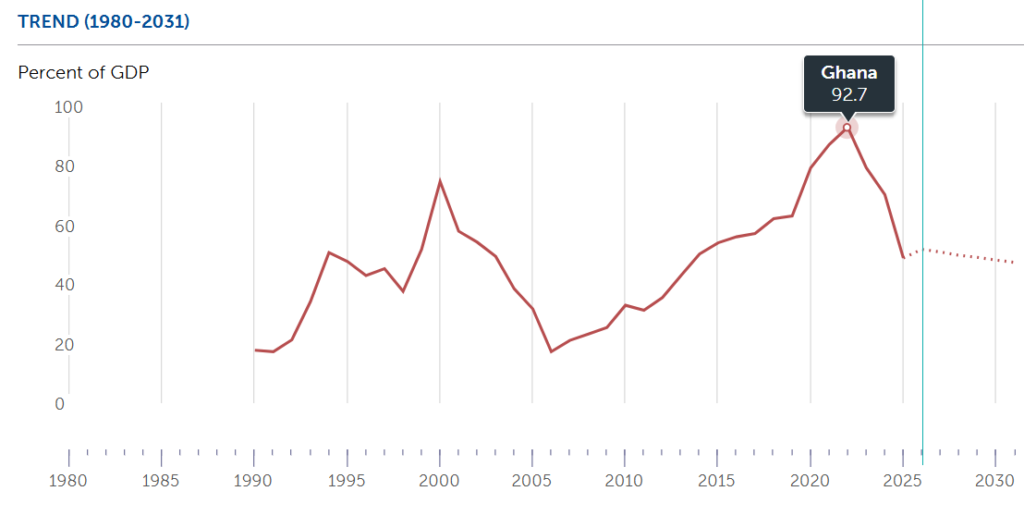
The IMF’s 2025 Debt Sustainability Analysis document confirmed that the debt-to-GDP ratio did not go over 100 in 2022. It read in part: “The large fiscal deficits and the economic slowdown in the wake of the pandemic led to an increase in public debt from 63 percent of GDP in 2019 to 92.7 percent of GDP at end-2022, of which 16 percent of GDP held by the Bank of Ghana.”
Our checks from the IMF’s live data dashboard also confirmed the 92.7% figure. GhanaFact also noted that the claim that debt-to-GDP exceeded 100% in 2022 has been restated multiple times by the Minister of Finance.
Verdict:
The claim that the IMF put Ghana’s debt-to-GDP ratio exceeded 100% in 2022 is False.
Claim 6:
Real GDP grew by 6.2 percent in the first half of 2026, compared with the 2026 growth target of 4.8 percent.
Fact-check
The Bank of Ghana’s September 2026 MPC release stated; “In the domestic economy, growth remained strong in the second quarter of 2026. Real GDP growth was 6.0 percent, driven mainly by the services and industry sectors, but slightly lower than the 6.6 percent recorded in the same quarter of 2025.”
Verdict:
Therefore the claim is partly true.