

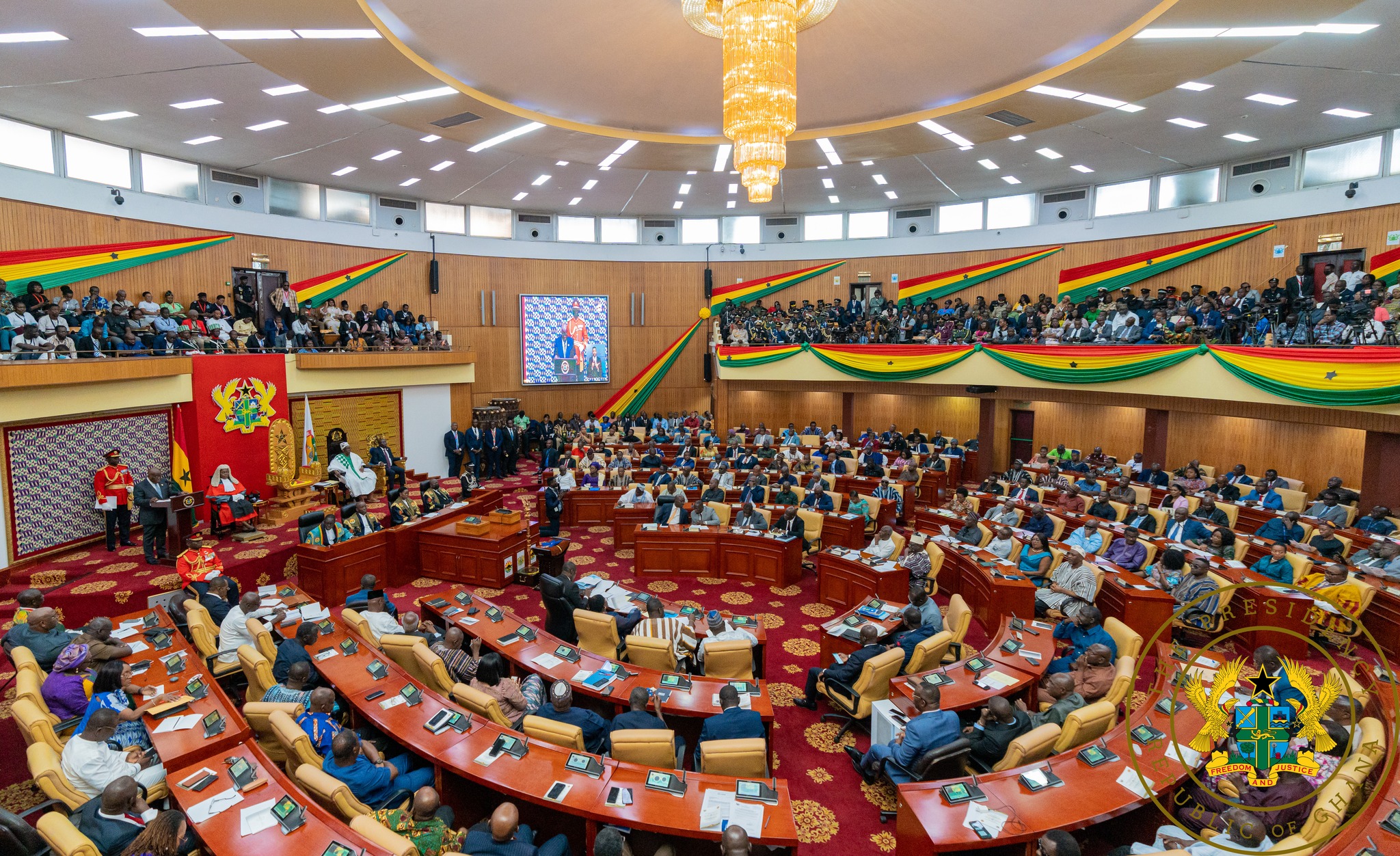
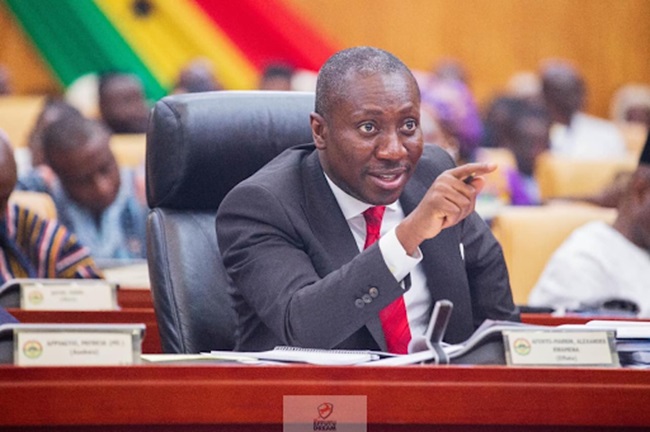
Minister for Finance, Cassiel Ato Forson, is presenting a mid-year review of the 2025 budget and economic policy statement he presented to Parliament in March 2025.
In the 2025 budget, Ato Forson presented the first fiscal action plans of the John Mahama-led government across all aspects of the economy, including 19 major allocations for, among others, the Big Push, Free SHS, Capitation Grant, Road Fund, NHIS and the District Assemblies Common Fund (DACF).
You can read our live fact-check of the 2025 budget here.
Between March and now, the local currency has gained considerable ground against the US dollar, inflation has dropped, and international reserves have been growing steadily.
This report is a live fact-check of claims in the minister’s presentation.
Claim 1: Ghana cedi used to trade at 17 cedis under the previous government
“I am happy to inform the House that our previous record, where the Ghana cedi used to trade against the US dollar at 17, is as at yesterday trading at 10.4. Similarly, the Ghana cedi which was once trading at 21 cedis to the British pound was trading at 14.1 as at yesterday, July 23, 2025.”
RelatedNews


Fact-check
In verifying the claim, GhanaFact reviewed historical interbank foreign exchange rates from the Bank of Ghana (BoG) and media reports.
According to official records from the BoG’s Historical Interbank Foreign Exchange Rates, the cedi never reached GH¢17 per dollar. The highest recorded interbank rate during the last government was GH¢16.4200, on November 6, 2024.
GhanaFact noted that the cedi-to-dollar rate reached GH¢16.1 on October 23, 2024, and peaked at GH¢16.4200 on November 6, 2024.
The minister’s figures on the current rate of the US dollar and British Pound are, however, true per the BoG’s data.
The claim that the dollar reached 17 cedis previously is False.
Verdict
Therefore, the claim is rated mixture because it has some element true and another element false.
Claim 2:
“Inflation has reduced significantly from 23.8% at the end of 2024 to 13.7% at the end of June 2025.”
Fact-check
According to the Consumer Price Index (CPI) of the Ghana Statistical Service (GSS), the inflation rate as of June 2025 was 13.7%
“The year-on-year inflation rate as measured by the CPI was 13.7 percent in June 2025 (Figure 1). This rate of inflation for June 2025 is the percentage change in the Consumer Price Index (CPI) over the twelve-month period, from June 2024 to June 2025. The monthly change rate for June 2025 is -1.2 percent.”
Verdict: True
Claim 3:
“Gross International reserves have significantly improved. Mr. Speaker, the Bank of Ghana accumulated 11.1 billion US dollars covering 4.8 months of imports at the end of June 2025.”
Fact-check
According to Bank of Ghana’s Monetary Policy Committee (MPC) press statement on July 18, 2025, “Gross international reserves improved to US$11.1 billion as at end-June 2025, equivalent to 4.8 months of import cover, from US$8.9 billion at end-2024.”

Verdict:
True
Claim 4:
Consumer Price Inflation (CPI) reduced from 23.8% in December 2024 to 13.7 in June 2025. Producer Price Inflation (PP1) declined from 26.1% to 5.9 in June 2025
Fact-check:
According to the Ghana Statistical Service, the CP1 for June 2025 stood at 13.7% compared to 23.8% in December 2024. The PP1 in June 2025 stood at 5.9% compared to 26.1% in December 2024
Verdict:
True
Claim 5:
Food inflation declined from 27.8% in December 2024 to 16.3% in June 2025 representing an encouraging 11.5% point reduction. Non food inflation also declined from 20.3 % in December 2024 to 11.4 in June 2025, representing 8.9 percentage point reduction.
Fact-check:
According to the Consumer Price Index from the GSS, “The Food and Non-alcoholic beverages inflation rate recorded a year-on-year inflation rate of 16.3 percent in June 2025 (see table 2). The Non-Food group recorded a year-on-year inflation rate of 11.4 percent in June 2025.”

Verdict:
True
Claim 6:
“We inherited a cocoa sector with a liability of 32bn cedis”
Fact-check
In March 2025, the Finance Ministry published a presentation by the minister in which the indebtedness of COCOBOD was captured. Under the heading of ‘COCOBOD’s Extra-Budgetary Spending & Fiscal Risks,’ the minister stated: “Total debt of GHS32.5 billion, of which GHS9.7 billion is due to be paid at the end of September 2025.”
The Acting Chief Executive Officer of COCOBOD, Dr Randy Abbey, in an interview with JoyNews on June 5, 2025, mentioned that the Cocoa sector has a debt of almost GH¢33 billion.
“The last time I checked, that debt was close to GH¢33 billion,” he disclosed. “I have to redo it now because the dollar components might go down as a result of the strength of the Cedi now. But that is the situation,” he said.
Before the statement by the Acting CEO of COCOBOD, the immediate past Chief Executive Officer of the Ghana Cocoa Board (COCOBOD), Joseph Boahen Aidoo, in April 2025, had justified the GH¢32.5 billion debt.
According to him, it was a strategic measure that prevented Ghana’s cocoa sector from collapsing.
Verdict
The claim is True.
Claim 7:
“Many micro, small and medium enterprises collapsed under the weight of economic mismanagement. To compound all these, the country suffered credit rating downgrades by all three major credit rating agencies, placing Ghana firmly in default or junk territory.”
Fact-check
GhanaFact will refer to the publication of Finely, a credit rating agency (CRA) company that assesses the creditworthiness of borrowers, such as corporations or governments, and assigns a credit rating to their debt instruments, like bonds.
According to the credit rating agency, Ghana’s creditworthiness has traditionally been rated by three top global agencies- Standard and Poors, Fitch and Moody’s.
By the end of 2024, the three agencies (all in October 2024) had indeed downgraded Ghana’s ratings as follows.
| Credit Rating Agency | Standard and Poors | Moody’s | Fitch |
| Rating as at end of 2024 | SD (Selective Default) | Caa2 | RD (Restricted Default) |
Bonds are categorised as investment grade if they receive ratings of BBB- or higher from S&P and Fitch, or Baa3 or higher from Moody’s. Bonds falling below these thresholds are classified as non-investment grade or “junk”. All three verdicts indeed fall within the junk category of the different rating agencies.
Verdict:
The claim that Ghana was in junk territory of all three CRA is True.