

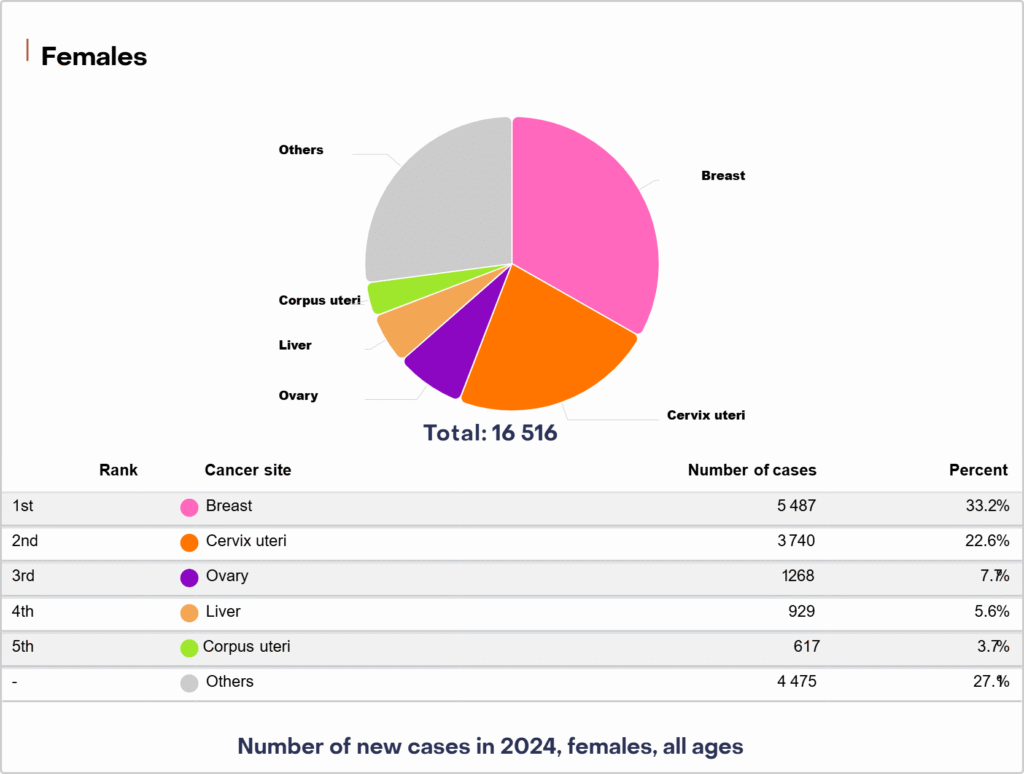
World Health Organisation (WHO) data shows that 2.4 million women, as of 2024, were diagnosed with breast cancer worldwide, 694,000 women died from the disease, and 8.2 million women were living with breast cancer at the end of the year.
Breast Cancer was the most common cancer in women in 164 countries out of 186 in 2024. In Ghana, it ranks top in terms of cancer cases and deaths, with an estimated 5,487 women living with the disease while 2,695 die from it.
Pink October
Pink October is a month dedicated to raising breast cancer awareness. Breast cancer is the world’s second-leading cancer. This year’s awareness campaign is under the theme “Every story is unique, every journey matters.”
Pink October is an annual global commemoration that helps to increase attention and support for awareness, early diagnosis, and treatment as well as palliative care for women facing this disease (see here, here.)
Breast society of Ghana president speaks
GhanaFact spoke to the President of the Breast Society of Ghana, Prof. Josephine Nsaful, a general surgeon with a special interest in breast cancer, about the growing rate of the disease and the challenges, including misinformation and stigmatisation.
“The most common cancer in women in Ghana, and it seems like every year the numbers keep increasing. We are way over 5,000 new cases diagnosed, and we are also far over 2000 deaths in a year, so that is quite serious. And when you compare the incidence and the test to other developed countries, you find that we have twice the death rate.
RelatedNews




“Let’s say America; they actually have double the number of cases of cancer. So they have more cancer and fewer deaths. We have less cancer but more deaths. In advanced countries, they pick it up early because of breast screening.
“In those countries, they use mammograms for breast screening. From age 40, it is compulsory that everybody gets their mammogram done. But in Ghana, we don’t have a national breast screening program. We don’t have enough mammograms,” she said.
Despite the limitation with screening, “We are trying to educate ourselves about breast screening. In Ghana, for breast screening, we don’t have mammograms everywhere. We focus more on clinical breast examination. That is when a doctor or nurse checks your breast. But obviously, the machines are more sensitive than the fingers. So we just need you to do breast screening and present early,” she added.
Breast cancers and impact of stigmatisation
Regarding the impact of misinformation and stigmatisation on the effort to prevent breast cancer, Prof. Nsaful said, “Some people even have early breast cancer, but they are afraid to come to the hospital for whatever reason. Eventually, when they come, it is too late. People have all sorts of funny ideas, that it’s not a disease for hospitals.
“They will rather use herbs or other alternative treatments or pray about it, and then come to us, and it’s too late. Some people are just afraid of the treatment because they say that if you remove your breast, you will die. If you are dying, it’s not because you remove your breast.
“It is the situation of reporting late. People don’t want to talk about it. The fact that they’ve been diagnosed with breast cancer because of how people in our community will behave. So they’d rather keep quiet about it,” she added.
What is breast cancer?
Breast cancer occurs when abnormal cells in the breast grow out of control and form tumours. It is a global condition that occurs in women at any age after puberty, but with increasing rates in later life.
Risk factors of breast cancer
According to WHO, approximately 99% of breast cancers occur in women, and 0.5–1% of breast cancers occur in men. Risk factors include:
- Age
- Obesity
- Family history of breast cancer
- History of radiation exposure
- Reproductive history (such as age that menstrual periods began and age at first pregnancy)
- Harmful use of alcohol
- Tobacco use
- Postmenopausal hormone therapy.
To reduce the risk of breast cancer,
- Maintain a healthy weight
- Stay physically active
- Avoid harmful use of alcohol
- breastfeeding
- Quit tobacco use and avoid exposure to tobacco smoke
- Avoid the prolonged use of hormones
- Avoid excessive exposure to radiation
Symptoms of Breast Cancer
Breast cancer can have combinations of symptoms, especially when it is more advanced. Symptoms of breast cancer can include:
- A breast lump or thickening, often without pain
- Change in size, shape or appearance of the breast
- Dimpling, redness, pitting or other changes in the skin
- Change in nipple appearance or the skin surrounding the nipple (areola)
- Abnormal or bloody fluid from the nipple.
Myth busters
We asked Prof. Nsaful about some myths surrounding breast cancer and its prevention.
- Does breast cancer affect only women?
“By and large, women have a significant risk of getting breast cancer compared to men because, obviously, we have big breasts. Men have some very, very small breasts, but it’s still breast tissue all the same, so they can get breast cancer.
“So you find that about 1-2% of all breast cancer patients tend to be men. So it’s not as common in men, but it certainly happens, and it presents in the same way; they also get a lump, and all those kinds of things, and the treatment is the same.”
- Breastfeeding prevents breast cancer
“When you are breastfeeding a baby, it causes a change in the female hormones and in the cycle, and it’s this female hormone, estrogen in particular, that puts us at risk of getting breast cancer. So research has shown that the more you produce breast milk, the lower your risk, so it actually lowers your risk or lowers your chance of getting breast cancer. It is not 100%.
“We are not saying that if you breastfeed, by all means you won’t get breast cancer. It’s been shown to lower your risk. So we encourage women to breastfeed their babies for as long as possible; you can breastfeed for 1 to 3 years. It has been shown to reduce your risk of getting breast cancer.”
- Partners massaging and sucking the breast prevents breast cancer
“A man sucking or massaging your breast doesn’t have anything to do with breast cancer. It does not prevent breast cancer. It doesn’t cause breast cancer. So it’s really not of any consequence.
“People have just capitalised on October Breast Cancer Awareness Month and are sexualizing the whole thing and making fun of it, but it is absolutely not true.”
Researched by Gifty Tracy Aminu