

Digital misinformation is an everyday challenge that must be addressed continuously. As social media continues to shape how people access and share information, the need to fact-check false information and to provide Media and Information Literacy (MIL) has become undeniable.
In this series, GhanaFact documents eight instances in which public institutions debunked false information that social media users have targeted them with.
National Service Authority
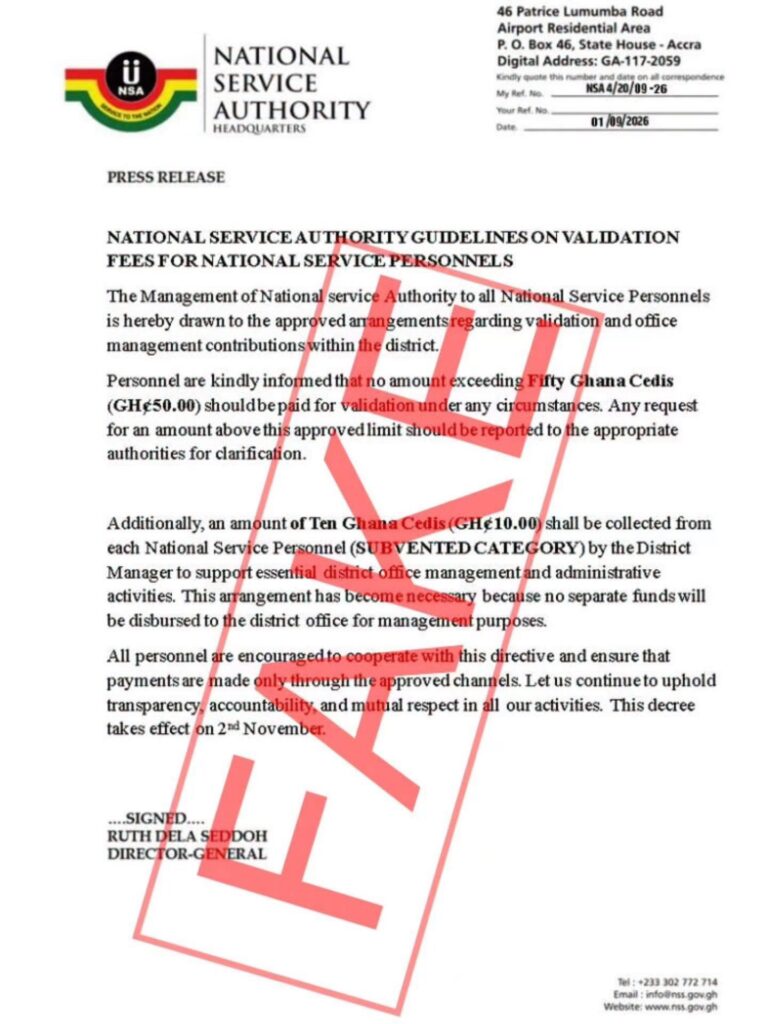
On September 1, 2026, a supposed press release from the National Service Authority (NSA) circulated on social media, alleging a directive for personnel to pay GH¢50 for validation and GH¢10 to the district manager to support essential district office management and administrative activities.
The National Service Authority via its X and Facebook pages debunked the claims. The NSA clarified that the letter did not originate from them and cautioned personnel not to make any payment.
Bank of Ghana
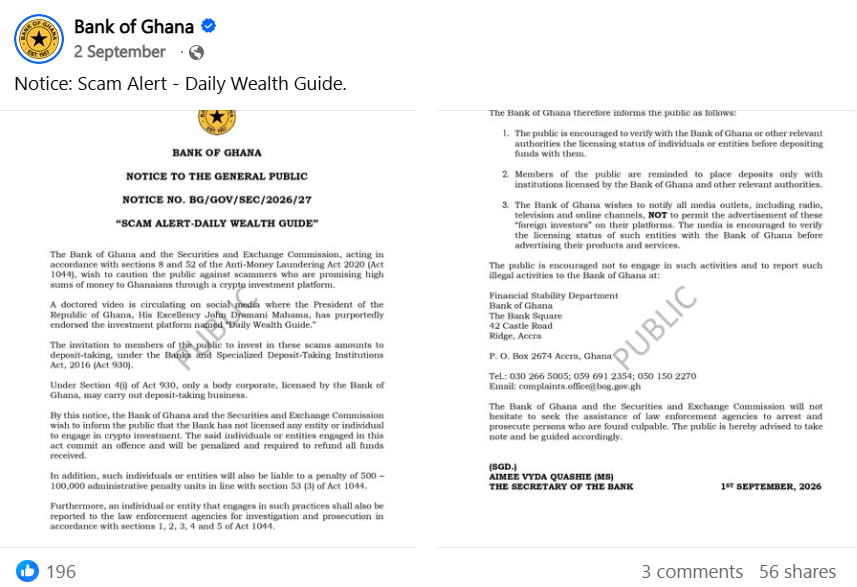
On September 2, 2026, the Bank of Ghana (BOG) and Securities and Exchange Commission (SEC) issued a disclaimer on Facebook and X warning against a fraudulent crypto investment platform named “Daily Wealth Guide.”
According to BoG, a doctored video falsely portraying President Mahama endorsing the platform circulated on social media with the platform promising Ghanaians high returns through crypto investment but that the platform was not licensed to provide such services. The central bank advised the public against depositing their funds with Daily Wealth Guide, also reminding the public “to place deposits only with institutions licensed by the Bank of Ghana and other relevant authorities.”
RelatedNews



“The Bank of Ghana wishes to notify all media outlets, including radio, televisions and online channels NOT to permit the advertisement of these foreign investors on their platforms,” the statement said, adding that the licensing status of such organizations should always be verified with the BoG before their adverts are carried out.
GoldBod
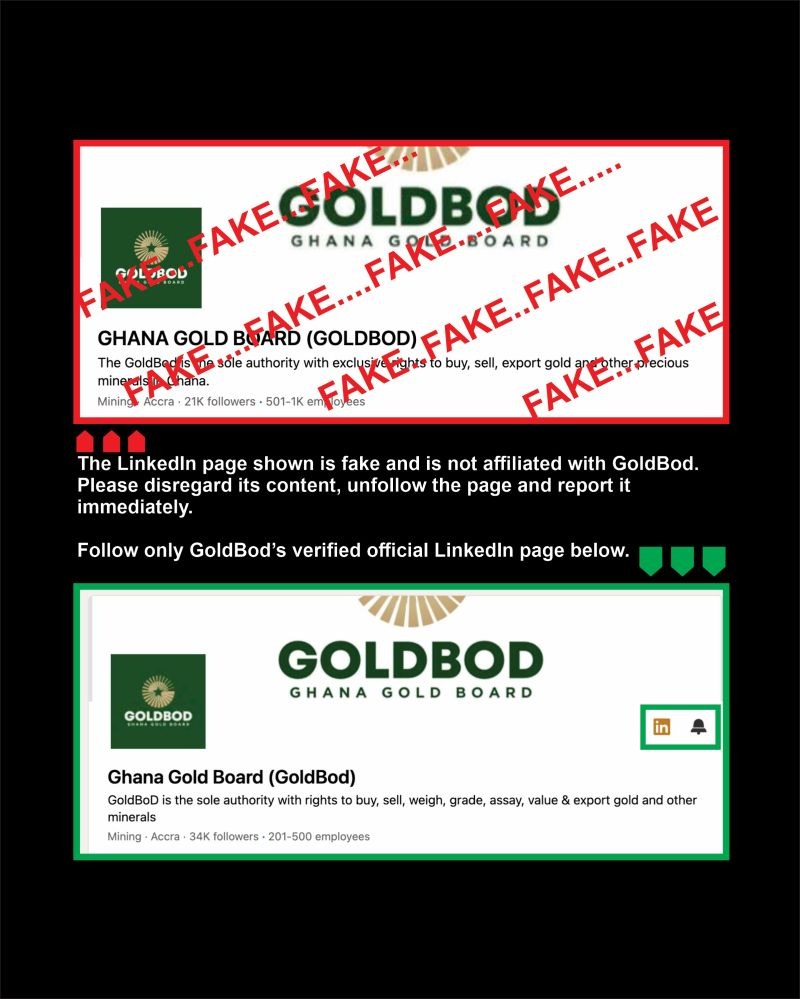
On September 3, 2026, Ghana Gold Board (GoldBod) alerted the public through its LinkedIn, X, Instagram and Facebook pages about a fake LinkedIn page purporting to be its official account.
GhanaFact also investigated the fake page and identified two key details: the impersonating page was not verified, and its LinkedIn URL had “bod” spelt as “board.” The page had amassed 24K followers. GoldBod advised that the page be unfollowed and its content disregarded.
Ghana Teacher Licensure Examination
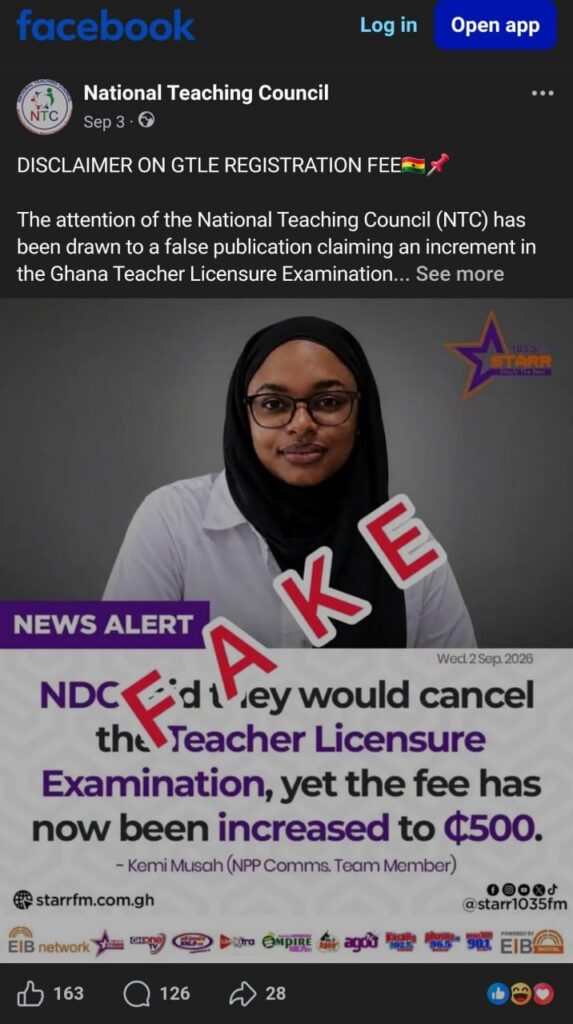
On September 3, 2026, the National Teaching Council (NTC) issued a disclaimer on Facebook in response to claims by a member of the New Patriotic Party (NPP) Kemi Musah, that the Ghana Teacher Licensure Examination (GTLE) fees had been increased.
Social media posts, here, here had also amplified the GHOne flyer that carried the claim.
In its disclaimer, the Council clarified that “NTC wishes to state that the GTLE fee still remains GH¢500 (GH¢450 for Registration and GH¢50 for Indexing), same as it has been since 2023. There has been no increment. The general public is therefore advised to disregard any publication that says otherwise.”
Ghana Revenue Authority
Quote cards on social media about a new directive from the Ghana Revenue Authority (GRA) claimed that items bought overseas as gifts for family members were subject to customs duties. These posts were made on Facebook (448 likes, 738 comments, 67 shares), Instagram (1 share, 8 comments), X (10.6K views, 7 likes, 1 comment, 2 reposts).
On September 3, 2026, GRA clarified the claims on its X page, explaining that travelling to Ghana with more than two phones does not automatically attract customs duty. Customs considers whether the items are for personal use or commercial purposes. The GRA also encouraged individuals to declare items and seek guidance from Customs when in doubt.
This clarification became necessary after GRA Customs Commissioner Aaron Kanor said, “You, as an individual, are entitled to one [phone]. So we implore that when you are coming home, you do not collect people’s things. If you collect them and they are beyond two, one individual can only carry two.”
Ghana Education Service
2026 WAASCE Results & BECE/ SHS Placement
The Ministry of Education issued a press release on September 7, 2026, cautioning the public about a fake communique with the Ministry’s letterhead.
The said communique claimed the WASSCE and BECE results had been released, and provided a link for members of the public to check results, it also included a WhatsApp contact for parents and students who needed assistance.
Manipulated CSSPS Placement Results
Two days later on September 9, the Ministry issued another disclaimer warning about fake and manipulated CSSPS placement results. The Ministry stated some individuals manipulated and digitally altered the Computerised School Selection and Placement System (CSSPS) slips and circulated them on social media as the originals.
The concerns emerged amid SHS school placement challenges after the release of BECE results on September 4, 2026. Following the release, many parents and students raised concerns about not being placed in a school or program of their choice.
Some also claimed that errors in their gender records in the system affected their eligibility for preferred single sex schools, amongst many concerns. To address these concerns, resolution centres were set up, attracting many parents and students seeking assistance ahead of the September 18, 2026 reopening date.
Ghana Health Service
On September 17, 2026, the Ghana Health Service (GHS) published a disclaimer on its Facebook and Instagram pages, cautioning the public about a flyer purporting to facilitate “GHS Staff Vehicle Ownership Programme.”
The flyer featured images and prices of various vehicles and listed Global Vehicle Sales and Leasing as the company involved.
Ghana Electricity Company (ECG)
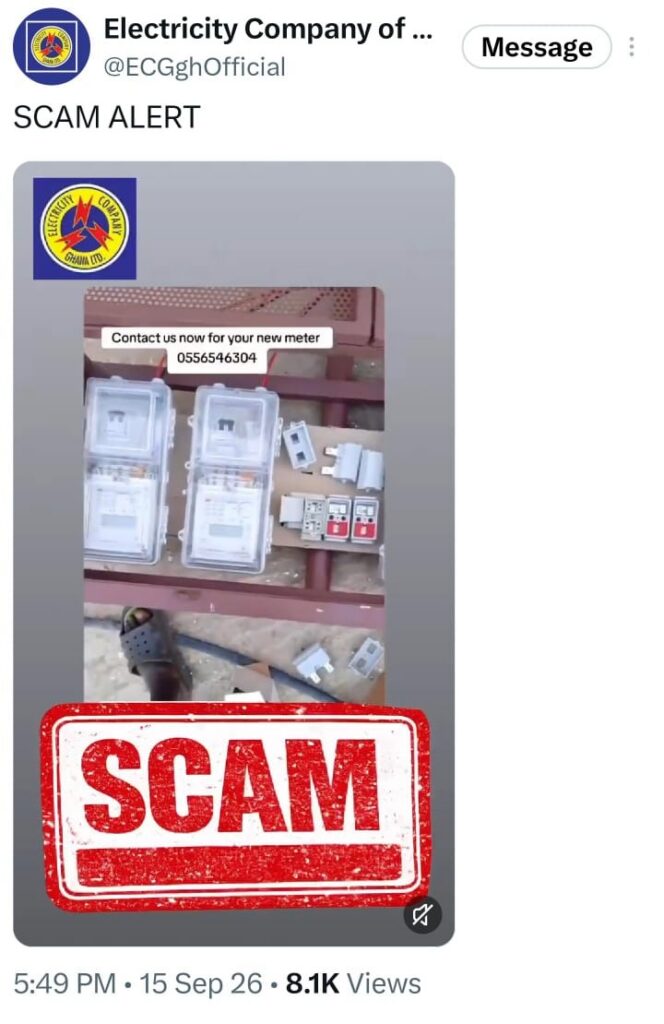
On September 15, 2026, the ECG through its X and Facebook pages alerted the public about a scam alert relative to a video circulating on social media, advertising the sale of new electricity meters alongside a contact number for interested buyers.
In the video, the individuals spoke in Twi and stated that customers are required to pay a GH¢100 registration fee for the service.
Conclusion
With eight public institutions having reason to actively combat misinformation and disinformation about their operations, it is evident that such occurrences highlight the continued targeting of these institutions and the need for the public to verify information through official channels before sharing.