
On most street corners in major towns, beyond the familiar sight of MobileMoney operators in their kiosks or the billboards of private businesses competing for space in these overcrowded spots, you would likely find that often overlooked business entity that offers nutrition and employment, yet contributes to Accra’s waste disposal crisis.
Coconut is a source of healthy nutrition – its water and fruit – and it provides employment for the 100s of vendors across the city – either those stationed at vantage points or those roaming with wheelbarrows filled with their wares.
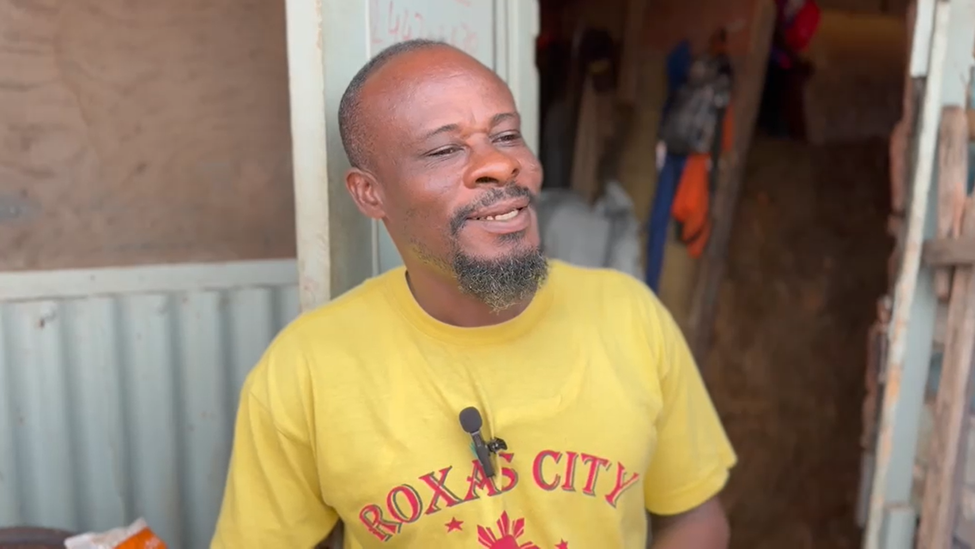
“My name is Ato Kwakye, I have been in this coconut business for the last few years, with all its ups and downs, it is profitable. One of the main challenges I have faced over the years is disposing off the outer fruit skin after serving customers. Imagine selling 100 fruits daily and having to deal with the refuse that is produced,” he told this reporter.
Ato says he has to pay refuse collectors to help move the heaps that he gathers weekly, sometimes every two weeks.
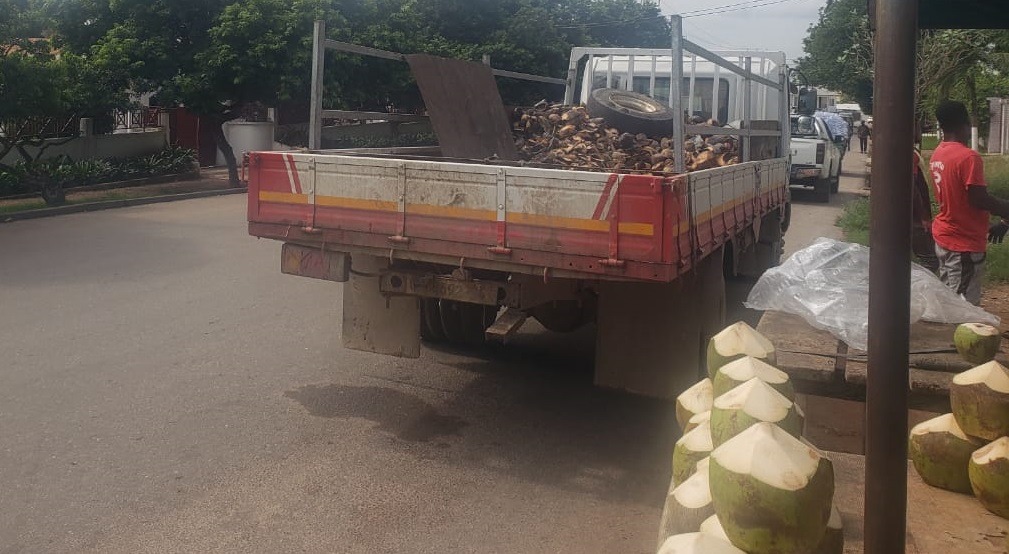
“This adds to the cost of doing business, the coconut heaps are often seen as unhygienic especially when they stay for long, so the option sometimes is to pack them neatly in sacks till the refuse collectors are ready to collect them,” Ato added.
A capital battling a waste disposal crisis
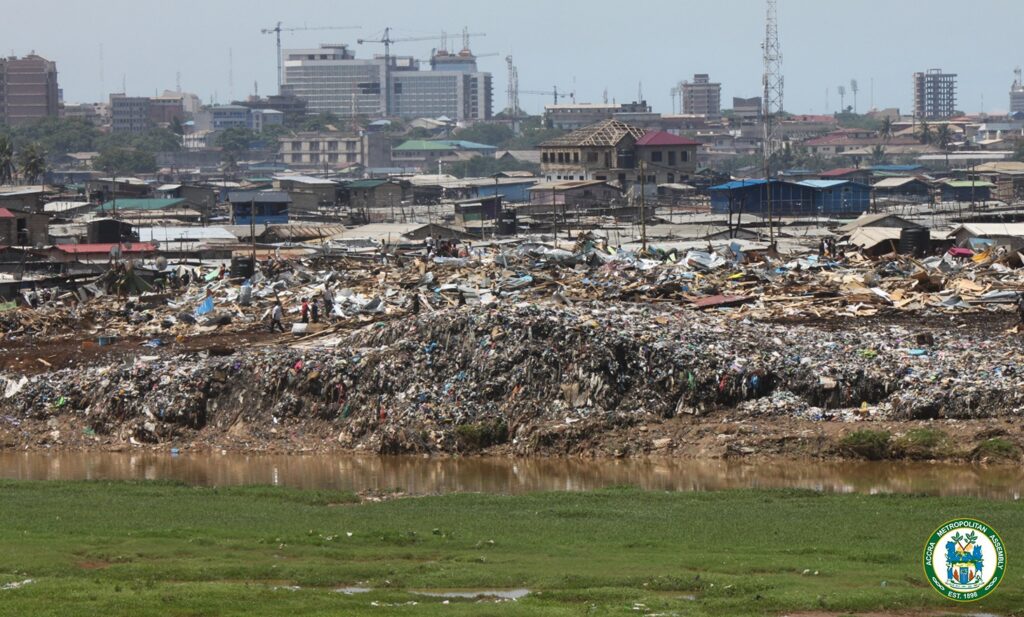
Waste like the coconut outer fruit skin and the shell which are the main residue discarded after sale of coconut contribute to the overall waste crisis that Accra specifically and Ghana generally grapples with daily.
RelatedNews




The Greater Accra Region alone according to statistics generates between 5,000 – 5,500 tonnes of solid waste daily, a quantity that could fill up to one meter high of an entire area of two and half stadia. Most of the waste generated is organic, which means they are components that can decompose like the coconut fruit skin. Other waste components include plastics, metals and glass as well as paper.
Even as the capital grapples with its waste crisis, the Accra Metropolitan Assembly (AMA) recently launched a Waste Optimisation Strategy, as part of efforts “to drive source separation, composting, and climate action.”
Ato, the coconut vendor, told us: “I admit that coconut waste likely contributes to every dumpsite across the country. It is evident that coconut is sold everywhere even if you take Accra alone.” Asked if he had thought through any possible ways of transforming the coconut waste, Ato responded in the negative, slapping his sharp cutlass on a small heap of waste.
Key facts to know:
· Ghana is the 12th largest producer of coconut globally, number one producer in Africa.
· Production has increased from 504,363 in 2022 to about 600,000 MT in 2025
· Total area under cultivation in 2025 covered 90,000 hectares.
· Coconut is cultivated actively in 11 out of 16 regions in Ghana.
· In 2021, Ghana exported over 41 million kg of coconut valued at US$11.4 million.
Source: Dr. Peter Boamah Otokunor, Director of Presidential Initiatives in Agriculture and Agribusiness
An SME transforming waste to wealth
But even as the landfill sites are the first place you would likely find coconut waste, some of this waste finds its ways to a factory, Tigasco Enterprise, located at Liberio in the Ablekuma Central Municipality of the Greater Accra Region.
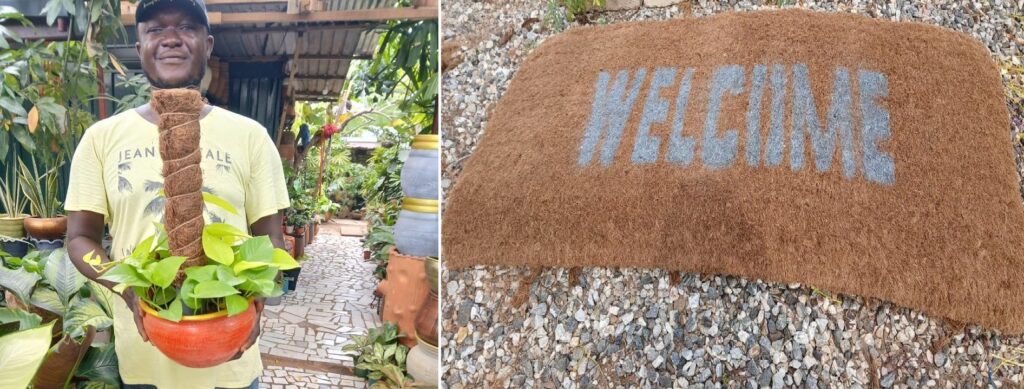
Tigasco, is a Small and Medium Enterprise (SME) founded specifically to transform coconut waste into household items such as doormats, brushes, pith and bio digesters.
CEO of Tigasco Enterprise, David Yartey Tetteh speaks about what motivated him to start an enterprise dedicated to transforming coconut waste. “We grew up learning how to generate coconut fiber crudely and using it to make door mats. Years later, I thought that we could scale up that skill so we assembled a machine locally to help us extract fiber from coconut waste for onward use into household items and other by-products.”
He tells us that at Tigasco, the utility of fiber is principally for making doormats, cleaning brushes and biodigesters. The pith from the crushing stage of the waste is also sold to farmers on demand. David points out that elsewhere fiber is used to make roads and car seats among others.
The fiber and pith extraction process
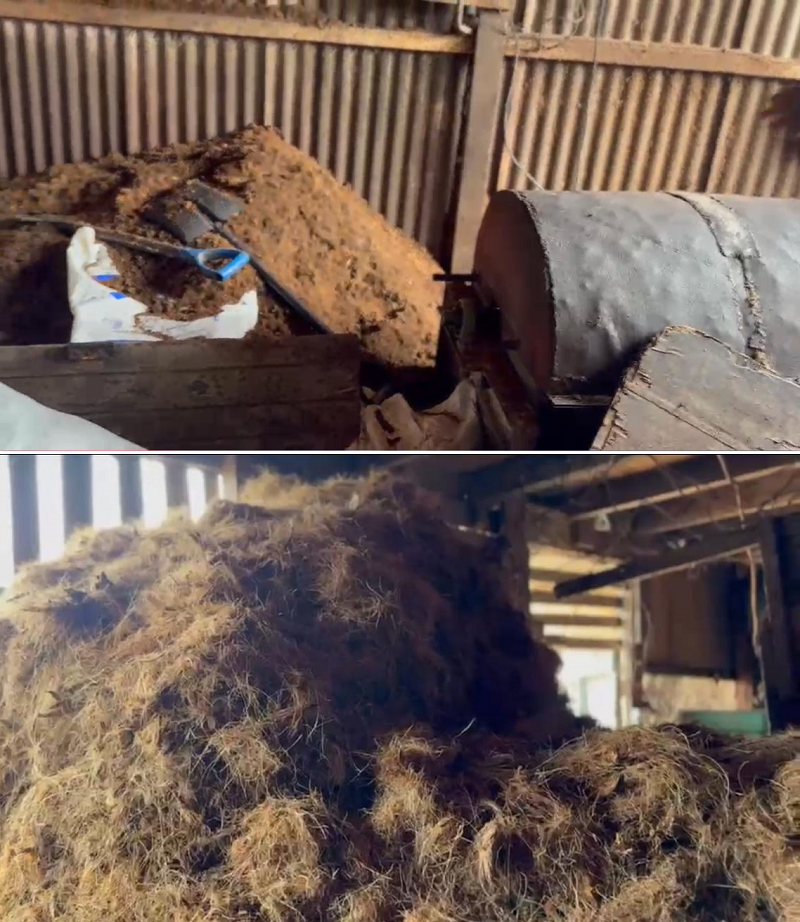
Tigasco’s commercial manager, Frederick Ganvoh, walked us through the process of producing the coconut fiber in the single unit factory divided into two areas. In the mechanical area, there is the waste crusher and defibering machine that extracts the pith from the fiber while the fabrication workshop at the other end caters for the finished products.
“The defibering machines separates the pith, which is the main binding agent of the coconut from the fiber. So when it separates it, the pith goes through some chemical reaction before they are processed for the market and then the fiber which is used for bio digester is used to produce doormats for households and institutions,” Frederick said.
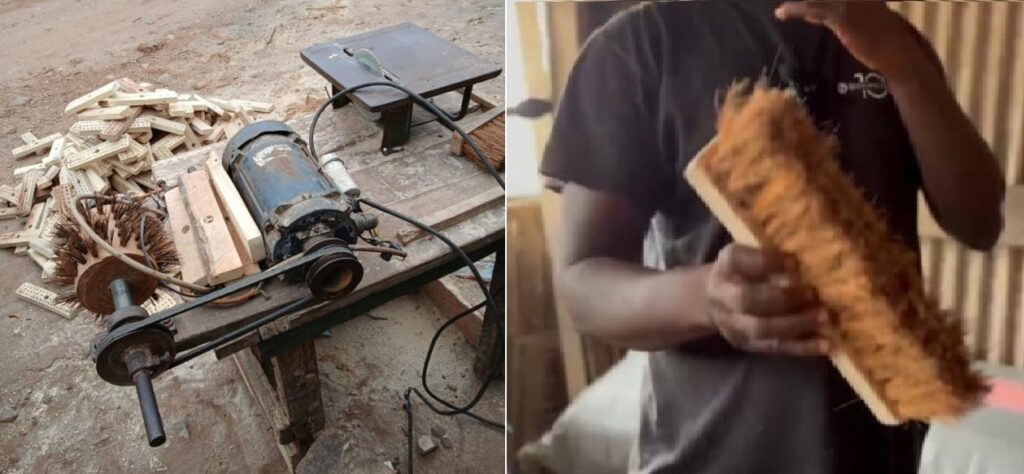
He also showed us the spinning defibering machine used to extract long fiber for brush production, it separates the bristles from the coconut and the pith.
Back at the coconut vending point, Ato admits that he does not know of any uses that coconut waste can be put to, except for food vendors using it as cooking fuel. When showed evidence of the work of Tigasco in transforming the waste into sweeping brushes and doormats as well as pith and plant support mechanisms, he said: “This is a very laudable way to reduce coconut waste that goes to the landfill sites, I wish they can come and collect my waste.”
Tigasco management says beyond the business being profitable and having a free supply line of raw materials, it provides part-time employment opportunity for youth in the area as well as keeping their community almost free from coconut waste.
“We cannot sidestep the challenges of operations. We are unable to produce doormats at scale during the rainy season because of weather conditions, we also often also struggle with transport to collect the waste, or our raw materials, from designated points, not to forget the competition we face with cheaper imported products made from plastics,” Ganvoh stressed.
He adds that Tigasco currently uses white label marketing where they strictly produce and give to suppliers within and outside Ghana to brand and sell. “That is our strategy for now as we look to invest resources into branding and packaging sooner than later,” Ganvoh added.
A strong case for green businesses
Rukayatu Sanusi, Executive Director of the Ghana Climate Innovation Center, says it is important to empower enterprises in the green business chain: “I feel that a lot of knowledge actually needs to be out there for consumers to know that you have options, and in some instances, not all, it may cost a little more. Then we give encouragement to the green businesses to actually grow.”
Rukayatu adds: “We give the incentive to the other green businesses to actually start, because if they don’t have that incentive, we are going to just be having brown businesses, we deplete the earth, deplete the environment. The government has less and less money to respond to it and then the problem just gets exacerbated.”
David Yartey Tetteh, the Tigasco CEO, fully supports Rukayatu’s position stressing his belief that government investment in recycling would help reduce the mountains of waste it has to deal with while creating jobs and preserving the environment.
Ato, the coconut vendor, says it is refreshing that there are groups transforming what he previously saw strictly as waste into items of value. “If I commit to supplying such enterprises with the waste, if they get needed support to scale up and if the public patronize their products, we all, one way or the other, help fight the coconut waste issue.”
Waste is no longer seen only as something to discard, but as a resource that can be rescued, reused and importantly transformed, and given an environmentally sustainable new value. This is the upside of this coconut waste transformation story.
This report was produced as part of DW Akademie’s Media Development training on Constructive Journalism AMIRP