
Introduction
Ghana’s 2024 election had a special focus on jobs with both the then ruling New Patriotic Party (NPP) titling their manifesto: “Selfless Leadership, Bold Solutions for Jobs and Business,” the word ‘jobs’ appeared 172 times while employment was captured 13 times.
The main opposition at the time, the National Democratic Congress (NDC) “RESETTING GHANA: Jobs. Accountability. Prosperity.” The words jobs and employment were also captured 61 and 42 times respectively. The NDC dedicated the entirety of Chapter 2 to “Jobs For All.”
It is against this background that when top political leaders, such as the President and the Majority Leader make categorical claims about employment or jobs, they are always subject to fact-checking. The last government insisted that in its eight years 2.3 million jobs had been created, a claim that was vehemently rejected by the NDC opposition.
The (over) one million jobs claim
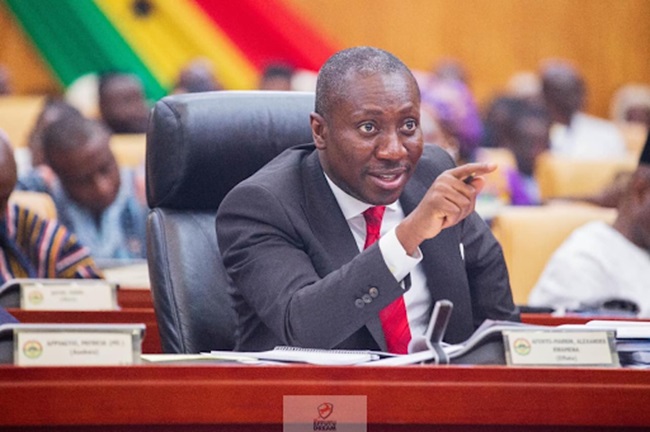
On Wednesday, February 25, 2026, Majority Leader Mahama Ayariga claimed one million people found jobs in 2025 alone. Speaking on the floor of Parliament, the leader of government business cited the Ghana Statistical Service (GSS) data as the source of his claim.
“Mr Speaker, he talked about job creation. The Ghana Statistical Service reported that in the last 12 months, one million people have found jobs in the Ghanaian economy. One million people have found jobs. Go to the Ghana Statistical Service, in the last 12 months, one million people have found jobs…,” he said. (between 2:38:48 – 2:39:40 of the parliamentary broadcast).
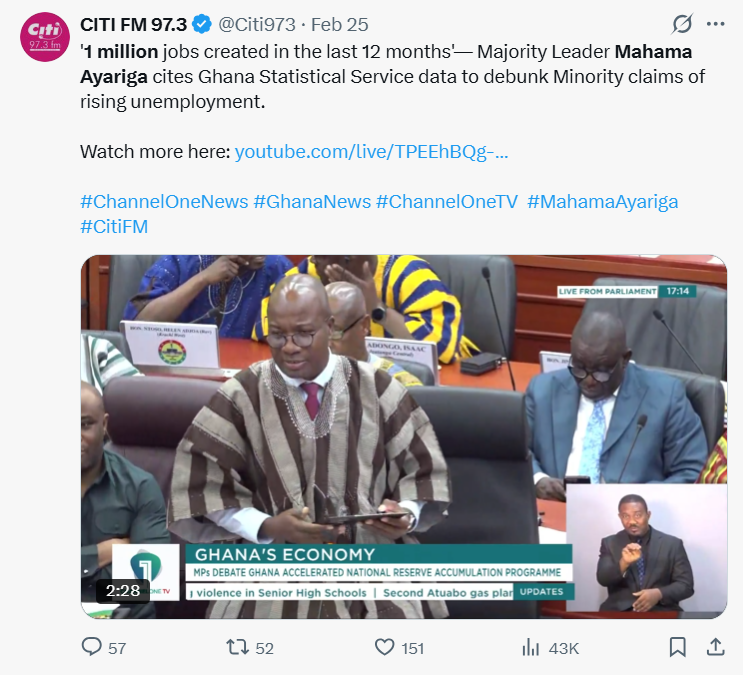
However, a post by Citi FM on X erroneously quoted him as saying ‘1 million jobs created in the last 12 months.’ The opposition vehemently rejected his claim on the floor even disrupting his speech.
RelatedNews

SONA 2026: President’s claim on jobs
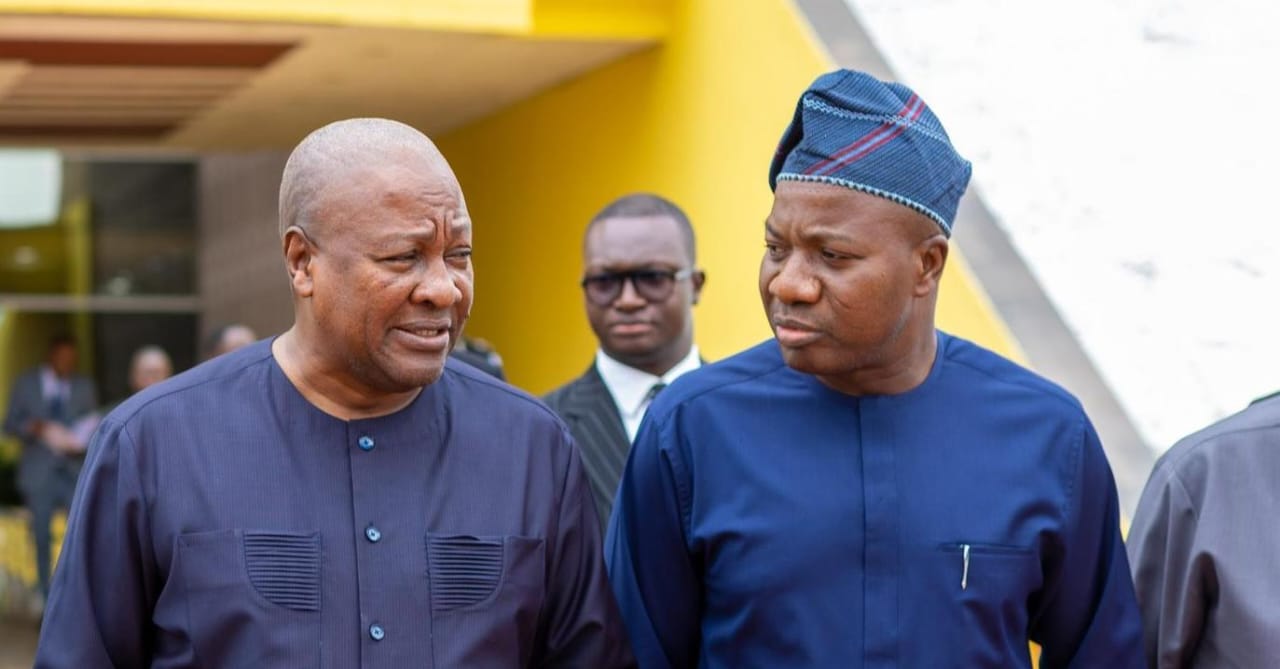
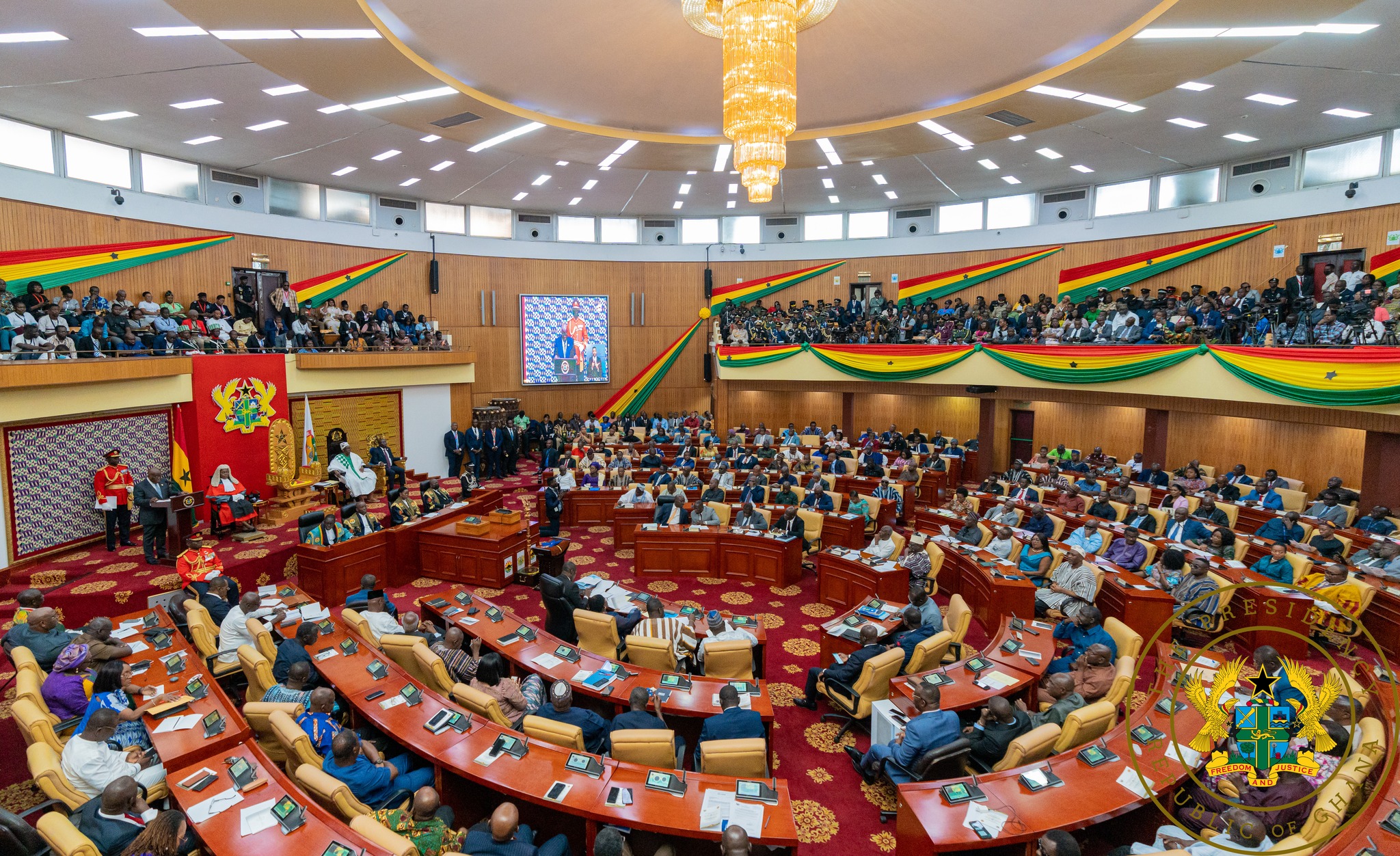
A day after the Majority Leader’s claim, President John Dramani Mahama, during his presentation of the State of the Nation Address (SONA) also made a similar claim about employment in Quarter 1 to Quarter 3 of 2025 (January to September 2025).
The President stated that “according to the Ghana Statistical Services, over 1 million Ghanaians have found employment between Q1 – Q3 2025.”
“First of all, it’s refreshing to see government messaging use the GSS as the source of truth for labour market data. We do not have to deal with “politically compiled” job numbers on spreadsheets,” Alfred Appiah, a data scientist and policy analyst posted on X.
GhanaFact has previously debunked the president’s claim during our Live-fact checking of his presentation here.
In this analysis piece, we interrogate the most recent GSS data on labour force statistics and also put a spotlight on pro-government defense of the President’s claim on over a million jobs in nine months of 2025.
| Metric | Mahama Ayariga | President John Mahama |
| Number of jobs created | One million | Over a million jobs |
| Time frame | January to December 2025 | Q1 – Q3 of 2025 |
| Source | Ghana Statistical Service | |
The Ghana Statistical Service report cited for the labour force statistics
While both the president and Majority Leader did not explicitly mention the GSS report that contained the jobs figure they referred to, the most recent report on jobs by the statistical agency was released on December 18, 2025.
GSS released a report titled the Q1-Q3 Labour Force Statistics, which provides a national representative picture of Ghana’s labour market.
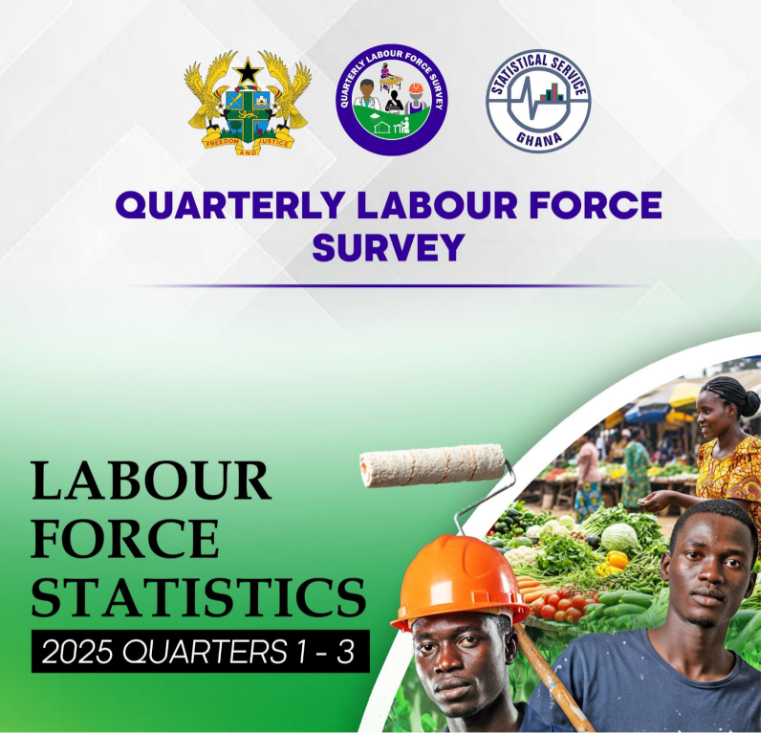
“It draws on data from households across all sixteen regions and offers clear evidence to inform public dialogue, policy decisions, and labour market reforms,” the GSS said.
According to this report, between Quarter 1 and Quarter 3 of 2025 (the duration referenced by the president), employment increased by over 330,000 persons. This contradicts the Majority Leader and the President’s claim of over one million people having found jobs.
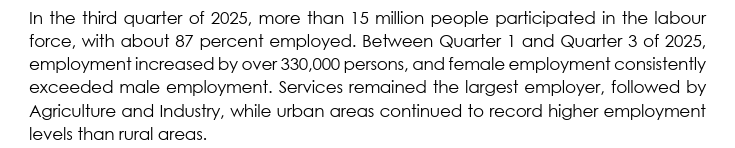
“Female employment consistently exceeded male employment. Services remained the largest employer, followed by Agriculture and Industry, while urban areas continued to record higher employment levels than rural areas,” the report added.
“According to the GSS, employment growth between Q1 and Q3 2025 was 330,000. Where did the figure of over one million come from? If it’s a year-on-year comparison (Q1 to Q3 2025 versus Q1 to Q3 2024), then that framing is incomplete and missing the baseline. It would also capture some employment growth under the previous regime,” data scientist Appiah added in his post.
It is important to note that the report does not capture the last quarter of 2025 because that data is typically released usually at the end of Q1 of the following year. That notwithstanding, it is the most updated and publicly available data on labour statistics.
Government’s defense of the President’s claim
Government spokesperson, Felix Kwakye Ofosu, explained on Joy News Top Story that the figures were derived from comparing average employment levels.
“We need to see the full gamut of data to extrapolate the figures, and we do have the full gamut of data. Indeed, the average job creation or the average number of people in employment as of the end of 2024 was 14.2 million.
“The average number of people in employment between Quarter 1 and Quarter 3 of 2025 was 15.3 million. So if you do a simple analysis, you get 1.2 million. That’s the difference. So that is where the figures emanate from. This is Ghana (Statistical) Service data,” he said. (Between 13:44 and 14:32)
On X, some pro-government accounts posted an image allegedly of a GSS spreadsheet titled Quarterly Labour Force Statistics to justify the president’s claim of “over one million people” having found employment.
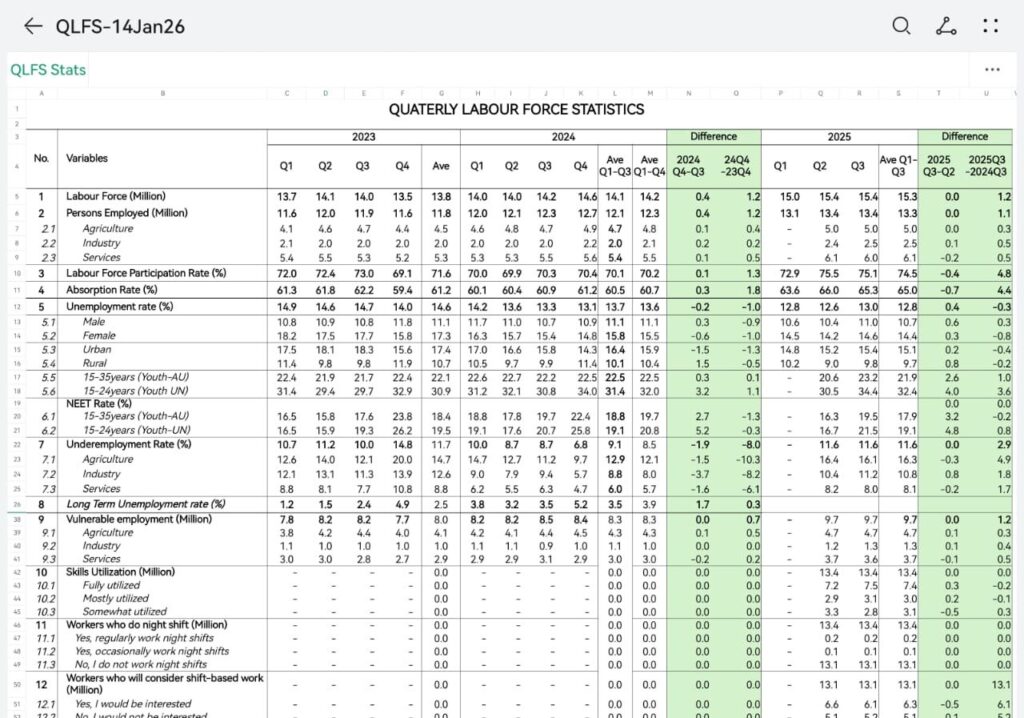
A careful review of the spreadsheet shows that the justifications appear to have been drawn from the difference between 2025Q3 and 2024Q3 statistics on persons employed.
- The 1.2 million figure cited in the report was a difference of labour force data from Q3 2024 to Q3 2025.
- The president was clear that the data he was relying on was from Q1 – Q3 of 2025.
Is there a difference between people finding jobs / employment and jobs created?
The President and the Majority Leader, used two identical words which when critically assessed are slightly different. The Majority Leader alluded to people finding ‘jobs,’ while the President used the term people found ‘employment.’
The Citi FM post referred to earlier ascribed a misleading quote to Mahama Ayariga, that he said 1 million jobs had been created, the quote stirred some reactions on social media about government intervention in job creation (find here, here, and here).
What is the difference between jobs and employment?
According to the International Labour Organisation (ILO), the term ‘job creation’ is used inconsistently, making it hard to grasp and address effectively.
Job creation, as defined by the ILO, is the emergence and response to viable opportunities for individuals to earn income that arises from a new demand for labour, be it as workers or through self-employment (see page 11 of the ILO report).
In the case of jobs and employment, the UN body makes a distinction in terms of the unit of analysis.
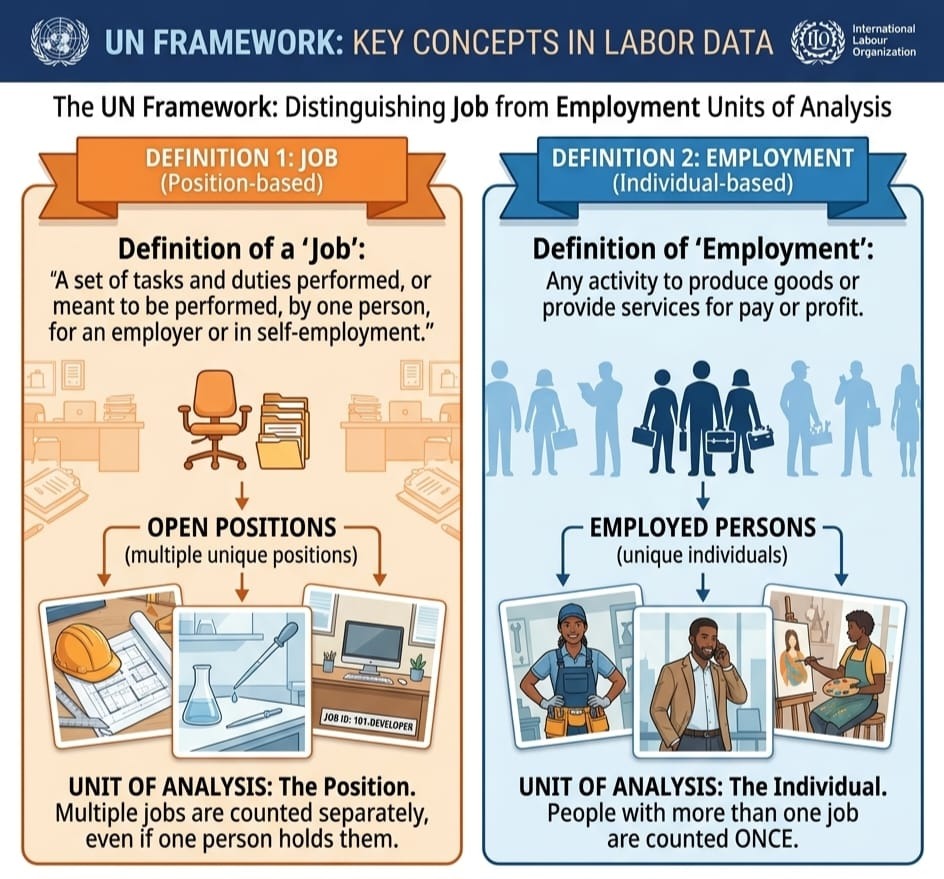
For data scientist Alfred Appiah, “The broader point remains that employment growth in a largely informal economy does not tell the full story. The extent to which the economy is generating more sustainable employment and moving people out of vulnerable employment is a more important indicator. The data so far show increases in the share of people in vulnerable employment and declines in the share of wage employment. That should be a concern for policymakers,” he concluded.
What is clear is that the jobs debate is far from over because unemployment and job creation are hotcakes in political conversations.